“Know your enemy and know yourself” — the half of the line almost nobody finishes (2026)
The most-quoted line in the most-quoted strategy book starts with “know your enemy” — and almost nobody finishes it right. Sun Tzu’s actual sentence is a triple, and the clause people drop is “and know yourself.” The enemy half you chase forever; the self half you can start on alone, today. The Friday-night fight that was really about an empty stomach, the conversation you finally won by naming one thing in the car — that’s the half that changes everything.


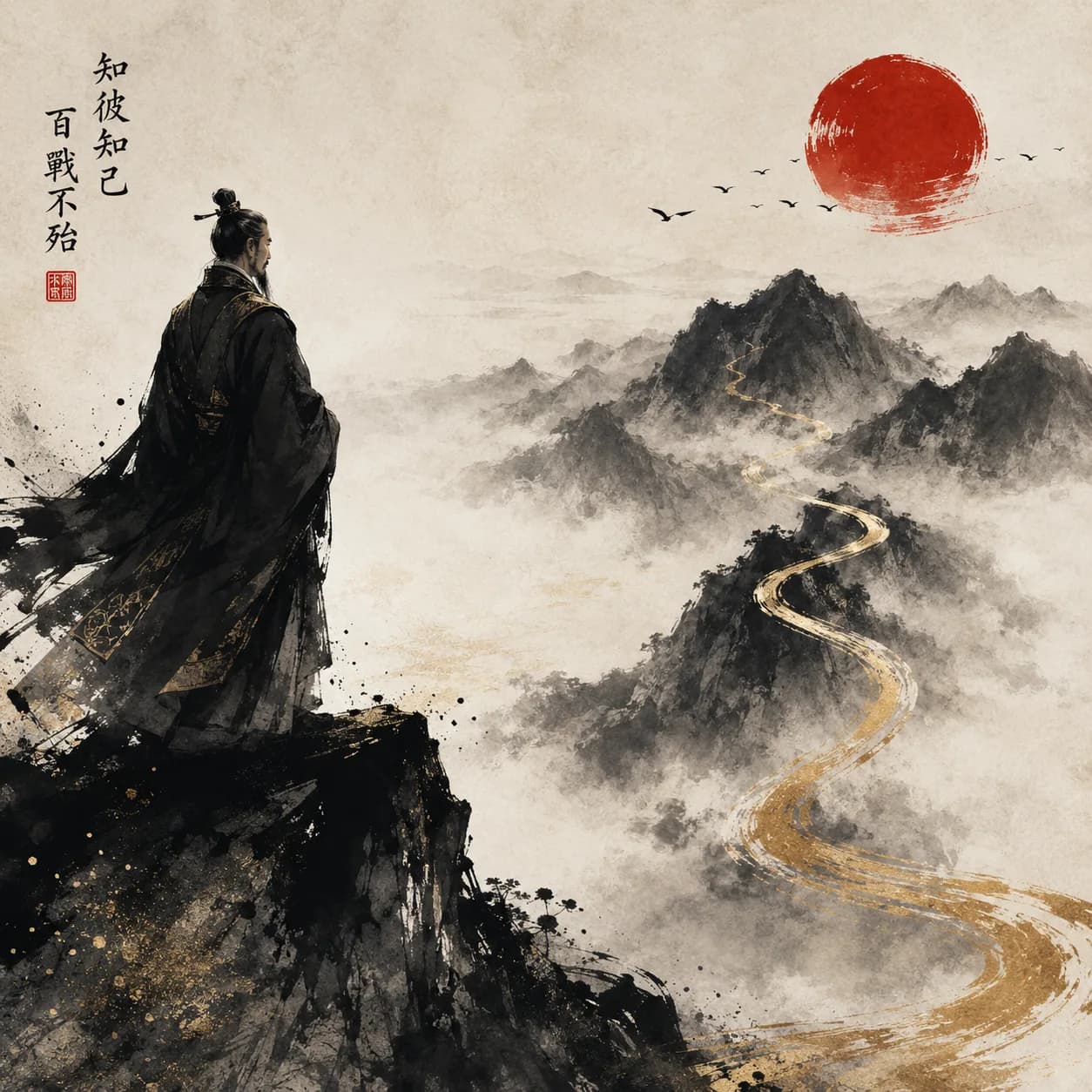
The most-quoted line in the most-quoted strategy book in history starts with know your enemy — and almost nobody can finish it. Try it yourself: you'll get something about a hundred battles, then trail off. The line in the book is three full sentences, and the half people drop is the half you can actually do something about today.
- The famous line is one third of the real one.Sun Tzu's sentence is a triple; “know your enemy” is just the opening clause.
- The skipped half is and know yourself. Three little words — the part you can start on alone, today.
- You can't read another person until you can read your own state. The fight about a tone of voice is often a fight about an empty stomach.
- The same chapter says when not to fight. Most fights you win by walking away were never about what they looked like.
📜 The whole line, all three sentences
Here is what Sun Tzu actually wrote, in the public-domain Giles 1910 translation — three sentences, not the half-sentence everyone carries around.
If you know the enemy and know yourself, you need not fear the result of a hundred battles. If you know yourself but not the enemy, for every victory gained you will also suffer a defeat. If you know neither the enemy nor yourself, you will succumb in every battle.
The famous half — know your enemy — is one third of it, and the middle sentence is a whole separate idea about knowing yourself first. The part nobody quotes is literally those three words.
🪞 The half you can act on today
Why does the dropped clause — and know yourself— matter more than the famous half? Because it's the one you can start on alone. The enemy half — reading the other person, the situation, the room — you chase forever. Your own state you can check before you walk in.
Three little words, and the way I read them, that phrase is the part you can start on alone, today. The enemy half you chase forever.
Sun Tzu's quietest claim is that the two halves aren't independent: you cannot see the other person clearly until you can see your own state first. The fight that looks like it's about a tone of voice is often about something much more boring.
You cannot see the other person clearly until you see your own state. The fight that looks like a fight about a tone of voice might actually be about an empty stomach.
That isn't a stretch a modern reader has to impose. One Goodreads reader, native to the language Sun Tzu was writing in, put it this way: “we actually use a lot of idioms from this book and we apply these expressions not to actual wars but to situations in life.” The book has always been read as a saying about living, not only about war.
🕊️ Knowing when not to fight
Earlier in the same Chapter III, Sun Tzu states the consequence of all this plainly. The scholar Michael Nylan has argued the whole book is “fundamentally a manual on avoiding conflict… not a blueprint for military aggression”, and this is the line that proves it.
He says, plainly: He will win who knows when to fight and when not to fight.
The polite translation of that is pick your battles. The honest one is harder: most of the fights you walked away from this year were never really about what they looked like.
Most of the fights I walked away from this year were never about what they looked like. They were about me being tired, or them being scared, or both of us trying to win something neither of us could even name.
And then, in the middle of all the strategy, the book does something genuinely strange — it stops to talk about music. It's the clearest sign that this is a weirder, more reflective book than its reputation.
There are not more than five musical notes, yet the combinations of these five give rise to more melodies than can ever be heard.
That's not a war manual sentence, that's a poem. Same idea, said sideways: you've only got a handful of true things about your own state, but you can play them forever. You never run out, and never need more.
🚗 One thing, named in the car
None of this needs a battlefield. On the podcast, Leo lays out the trap exactly: Friday at four, nobody's eaten since eleven; by Sunday night the dishwasher's open and a forty-five-minute fight is underway that was never really about the dishwasher.
Actual content was, you skipped dinner on Friday and you haven't sat down since Thursday. Sun Tzu would have handed me a sandwich at four pm on Friday and saved everyone the whole weekend.
The repair is just as small. Sharon describes a conversation with her sister she'd put off for four months — and the ten seconds in the car beforehand that changed it.
Morning of, I sat in my car for ten extra seconds and asked one question: what's the one thing I actually want out of this?
I'd been carrying seven of them, and they were drowning each other. When I named the one, the rest got quieter. I walked in, said it in the first two minutes, and the hour after that was the kindest version of that conversation I've ever had with her.
Ten seconds on herself; four months of rehearsing her sister. That ratio is the whole chapter. The couples therapists who tell you to pause a fight when you're both tired, hungry, or unwell are giving the same instruction in newer words: know yourself first.
The smartest fight you'll have this week is the one you walk away from because you ate something first. Know your enemy, sure — and know yourself first. Next door, the book's most famous tactical line sounds like a manipulator's how-to, and turns out to be the opposite: all warfare is based on deception.Journey to the West turns the same strategic patience into eighty-one trials instead of one campaign.
Sources
- The Art of War (Lionel Giles, 1910 translation) — Chapter III, Attack by Stratagem — Project Gutenberg
- If you know the enemy and know yourself… — quotation page — Goodreads
- The Art of War Is Actually a Manual on How to Avoid It — Literary Hub
- 13 Common Couple Arguments and How to Handle Them — Anchor Light Therapy
- The Art of War — reader reviews and ratings — Goodreads
Frequently asked questions
- What does “know your enemy and know yourself” mean?
- It means that lasting confidence in a conflict comes from two kinds of knowledge, and most people only chase one. Sun Tzu’s full line (Chapter III of the Giles translation) is three sentences: “If you know the enemy and know yourself, you need not fear the result of a hundred battles. If you know yourself but not the enemy, for every victory gained you will also suffer a defeat. If you know neither the enemy nor yourself, you will succumb in every battle.” The clause people drop — “and know yourself” — is the half you can actually start on alone, because you can’t read another person clearly until you can see your own state.
- What is the full “know your enemy” quote from The Art of War?
- It’s the closing passage of Chapter III, “Attack by Stratagem,” in the Giles 1910 translation: “If you know the enemy and know yourself, you need not fear the result of a hundred battles. If you know yourself but not the enemy, for every victory gained you will also suffer a defeat. If you know neither the enemy nor yourself, you will succumb in every battle.” The popular short form — just “know your enemy” — is one third of it, and the middle sentence about knowing yourself first is a separate idea most quoters skip.
- Is The Art of War about winning or about avoiding the fight?
- More about avoiding it than people expect. The scholar Michael Nylan has argued the book is “fundamentally a manual on avoiding conflict… not a blueprint for military aggression.” Sun Tzu writes plainly, in the same chapter as the ‘know yourself’ line, “He will win who knows when to fight and when not to fight.” Read that way, most of the fights you ‘win’ by walking away from were never really about what they looked like — they were about being tired, or scared, or both.
- How does knowing yourself help in an argument?
- Because a surprising number of fights aren’t about their stated subject. A Sunday-night argument about the dishwasher can really be about nobody having eaten since Friday afternoon. Couples therapists give the same advice Sun Tzu does in older words: when both people are tired, hungry, or unwell, pause before it spirals. Checking your own state first — literally, ‘what did I eat today?’ — is the cheapest way to tell which fights aren’t worth having, and which ones are about something real.
- Why is The Art of War considered surprisingly philosophical?
- Because in the middle of all the troop movement it keeps stopping to say beautiful, almost poetic things. One famous passage reads, “There are not more than five musical notes, yet the combinations of these five give rise to more melodies than can ever be heard.” That’s not a tactics sentence — it’s a meditation on how a few simple elements make endless variety. Readers who arrive expecting a cold manual often leave calling it the calmest, strangest, most reflective book they didn’t expect to like.
Enjoyed this one?