Twenty Thousand Leagues Under the Sea Characters: Nemo, Ned Land, Conseil and Aronnax
Four people carry this novel, and the alphabet is the wrong way to sort them. Verne gives you three answers to one predicament, plus the man who set it.


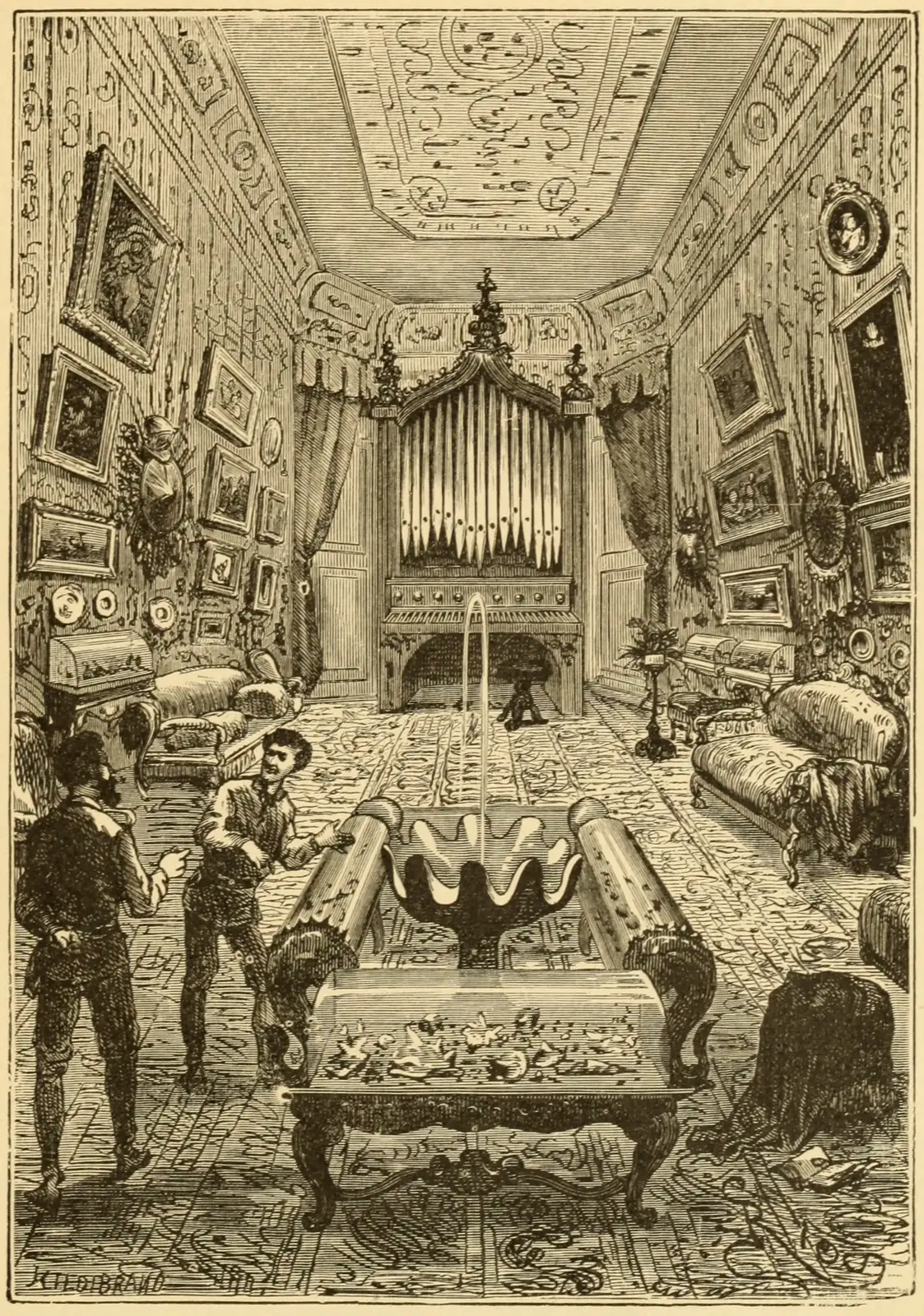
Most character lists for this novel are alphabetical, which hides the thing that actually organises the cast. Verne gives you three responses to one predicament, plus the man who created the predicament, and the grouping does more work than any alphabet. Verne compresses the whole arrangement into a single sentence on their first night aboard, before any of them has met their host, and the same four are the ones you meet in the playable Twenty Thousand Leagues.
🧭 The sentence that sorts the cast
They are locked in a metal cell with no light and no explanation, twenty-four hours after being fished out of the Pacific. Aronnax counts the hours, Ned Land shouts at the walls until his voice goes, and Conseil waits. The narrator, who is the professor, then writes the shortest and most useful line in the book.
“I felt terrified, Conseil was calm, Ned Land roared.”
Nine words, three men, and the entire dynamic of the next six hundred pages. Every argument the three of them have afterwards about whether to escape, whether to fight, and whether their host is a monster or a genius runs along exactly those lines, and none of the three ever genuinely changes position.
🔬 Pierre Aronnax, who classifies his own captivity
A professor at the Museum of Natural History in Paris, forty years old, and the author of a two-volume quarto on the mysteries of the great submarine grounds, which is precisely the book that gets him invited on the hunt and then imprisoned by its quarry. He is also the narrator, so every page of the novel reaches you filtered through a working scientist’s professional habits.
The habit is classification, and it never stops. Locked up, threatened, walking on the sea floor, watching a warship go down, he reaches for the genus and species of whatever is in front of him, and the effect is both comic and quietly devastating. A man who can name every fish in the window is using the naming to avoid asking how long he is going to be looking through it.
- He is the reason the book slows down. The long taxonomic passages readers complain about are in character, because the narrator is a specialist writing up a once-in-history data set.
- He is compromised and knows it. Every hour of captivity is also an hour of research no rival will ever match, and he says so repeatedly while Ned Land is packing.
- He gets the last word. The closing pages are his report, and their refusal to resolve anything is a scientist declining to publish beyond his evidence.
🪝 Ned Land, who wants out from the first page
The novel calls him the prince of harpooners and then spends a chapter justifying the title. He is Canadian, about forty, tall, with a family that came to Quebec when the town still belonged to France, and he has the hands of a man who has killed large animals in cold water for a living. The frigate takes him on as a weapon rather than as a passenger, and the narrator says so in exactly those terms when he lists what the ship is carrying.
Once aboard he becomes the book’s engine of dissent, which is exactly what a novel narrated by a fascinated scientist needs. Where Aronnax sees a laboratory, Ned sees a prison with better food, and he keeps saying so at inconvenient volume for the entire voyage. He also supplies the physical courage twice over, once with a harpoon in open water at a moment when the captain is about to die under a shark.
“If you do not come for more, I am no longer the king of harpooners.”
The Sago Forest Skirmish is a doorway in the playable Twenty Thousand Leagues: the three of you are ashore gathering provisions when the locals find you, and you can run for the boat, stand with the harpooner, or try to talk your way out of it. Role-play Twenty Thousand Leagues →
🎩 Conseil, who will not say “you”
A Flemish servant of thirty, ten years in the professor’s employment, with a name that means advice in French and a standing refusal to give any, even when it is asked for. He is the flattest of the four on paper and the funniest in practice, because Verne uses him as a machine for absorbing catastrophe without comment.
The third-person habit is the running joke and also the character. Aronnax records it as a fault, notes that it is sometimes provoking, and then lets it run for the length of the novel: master will find, if master will permit, has master been. It survives a drowning, an arrest, a shark and a whirlpool. Ned Land names the quality precisely while they are all starving in a locked room.
“You are never out of temper, always calm; you would return thanks before grace, and die of hunger rather than complain!”
🕯️ Captain Nemo, host and jailer at once
Aronnax cannot even fix his age, and says so: somewhere between thirty-five and fifty, tall, with a large forehead and fine tapering hands. That is the level of detail the novel allows about him, and it is deliberate on Verne’s part, because the withholding is the character.
What the book does establish is a contradiction it never resolves. He pulls three men out of the sea and keeps them alive, he shows the professor things no scientist of the period could otherwise have seen, he risks his own life for a stranger on a pearl bank, and he will not release any of his guests under any circumstances, ever. Hospitality and imprisonment are the same policy on this vessel, delivered by the same courteous man at the same dinner table.
Whether the balance comes out as tragedy or as menace is the oldest argument about this book, and it has a separate essay of its own here, with the primary-text evidence laid out. His declared philosophy, including the line about the sea that everybody quotes, is handled in the quotes essay rather than repeated here. Both work from the same free text, the Project Gutenberg edition, whose publication history is set out in the standard reference article on the novel.
Sources
- Twenty Thousand Leagues under the Sea (Project Gutenberg eBook #164) — Project Gutenberg
- Twenty Thousand Leagues Under the Seas — Wikipedia
- Jules Verne — Wikipedia
- Twenty Thousand Leagues Under the Seas: An Underwater Tour of the World (Project Gutenberg eBook #2488, trans. F. P. Walter) — Project Gutenberg
Frequently asked questions
- Can you provide a brief character sketch of Captain Nemo as he has been revealed in the novel?
- A courteous host with absolute power and no biography. He is tall, somewhere between thirty-five and fifty, a scientist and a musician, and he gives his orders to the crew in a language his prisoner cannot place after months aboard. Everything else the novel tells you about him is something he does, never something he is.
- What is the significance of Captain Nemo?
- He is the first great science-fiction character who is also the antagonist of his own story. Verne signals the size of the idea in the chapter heading that introduces him, “The Man of the Seas,” and everything later fiction does with the brilliant outsider who has left the world behind runs back through that chapter.
- Why does Captain Nemo hate society?
- The book never says, on purpose, and the closest it comes is a statement of principle rather than a grievance. He tells Aronnax that “the sea does not belong to despots” and that on its surface men still exercise unjust laws and tear one another apart. What was done to him personally is withheld from the reader to the last page.
- Why does Conseil always refer to Aronnax in the third person?
- It is servant's usage kept up past the point of parody, and Verne uses it to measure the man. The night the two of them go over the side of the Abraham Lincoln, Conseil tows his exhausted employer through open water for hours, shouting for help with the last of his voice, and still will not address him as anything but master.
- Is Ned Land based on a real whaler?
- No source for him has ever been established; he is built out of the trade rather than from a person. The novel gives him a demonstration instead of a biography: Commander Farragut lends him to a passing whaler called the Monroe, and he harpoons two whales with a double blow, one struck straight to the heart.
Enjoyed this one?