Caroline Sheppard: the Woman Who Became Miss Marple
The most famous spinster detective in English fiction started as the narrator's nosy sister, in a village whose recreations come down to one word.


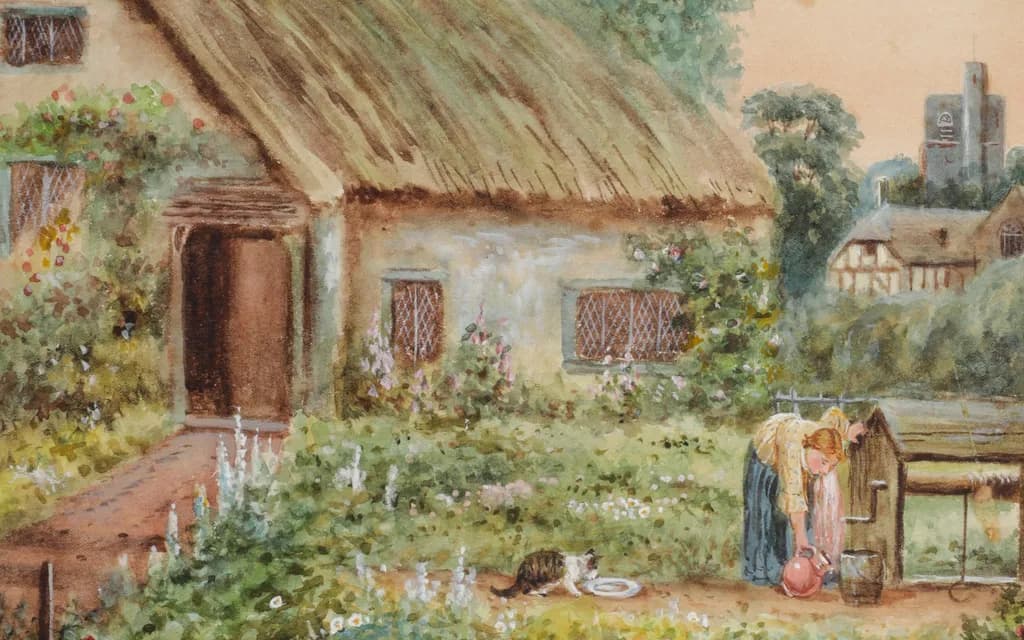
Miss Marple is one of the two most famous detectives Agatha Christie ever wrote, and she did not arrive from nowhere. Four years before Marple got a novel of her own, Christie wrote a middle-aged unmarried woman in a small village who knows everything about everybody, is right most of the time, and is treated by every man in the book as a nuisance. Her name is Caroline Sheppard, she is the narrator's sister in The Murder of Roger Ackroyd, and Christie later pointed back at her when people asked where Marple came from.
- Christie acknowledged the link herself, naming Caroline as a possible precursor of Miss Marple.
- She is the fastest intelligence service in the book. Her brother calls her network the Intelligence Corps, half as a joke.
- The stage version cut her, replacing her with a young girl, and Christie was still annoyed about it decades later.
- The tidy origin story has a date problem, which is more interesting than the tidy version.
What follows is what Caroline actually does in the book, the strange history of how she turned into somebody else, and why so many first-time readers decide early that she must be the murderer. If you would rather meet her than read about her, the playable Murder of Roger Ackroyd opens across a breakfast table from her.
🫖 King's Abbot's one-woman Intelligence Corps
Caroline's method is stated plainly in the book's second chapter, and it is a method rather than a character trait. She has sources: the people who deliver milk, meat, vegetables and fish to every house in the village, and the servants who take delivery. She cross-references them. She asks direct questions and treats a refusal as information.
Her brother notes, with the resigned tone of a man who has lost this argument for thirty years, that somebody very like Caroline must have invented the questions on passports. The name he gives the operation is the Intelligence Corps, and it appears twice in the novel, both times when the network has done something the police have not. Its one recorded failure comes early: the foreigner who has taken the house next door cannot be identified by any of it, because he buys milk and vegetables like everybody else and tells nobody anything. Caroline borrows garden tools to get closer and asks him outright whether he is French. He says no. She retreats.
The village around her is drawn in two pages that explain the whole book. King's Abbot has a large railway station, a small post office, two rival general stores, and, by the doctor's own account, a demographic problem.
“We are rich in unmarried ladies and retired military officers. Our hobbies and recreations can be summed up in the one word, ‘gossip.’”
Read that as a joke and it is a joke. Read it as a description of the detective apparatus the novel actually runs on, and it is the thesis of Miss Marple, stated four years early by a narrator who thinks he is being witty about his sister.
🎭 The stage version that wrote her out
In 1928 the novel became a West End play, and the adaptation made one change that mattered more than anything else it did. Michael Morton removed Caroline and replaced her with a young girl, presumably on the theory that a romantic lead sells more tickets than a middle-aged sister.
Christie disliked the change, and the record of her reaction is specific: it saddened her, and it left her determined to give old maids a voice. That determination is the usual explanation for Miss Marple, and it is the version most retellings of this story stop at. A publisher cuts the interesting woman; the author, quietly furious, invents a better version of her and gives her a shelf of her own; the woman who was not worth a subplot becomes one of the most recognisable characters in English popular fiction. It is a good story, and it is nearly true.
The part of it that is solidly true is the annoyance and what she did about it afterwards. Christie went on to write Marple across four decades, ending with a novel published in 1976, and Marple never once has to be the love interest or the girl. Whatever the play cost Caroline, the answer to it ran for fifty years.
📅 Does the origin story survive the calendar?
Not in its neatest form, and the dates are easy to check. Alibi opened at the Prince of Wales Theatre on 15 May 1928. Miss Marple had already appeared in print five months earlier, in December 1927, in a short story called The Tuesday Night Club in The Royal Magazine. A play that opened in May cannot have caused a character published the previous December.
What the dates do support is a smaller and more believable claim. Marple existed as a short-story idea before the play; the play then demonstrated exactly what the world was going to do with a Caroline if Christie left one lying around; and the first full Marple novel, The Murder at the Vicarage, arrived in 1930, two years after the cut. The play did not invent Marple. It may well have promoted her.
Christie was also honest that Caroline was never the only source. She attributed Marple to the sort of old ladies she had stayed with as a girl, and specifically to the elderly friends of her step-grandmother Margaret Miller. Caroline was the one she had already tried out on paper, in a book where the experiment worked so well that the reviewers wrote about the sister instead of the murder.
🔎 Why so many readers suspect Caroline first
Because in a fair-play detective novel, the character who already knows everything looks structurally guilty. Caroline turns up with facts she should not have, anticipates the investigation, and takes a visible interest in a death the reader has been told to find suspicious.
Every one of those is a habit the genre has trained readers to distrust, and none of them is evidence of anything except that she is good at her hobby. The suspicion has an eminent history. In 1998 the French literature professor Pierre Bayard published a book-length argument, Qui a tue Roger Ackroyd?, proposing Caroline as the real murderer of the novel and Christie as an author who did not fully know what she had written. You do not have to buy the thesis to notice what it proves: seventy years on, Caroline was still the most alive person in the book.
Her contemporaries got there first. The Observer's 1926 notice praised Christie's handling of false clues and red herrings, then singled out one character by name: the gossip-loving Caroline would be an acquisition to any novel. Christie was three books into Poirot at that point. The reviewer had spotted the character she would still be writing in the 1970s.
As for what becomes of Caroline in the last chapter: she survives, and the book ends on a choice made to spare her rather than to punish anybody. Saying who makes it, or why, would hand over the solution, so this piece stops here. The full ending is set out in our spoiler-flagged explainer, if you do not mind knowing.
The 1926 text is free at Project Gutenberg, and Caroline is on the first page of it. If you want the wider case for reading the novel at all, the honest version is here, caveat included.
Sources
- The Murder of Roger Ackroyd (1926), full text — Project Gutenberg
- Miss Marple — Wikipedia
- The Murder of Roger Ackroyd — Wikipedia
Frequently asked questions
- Was Caroline Sheppard the inspiration for Miss Marple?
- Partly, and Christie said so herself, though the wording matters: Caroline was later acknowledged by her as a possible precursor of Miss Marple, not as a blueprint. The other sources Christie named were real: the elderly friends of her step-grandmother Margaret Miller, the sort of village old ladies she stayed with as a girl.
- When did Miss Marple first appear?
- In print, in December 1927, in a short story called The Tuesday Night Club published in The Royal Magazine; it later became the first chapter of the 1932 collection The Thirteen Problems. Her first full-length novel was The Murder at the Vicarage in 1930, four years after Caroline Sheppard.
- Why do readers suspect Caroline Sheppard first?
- Because she is the character who already knows everything, which in a detective novel reads as motive-adjacent. Reviewers noticed her instantly and for the opposite reason: The Observer's 1926 notice singled her out as the book's chief pleasure, saying the gossip-loving Caroline would be an acquisition to any novel.
- Is Caroline Sheppard based on a real person?
- Christie never named a model for her, and the honest answer is that nobody knows. She has attracted a life of her own regardless: in 1998 the literature professor Pierre Bayard published a whole book, Qui a tue Roger Ackroyd?, arguing that Caroline rather than the official culprit is the real murderer of the novel.
- What is Caroline's Intelligence Corps?
- Her brother's private name for her information network, used twice in the book. It is not a metaphor for one nosy woman: Caroline runs sources, cross-checks them, and reaches conclusions in hours that the police reach in days. The joke of the phrase is that he is mocking a system that keeps being right.
- What happens to Caroline at the end of the book?
- She survives, and the book ends on a choice made to spare her rather than to punish anybody. She is also never told what the choice was about, which is the quietest cruelty in a novel with a murder in it. Saying who decides, or why, would give away the solution, so this piece does not. The full ending is set out in our spoiler-flagged explainer, if you do not mind knowing.
Enjoyed this one?