Every Adaptation of The Murder of Roger Ackroyd, Ranked for Faithfulness
Six adaptations across ninety years, one of them a lost film, one of them a radio play where the same actor takes both leading roles.


For a novel that professional crime writers voted the best ever written, The Murder of Roger Ackroyd has been filmed remarkably little. There are two screen versions in English, sixty-nine years apart, and one of them is lost. The most complete adaptation ever made was broadcast in Japanese in 2018 and has almost no English coverage at all. In between sit a West End hit, two radio plays, and a Russian serial nobody outside Russia mentions.
- The 2018 Japanese version is the most faithful, at 190 minutes, and it moves the whole story to rural Japan in 1952.
- Orson Welles played both leads in a one-hour radio version in 1939.
- The first Christie adaptation of anything was this book, on stage, in 1928.
- The 1931 film is lost, and no screen version followed it for 69 years.
Below is each version, what it keeps and what it drops. If you would rather run the investigation than watch someone else run it, the playable Murder of Roger Ackroyd gives you the dinner at Fernly Park with nothing decided yet.
🏆 The ranking, shortest version
Faithfulness here means how much of the novel's actual structure survives, not how good the production is. On that measure the order is unusual, because the version most English-speaking viewers have never heard of is the one that cuts the least.
| Version | What it keeps, what it loses |
|---|---|
| 1. Kuroido Goroshi, Fuji TV, 2018 | 190 minutes, the longest ever made. Relocated to a Japanese village in 1952 and otherwise adapted as closely as the change of setting allows. |
| 2. Poirot, ITV, 2000 | 103 minutes with the definitive English Poirot. Compresses hard and adds series continuity the novel does not have. |
| 3. Neudacha Puaro, Russia, 2002 | Five parts, English setting and names kept, serial length used for the village rather than the puzzle. |
| 4. BBC Radio 4, 1987 | 90 minutes, faithful in dialogue, and unhurried enough to keep the village as well as the case. |
| 5. The Campbell Playhouse, 1939 | One hour for a whole novel, so most of the suspects go. Historically the most interesting cast decision anyone has made with this book. |
| 6. Alibi, stage, 1928 | A West End hit that rebuilt the story for the theatre, cut the narrator's sister entirely, and gave the film that followed its shape. |
📻 Orson Welles played both leading roles
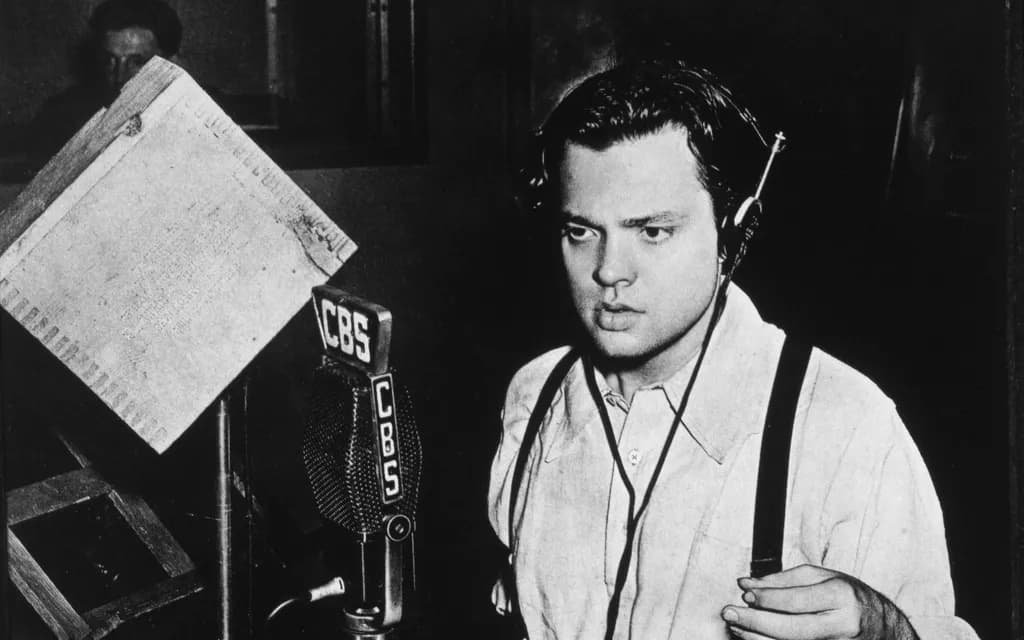
On 12 November 1939, a year after the War of the Worlds broadcast that made him famous, Orson Welles put The Murder of Roger Ackroyd on The Campbell Playhouse as a one-hour radio play, and cast himself twice. He played Hercule Poirot. He also played Dr Sheppard, the village doctor who narrates the novel. The adaptation was written by Herman J.
Mankiewicz, who would go on to write Citizen Kane with Welles; Welles produced it with John Houseman and directed it himself, and Edna May Oliver played Caroline. Doubling those two parts is not a stunt, whatever it looks like on a cast list. It is the earliest surviving evidence of how this novel's first adapters thought it had to be handled, and they reached that answer in 1939, decades before anyone managed a screen version. Why the story sets its adapters that particular problem is itself a spoiler, and it is left to the sibling piece linked at the end.
An hour is not enough time, and the version pays for it: suspects vanish, the village shrinks, and the middle of the novel is gone. As a document of how the 1930s understood this book, it is the most revealing thing on the list.
🇯🇵 The 2018 Japanese version nobody mentions
Kuroido Goroshi, broadcast on Fuji Television on 14 April 2018 and running 190 minutes, is the most complete adaptation of this novel ever made, and English-language coverage of the book barely acknowledges it. It was written by Koki Mitani, one of Japan's best-known screenwriters, and directed by Hidenori Joho, with Mansai Nomura as the detective and Yo Oizumi as the doctor.
It follows Mitani's Japanese version of Murder on the Orient Express, made for the same channel in 2015 with the same lead. The transposition is total and the fidelity is total with it. The village becomes Tonozato, the year becomes 1952, every character gets a Japanese name, and the Japanese account of the production is explicit that the adaptation stays as close to Christie as the change of setting permits. The detective is retired next door, exactly as in Chapter III of the novel, and grows pumpkins instead of vegetable marrows.
If you want the novel's shape rather than the novel's postcode, this is the version to find. It is also the strongest argument against the idea that the book resists adaptation: given three hours and a screenwriter willing to leave the structure alone, it adapts.
🎟️ A stage hit in 1928, a lost film in 1931
The first adaptation of any Agatha Christie work was this book, on stage, two years after publication. Alibi, adapted by Michael Morton, opened at the Prince of Wales Theatre in London on 15 May 1928 and ran for 250 performances, with Charles Laughton as Poirot.
It was a genuine hit, and Christie found the experience irritating enough that she went away and wrote a play of her own rather than let anyone do that to a book of hers again. Morton's biggest change was to remove the doctor's sister and put a young girl in her place, a decision that annoyed Christie for years and has its own consequences in the story of where Miss Marple came from. Laughton took Alibi to Broadway in 1932 under the title The Fatal Alibi, where it opened in February and closed after 24 performances.
The play, not the novel, became the first sound film ever made from a Christie work: a 75-minute Alibi released on 28 April 1931 by Twickenham Film Studios, produced by Julius S. Hagan, with Austin Trevor as Poirot. It is considered lost. Nobody can rank it, and nobody alive has an opinion about it worth having.
📺 Suchet in 2000, and a Russian five-parter
The version most English-speaking viewers mean by this book is the ITV Poirot film transmitted on Sunday 2 January 2000: 103 minutes, adapted by Clive Exton, directed by Andrew Grieve, with David Suchet in the role he became identified with, and location filming at Castle Combe in Wiltshire. It looks exactly like the England the novel is set in, which no other version manages.
What it loses is length. A hundred minutes cannot hold twenty-seven chapters, so the village thins out, the suspects lose their subplots, and the series has to supply continuity the book deliberately does without. It is the best-made version on this list and the second most faithful, and those two facts are worth keeping apart.
Then there is Neudacha Puaro, which translates as Poirot's Failure: a Russian five-part television serial directed by Sergey Ursulyak in 2002, with Konstantin Raykin as Poirot. It keeps the English setting and the English names, and it is the only version outside Japan given room to breathe. The title is a small joke at the novel's expense and a fair one.
There is one more adaptation worth knowing about, on paper: HarperCollins published a graphic-novel version on 20 August 2007, adapted and illustrated by Bruno Lachard from a French edition of 2004. The novel itself is free at Project Gutenberg. As for why so few directors have taken this one on, the honest answer gives the book away, so it lives in our spoiler-flagged piece on the 1926 controversy, if you do not mind knowing.
Sources
- The Murder of Roger Ackroyd — Wikipedia
- Kuroido Goroshi (The Murder of Kuroido, 2018) — Japanese Wikipedia
- Neudacha Puaro (Poirot's Failure, 2002) — Russian Wikipedia
Frequently asked questions
- What is the best adaptation of The Murder of Roger Ackroyd?
- For English-speaking viewers the default is the ITV Poirot film transmitted on Sunday 2 January 2000, 103 minutes long, adapted by Clive Exton and directed by Andrew Grieve, with location filming at Castle Combe in Wiltshire. On faithfulness to the book, though, the 2018 Japanese version beats it.
- Is there a Japanese version of The Murder of Roger Ackroyd?
- Yes, and it is the longest adaptation ever made. Kuroido Goroshi ran 190 minutes on Fuji Television on 14 April 2018, adapted by Koki Mitani and directed by Hidenori Joho, with Mansai Nomura as the detective. It moves the story to a Japanese village in 1952 and changes almost nothing else.
- Did Orson Welles really play two roles in the same radio adaptation?
- He did. On the 12 November 1939 episode of The Campbell Playhouse, Welles took both Hercule Poirot and Dr Sheppard in a one-hour version adapted by Herman J. Mankiewicz, produced by Welles with John Houseman and directed by Welles. Edna May Oliver played Caroline Sheppard.
- Was The Murder of Roger Ackroyd ever a stage play?
- It was the first Christie work ever adapted for anything. Alibi, adapted by Michael Morton, opened at the Prince of Wales Theatre in London on 15 May 1928 and ran 250 performances with Charles Laughton as Poirot. The Broadway version, retitled The Fatal Alibi, opened in February 1932 and closed after 24.
- Is there a Russian film version of The Murder of Roger Ackroyd?
- There is a Russian television one. Neudacha Puaro — Poirot's Failure — is a five-part serial directed by Sergey Ursulyak in 2002, with Konstantin Raykin as Poirot. It keeps the English setting and the English names, and it is the only version that gives the story serial length outside Japan.
- Why are there so few screen versions of The Murder of Roger Ackroyd?
- Because of something the novel does that adapters have found very hard to carry across, and the record shows the difficulty: after a 1931 film that is now lost, no screen version appeared for 69 years, while the story was adapted for radio twice in the same period. What exactly sets the problem is a spoiler in itself, so it is explained in our spoiler-flagged piece on the 1926 controversy rather than here.
Enjoyed this one?