Every Dracula Adaptation, Ranked for Faithfulness: Coppola, Nosferatu, The Last Voyage of the Demeter and the 2026 Film
Ranked lists crown Coppola, because his 1992 film is the only one that covers the whole plot. Judged on what it does to the pages it adapts, the winner is a commercial failure from 2023 that films nine pages of a ship's log and changes almost nothing in them.


Rank the Dracula films by faithfulness and you get an argument, because the two obvious criteria pull in opposite directions. One asks which film covers the most of the novel. The other asks which film gets the most of what it covers right. Answer the first and you land on Francis Ford Coppola. Answer the second and you land on a 2023 shipwreck movie that adapts nine pages.
- The ranked lists crown Coppola.TheWrap’s faithfulness ranking puts the 1992 film first, and it does cover the whole plot.
- It also invents the romance. Dracula loving Mina as his reincarnated wife is not in Stoker.
- The 2023 Demeter film adapts one chapter.Chapter VII, the ship’s log, and almost nothing else.
- The 2026 release repeats 1992.Luc Besson’s Dracula is a 400-year search for a dead wife’s reincarnation.
What the films invented about vampires in general, as opposed to what they did to this specific plot, is a separate reckoning on this hub. Nothing below re-argues the cape or the stake. If you would rather stand on the deck of the Demeter than read about the film of it, the playable Dracula opens that voyage as one of its nineteen doorways.
🎬 The short answer: coverage says Coppola, craft says Demeter
Faithfulness is two questions wearing one word. Coppola’s 1992 film is the only major adaptation that keeps the shape of the whole book: Harker in the castle, the voyage, Whitby, Lucy, the hunt back to Transylvania. TheWrap put it at number one in its ranking of the most faithful Dracula adaptations, and CrimeReads, which argues that no adaptation has ever really been loyal, still treats it as the closest of the mainstream attempts. That is a fair verdict on coverage.
It is not a verdict on accuracy. The 1992 film opens with an invented prologue and closes on an invented love story, and both of them change what the Count is for. André Øvredal’s 2023 film does the opposite trade. It adapts nine pages and changes almost nothing inside them.
| Film | What it does to the book |
|---|---|
| Nosferatu (1922) | Unauthorised. Renames everyone and kills the vampire with sunrise, which the novel never does. |
| Dracula (1931) | Fixes the popular image of the Count and gives him the line he is most quoted for, which Stoker never wrote. |
| Horror of Dracula (1958) | Cuts the sea voyage, Renfield and Quincey Morris. Harker arrives already intending to kill his host. |
| Count Dracula (1970) | Gets the one detail nearly everyone drops: an old man with a white moustache who grows younger as he feeds. |
| Bram Stoker’s Dracula (1992) | Keeps the whole plot and adds a reincarnation romance that reverses the Count's purpose. |
| The Last Voyage of the Demeter (2023) | Adapts chapter VII only, and keeps it. The rest of the novel is simply not attempted. |
| Nosferatu (2024) | A remake of the 1922 film, so it inherits the 1922 departures by design. |
| Dracula: A Love Tale (2025/2026) | Builds the whole film on the 1992 invention: a 400-year search for a dead wife. |
🦇 1922: the version that got sued, and invented the sunrise
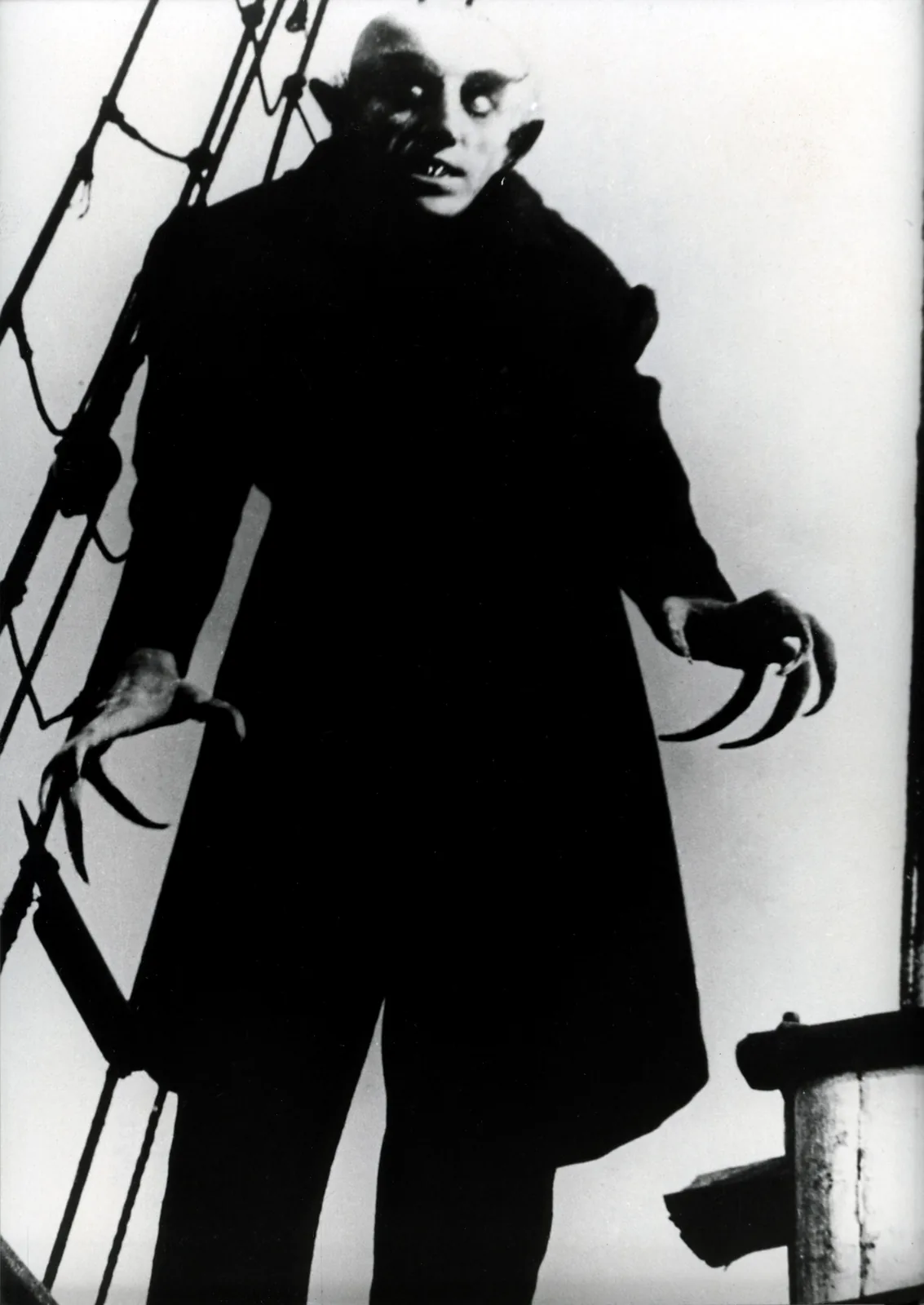
F. W. Murnau’s Nosferatupremiered in Germany on 4 March 1922 without a licence. The names were changed, badly: Count Orlok for Dracula, Thomas Hutter for Harker, Ellen for Mina. Florence Stoker, Bram’s widow, sued, and in 1925 a German court ordered every print and negative destroyed. The order was carried out and it did not work. Copies had already left the country, which is why the film exists and is now in the public domain in the United States.
Its lasting contribution to the mythology is an ending Stoker did not write. Orlok is destroyed by the rising sun. In the 1897 novel daylight limits the Count, restricting when he can change form, but it does not kill him; he is killed by two men with knives at the end of a horseback chase. Almost every vampire that has burned on screen since 1922 is descended from a plot convenience invented to end a silent film.
Robert Eggers’s 2024 Nosferatu is a remake of that film rather than of the novel, which is why it carries the same departures forward. It took about $182 million worldwide against a $50 million budget and holds 85 per cent on Rotten Tomatoes from 383 reviews, so the lineage is in no danger of dying out.
🍷 1931 and 1958: the image, and the voyage that vanished
Universal’s Dracula, directed by Tod Browning and starring Bela Lugosi, premiered on 12 February 1931 and is the reason most people can quote the Count at all. It is also the reason the quotation is usually wrong. The line everyone attributes to Dracula, the one about what he never drinks, is Lugosi’s, and it turns out to be absent from Stoker’s text, which is a sibling post’s subject rather than this one’s.
Hammer’s 1958 Horror of Dracula, directed by Terence Fisher with Christopher Lee and Peter Cushing, made the opposite kind of cut. The table above lists what went; what the cuts add up to is a different story under the same title. Harker arrives at the castle already meaning to destroy his host rather than to close a property sale, so the slow discovery that occupies Stoker’s first four chapters is over before the first reel ends. What the film keeps, and what almost every later version drops, is that Dracula is genuinely dangerous in a room rather than romantic in one.
The 1970 Count Dracula, directed by Jesús Franco with Lee again, is worth naming for one detail nobody else attempts. Stoker’s Count is introduced as an old man with a heavy white moustache, and by the time Harker sees him in London he has grown young. Franco filmed that. Lee starts white-haired and de-ages as he feeds.
“I believe it is the Count, but he has grown young.”
⚓ 2023: one chapter, whole movie
The Last Voyage of the Demeter reached American cinemas on 11 August 2023 and took roughly $21.8 million worldwide against a $45 million budget, which is a commercial failure by any measure. It is also the most disciplined Dracula adaptation anyone has made.
Its source is chapter VII, a newspaper cutting containing the salvaged log of a Russian schooner, kept by a captain who is steadily losing his crew and cannot say why. None of the novel's five diarists narrates a word of it. The chapter runs a few pages. The entries get shorter as the men disappear. It ends with the ship running aground at Whitby with a dead man tied to the wheel and a dog-shaped thing leaping ashore.
Øvredal’s film takes that document and does the one thing a film can do that a log cannot, which is to be present for the nights the log summarises. It adds characters to be eaten, because a ship needs faces. It does not add a romance, a prophecy, or a reason for the Count to be anything other than an appetite in the hold. Readers who find the middle of the novel slow almost never say that about this chapter, and the film is built on exactly that instinct.
💍 2026: a brand-new Dracula, a thirty-four-year-old invention
Luc Besson’s Dracula, marketed internationally as Dracula: A Love Tale, opened in France on 30 July 2025 and reached North American cinemas on 6 February 2026, with Caleb Landry Jones as the Count and Christoph Waltz as a priest. Reviews were mixed: 54 per cent on Rotten Tomatoes from 114 reviews and 44 on Metacritic from 21.
The premise is a four-hundred-year search for the reincarnation of the Count’s dead wife. That is not from Stoker. It is from Coppola, who added it in 1992 to give a predator a motive an audience could root for, and it has now outlived the film that invented it by thirty-four years. The novel’s Dracula never loved anyone. He buys property across London under assumed names and distributes fifty boxes of his own grave-earth among the houses, which is the behaviour of a man planning a long occupation rather than a reunion.
Coppola’s own film, to be fair to it, earned its place. It cost $40 million, took $215.9 million worldwide, and won three Academy Awards from four nominations, for Costume Design, Sound Effects Editing and Makeup. It is the most watched Dracula and the most complete one. It also taught three decades of film-makers that the Count needs a broken heart, and he does not.
📖 So is the 1897 book still frightening?
In parts, and the parts are predictable. The first four chapters, in which a young solicitor works out over several polite weeks that he is a prisoner, are the section readers still describe as genuinely frightening, and the Demeter log is the section they describe as the creepiest thing in the book. The long middle, where five people take turns being reasonable at each other about property records and train timetables, is where most abandoned copies stop.
That shape explains the adaptation history better than any argument about faithfulness. The parts that scare are the parts nobody has needed to change, which is why the one film that filmed only the log had so little to invent. The ending is worth reaching, though. There is no wooden stake and no sunrise. Harker’s kukri knife shears through the Count’s throat as Quincey Morris drives a bowie knife into his heart, and the body crumbles into dust in the drawing of a breath, with the sun still on the mountain tops.
The full text is free at Project Gutenberg and the one famous screen line that is genuinely Stoker’s own is examined here.
Sources
- Dracula (1897 text) — Project Gutenberg
- Most Faithful “Dracula” Adaptations, Ranked — TheWrap
- A Quest for a Loyal Dracula Adaptation — CrimeReads
- Book vs. Film: Dracula vs. The Last Voyage of the Demeter — LitReactor
- The Last Voyage of the Demeter — box office — Box Office Mojo
- Nosferatu (1922 film) — Wikipedia
- Nosferatu (2024 film) — Wikipedia
- Dracula (2025 French film) — Wikipedia
- Bram Stoker's Dracula (1992) — Wikipedia
Frequently asked questions
- Which Dracula movie is the most faithful to the book?
- Ranked lists say Coppola's 1992 film, the only major version that covers the whole plot. Judged on what it adapts rather than how much, The Last Voyage of the Demeter is closer. The scale gap is the whole argument: chapter VII runs about 5,700 words of a novel of roughly 161,000, so the film builds two hours out of three and a half per cent of the book.
- Is The Last Voyage of the Demeter accurate to the book?
- To the chapter it covers, unusually so. Chapter VII of Dracula is a salvaged ship's log in which a Russian crew disappears one by one on the crossing to Whitby. The film invents crew members so there are faces to lose, and adds no romance, no prophecy and no motive for the Count beyond appetite.
- Is the 2026 Dracula movie based on the real book?
- Loosely. Luc Besson's Dracula, marketed as Dracula: A Love Tale, opened in France on 30 July 2025 and in North America on 6 February 2026. Its plot is a four-hundred-year search for the reincarnation of Dracula's dead wife, which comes from Coppola's 1992 film rather than from Stoker, whose Count has no lost love.
- Is Nosferatu (2024) faithful to Dracula?
- It is faithful to the 1922 Nosferatu rather than to the novel, and that is deliberate. Robert Eggers's version opened on 25 December 2024 and keeps the names Murnau's film invented to get around the Stoker estate, so its vampire is Count Orlok and its heroine is Ellen Hutter. A viewer looking for Dracula and Mina by name will not find them in it.
- Did Bram Stoker's Dracula (1992) win any Oscars?
- Three, from four nominations: Costume Design for Eiko Ishioka, Sound Effects Editing and Makeup. It lost Art Direction. All three wins are surface craft, which fits, because the film's invented love story replaced a motive Stoker had already written. In chapter II the Count says what he wants from England: to be in the midst of the whirl and rush of humanity.
Enjoyed this one?