How dark is the Wizard of Oz book? Darker than the film, and much more specific
A woman pays a witch two sheep and a cow to enchant a young man's axe. That is chapter five of a children's book from 1900, and it is where the Tin Woodman comes from.


A woman does not want to lose her housekeeper. So she goes to a witch and offers two sheep and a cow, and the witch enchants a young man's axe so that it will cut off a piece of him every time he swings it. You will not find that in a horror novel. You will find it in chapter five of a children's book from 1900, which is where the Tin Woodman comes from.
- The Tin Woodman was a man.His own axe took him apart limb by limb, on a witch's instruction, and a tinsmith replaced each piece.
- The Scarecrow kills forty crows with his hands. Baum counts them.
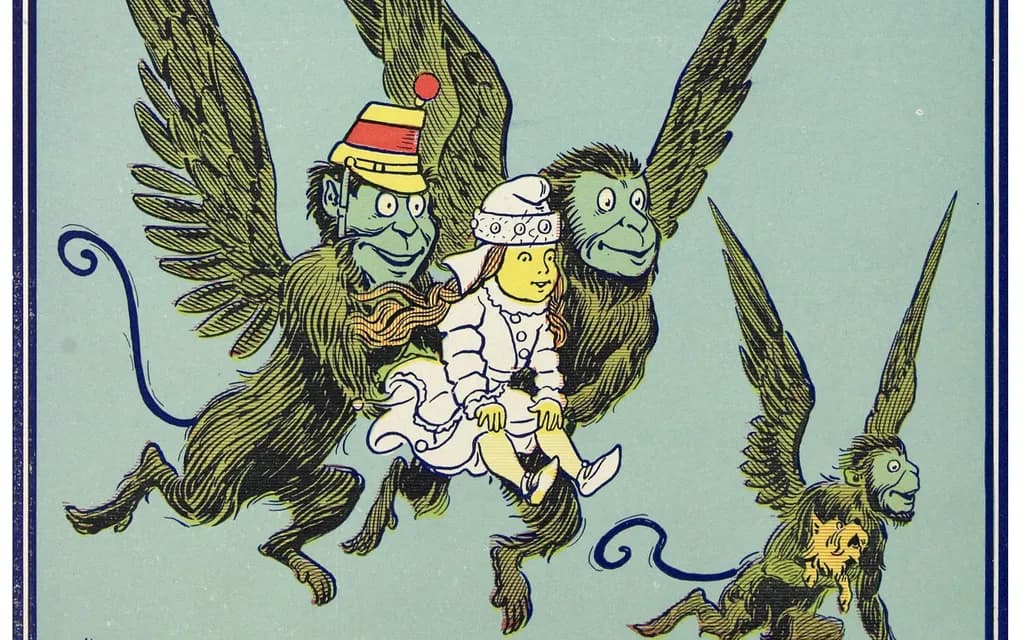
- The Winged Monkeys are prisoners. They have a backstory, a punishment, and an owner, and none of it is their fault.
- The Emerald City is not green. The Wizard says so himself, and explains the eyewear.
The strangest part is that Baum announced the opposite. The book opens with a short preface, signed in Chicago in April 1900, in which he explains that the old fairy tales were full of horrible and blood-curdling incidents and that his will not be.
It aspires to being a modernized fairy tale, in which the wonderment and joy are retained and the heartaches and nightmares are left out.
Twelve chapters later the Scarecrow is killing birds with his hands. Baum meant the promise, and by the standards of the Grimm collections he grew up on he arguably kept it: nobody in Oz is punished for a moral failing, nothing is described to frighten a child into behaving. What he did not promise was to leave out violence, slavery or mutilation. He only promised they would not be used to teach anyone a lesson, and on that narrow undertaking he delivers completely.
None of this is buried in some rare variant text. It is in the book almost everyone thinks they have already read, freely available and unchanged since 1900, and it survives in the story because Baum is not interested in shielding you from it. He states it, sometimes with a number attached, and then the road continues. What the 1939 film did was not add sweetness so much as remove specifics, and specifics are where this book keeps its teeth.
The travelling party of a girl, a straw man, a tin man and a lion sounds like a nursery rhyme until you notice what each of them is actually carrying. One is a mutilation survivor who no longer loves anyone. One kills whatever comes at the group and then apologises for having no brains. The lion is the only one who talks about being frightened, which in this company is the sanest position available.
🐦⬛ Forty crows, counted
In chapter twelve the Wicked Witch of the West sends three waves of animals to kill the travellers, and the book tallies every one. Forty wolves come first, and the Tin Woodman beheads all forty with his axe, one swing per wolf, until they lie in a heap. Forty crows follow. The Scarecrow, who cannot be pecked because he is stuffed, handles them personally.
The King Crow flew at the Scarecrow, who caught it by the head and twisted its neck until it died. And then another crow flew at him, and the Scarecrow twisted its neck also. There were forty crows, and forty times the Scarecrow twisted a neck, until at last all were lying dead beside him.
Then come the bees, and the bees are the strangest of the three. The Scarecrow has himself emptied of straw so his friends can hide under it, leaving the Tin Woodman standing alone as bait. The swarm breaks every sting against him and dies, and Baum finishes the image the way a naturalist would: they lie scattered thick about the Woodman, like little heaps of fine coal. It is a lovely sentence about several thousand small deaths.
The number is the part that does the work. “They fought off some crows” is an adventure beat. Forty, itemised, twisted one at a time by a creature built to frighten birds and now doing the job by hand, is something else, and Baum keeps the total in front of you rather than letting the fight blur. He does the same with the wolves. He does it again in chapter seven with the Kalidahs, the beasts with bodies like bears and heads like tigers, who are dropped into a gulf when the Tin Woodman chops through the tree the party has just used as a bridge.
🪓 The Tin Woodman is a curse, not a costume
He was Nick Chopper, a Munchkin woodcutter, and he was engaged. The girl lived with an old woman who did not want to lose her cook and housekeeper, so the old woman went to the Wicked Witch of the East and promised her two sheep and a cow to prevent the marriage. The Witch enchanted the axe.
Every time he swung it after that, it cut off part of him, and every time he went to a tinsmith and had the part replaced. Left leg. Right leg. Then the arms, one at a time. Then his head. He keeps working through all of it, because he is trying to earn enough to build the house, and the more of him the axe takes the harder he works. The Witch has no interest in killing him. She is being paid to stop a wedding, and she is patient about it.
She thought of a new way to kill my love for the beautiful Munchkin maiden, and made my axe slip again, so that it cut right through my body, splitting me into two halves. Once more the tinsmith came to my help and made me a body of tin… But, alas! I had now no heart, so that I lost all my love for the Munchkin girl, and did not care whether I married her or not.
That is the curse working exactly as commissioned. The point was never the axe. The point was that a man rebuilt entirely in metal has no heart in him, and a man with no heart stops wanting to get married, which is what the old woman paid for.
And then Baum adds the line that makes the whole thing land, delivered in the same mild tone as everything else the Woodman says: I suppose she is still living with the old woman, waiting for me to come after her. He describes it as an appointment he no longer feels like keeping, and the word tragedy never comes near it. Every later scene where he cries and rusts his own jaw shut, and has to be oiled by his friends, is a man trying to feel something about a person he can remember loving.
🐒 The Winged Monkeys never chose any of this
The Winged Monkeys belong to nobody in particular. They are bound to an object, the Golden Cap, and whoever holds the Cap can command them three times and no more. The Witch of the West spent two of her three commands long before Dorothy arrived: once to enslave the Winkies and take their country, once to drive the Wizard himself out of the West.
Dorothy's party gets attacked with the last one. In chapter fourteen the Monkey King explains where the Cap came from, and the story is pettier and sadder than any curse. Their band once lived free in the forest and liked jokes. A sorceress-princess named Gayelette, who lived in a palace built of ruby blocks, was about to be married to a young man called Quelala. The King's grandfather thought it would be funny to drop the bridegroom in the river. It was funny for about a minute.
Gayelette's punishment was permanent and inherited: the whole band, and every band after it, tied to a hat, to be handed between owners forever. When Glinda finally spends the last three commands at the end of the book she gives the Cap to the Monkey King so that his people are free from then on, which is the only emancipation in the story and takes about two sentences. Baum lets the reader work out how long the sentence had run.
What the Monkeys actually do under orders, back in chapter twelve, is worth being precise about, because the film turns it into a swirl of shadows. They lift the Tin Woodman, carry him over a stretch of sharp rocks and drop him, and he lands so battered and dented that he can neither move nor groan. They take the Scarecrow apart, pull every piece of straw out of his clothes and head, and throw the empty bundle into the top branches of a tall tree. One of Dorothy's friends is destroyed and the other is disassembled, and both are left where they fall.
🟢 The Emerald City is a pair of locked glasses
Before anyone may enter the Emerald City, the Guardian of the Gates opens a box, fits every traveller with green spectacles, including the dog, and locks them on with golden bands fastened at the back of the head. He holds the only key. The people who live in the city wear theirs night and day. The stated reason is that the glory of the city would otherwise blind them.
The real reason arrives in chapter fifteen, once the Wizard has been caught out and has stopped performing. He explains that he ordered the city built to keep the population busy, named it the Emerald City because the country around it was green and pleasant, and then made the name true by other means.
“But isn't everything here green?” asked Dorothy. “No more than in any other city,” replied Oz; “but when you wear green spectacles, why of course everything you see looks green to you.”
A whole population has been wearing locked eyewear for a generation so that a man from Omaha could keep a name accurate. He wields it with no malice at all. He is a circus balloonist who landed in a place that assumed he was a god, went along with it, and then had to keep going along with it, and the spectacles are the cheapest way he found to make the lie hold. When he is finally exposed he is genuinely relieved, and he calls himself a humbug before anyone else can.
That is the register the whole book works in. The cruelty is real and precisely described, and then the story keeps its manners about it. Nobody in Oz is scandalised by the crows or the Cap or the spectacles, which is why they stay with you: the horror is not that something terrible happens, it is that it is reported calmly, in a book written for children, by a narrator who assumes you can take it.
The 1985 film Return to Oz has spent four decades being remembered as the frightening one, and it is usually the film people reach for when they want to say the source material is harsher than the 1939 version. That instinct is pointed the right way, though the film is working from the second and third Oz books rather than this one, and Walter Murch's darker reading of Baum was a deliberate gamble at the time.
The playable version does not soften any of this, and it does not have to, because the interesting decisions are all still there in the original chapters. You can be the one standing in front of the party when the Cap is used, and choose whether the Monkeys are something to survive or someone to talk to.
If it is the gap between book and film that interests you, the shoes are the cleanest place to see it: what the 1939 movie changed. Wicked gives the Monkeys a different, much-discussed origin involving the Wizard and a pair of wings — that version is a modern invention, and Baum's is the one told above. The full text of the novel is at Project Gutenberg, free, in the 1900 wording quoted throughout.
Sources
Frequently asked questions
- How did the Tin Woodman lose his body?
- The Wicked Witch of the East put an enchantment on his axe, paid by an old woman who did not want to lose her housekeeper to his marriage. The axe took a leg, then the other leg, then his arms, then his head, then split his body in two. A tinsmith replaced each part but could not supply a heart — which Baum treats as the actual curse, not the metal.
- Where do the Winged Monkeys come from in the book?
- A sorceress named Gayelette bound their whole band to the Golden Cap after the Monkey King's grandfather dropped her bridegroom in a river as a prank. Whoever holds the Cap may command them three times and no more. Glinda spends the last three commands at the book's end freeing them for good — the only emancipation in the story.
- How many crows does the Scarecrow kill?
- Forty, one at a time, by twisting their necks, and Baum keeps the tally in the text. The Tin Woodman beheads forty wolves in the same chapter with the same arithmetic. Chapter seven does the same counting trick with two Kalidahs, beasts with bears' bodies and tigers' heads, dropped into a gulf.
- Is the Emerald City really green in the book?
- No. Every visitor is fitted with green spectacles at the gate, locked on with golden bands, and residents wear theirs day and night. In chapter fifteen the Wizard admits the city is no greener than anywhere else: he named it the Emerald City and then made the name fit by controlling what everyone could see.
- Is Return to Oz closer to the books than the 1939 film?
- It is drawing on different books. Walter Murch's 1985 film adapts the second and third Oz novels, The Marvelous Land of Oz and Ozma of Oz, rather than the first, and its bleaker tone was a deliberate choice. Readers who call it the more faithful adaptation are usually responding to that register rather than to plot fidelity.
Enjoyed this one?