Who's who in The Wonderful Wizard of Oz: a guide to the 1900 book's cast
Most Oz character guides are really guides to the 1939 film, which is a problem, because the film keeps two witches and the book has four, in four different countries.


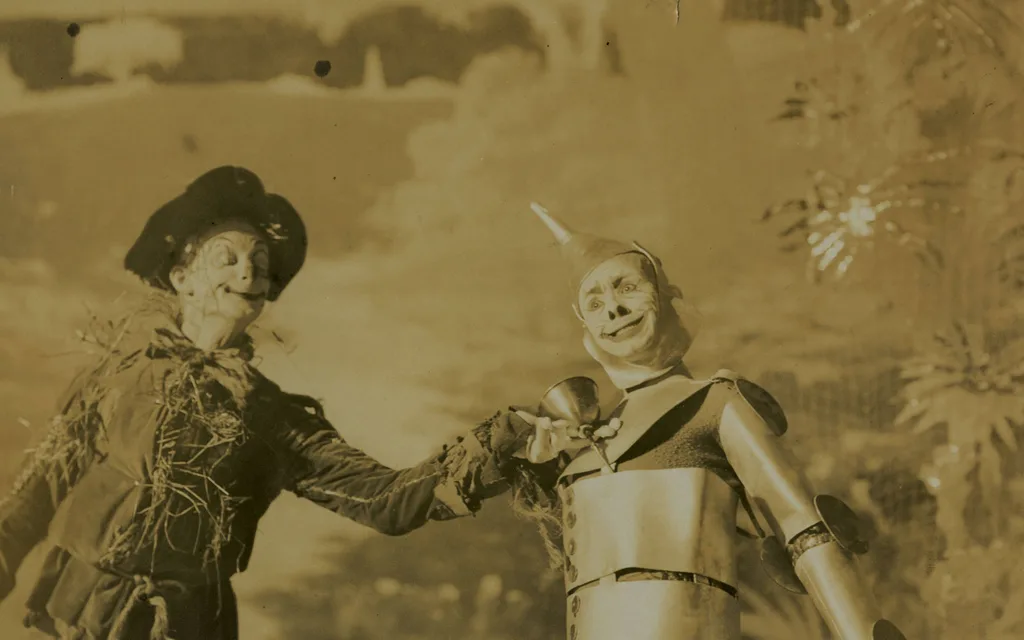
Most character guides to Oz are really guides to the 1939 film, which is a problem, because the film keeps two witches and the book has four. It keeps one good witch and the book has two, in different directions, with different jobs. Getting the cast right is the fastest way to notice that the novel is a stranger and more governed place than the movie version of it.
- Four witches, two good and two wicked, one per compass point, and the good one Dorothy meets first is not Glinda.
- Dorothy has no stated age. The book gives her one description and no number at all.
- The Wizard has no name in this book. He has a birthplace, two former careers and a confession.
- The Wicked Witch of the East never appears alive. She is dead on page one of the adventure and shapes the whole of it.
The compass matters more than it sounds. Oz in this book is administered: four countries, four colours, one witch each, and a capital in the middle that answers to none of them. The Munchkins in the blue East had been ruled by a wicked witch for years. The Winkies in the yellow West had been enslaved by another. Dorothy's journey is not a wander through a dreamscape, it is a walk across four jurisdictions, and the plot turns on which authority is in charge of the ground under her feet.
🧭 Four witches, and Glinda rules the South
Glinda rules the South. This is the single most common Oz mistake, and it comes from the film, which merged the North and the South into one character and gave her Glinda's name. In the book they are two different people, met twenty-one chapters apart, and the one who meets Dorothy in the opening is an old woman from the North whose name we are never told.
| Witch | What she does in the book |
|---|---|
| Wicked Witch of the East | Ruled the Munchkins and enslaved them for years. Killed instantly by Dorothy's falling house before the story properly starts. Her silver shoes pass to Dorothy. |
| Good Witch of the North | Unnamed. Arrives with the Munchkins, hands Dorothy the silver shoes, and kisses her forehead, leaving a mark that protects her for the rest of the journey. |
| Wicked Witch of the West | Rules the Winkies as slaves. Has one eye, as powerful as a telescope. Sends wolves, crows, bees and the Winged Monkeys. Melts when Dorothy throws water at her. |
| Glinda, Good Witch of the South | Rules the Quadlings. Described as the most powerful of all four. Appears only near the end, and is the one who explains how the silver shoes work. |
The kiss is the detail worth holding on to. The Witch of the North cannot travel with Dorothy, so she leaves a round, shining mark on her forehead instead, and tells her that nobody will dare injure a person who has been kissed by the Witch of the North. It works. It is why the Wicked Witch of the West, who could kill any of the others outright, spends chapter twelve throwing animals at the party rather than touching the girl herself.
Glinda's function at the end is administrative rather than magical. She does not transport Dorothy home. She tells her that the shoes she has been walking in since chapter two could have carried her over the desert on the first day, and then sends the Scarecrow, the Tin Woodman and the Lion off to govern three separate countries, which is what the last chapters of this book are actually about: who ends up in charge of what. How she plans those flights with the Golden Cap, and what she promises the Winged Monkeys afterwards, is laid out in the Wizard of Oz ending explained.
👧 Dorothy Gale, age unstated
The book never says how old Dorothy is. It gives one physical description, in chapter two, when she stands among the Munchkins and is measured against them: she is a well-grown child for her age, and they are no taller than she is. That is the whole of it. No birthday, no year at school, no number in twenty-four chapters.
What the book does give you is her behaviour, and it is not a frightened child's. She negotiates with a witch in the first hour. She recruits three strangers on the road by working out what each of them wants and offering to get it for them. When the Wizard sends her to commit a murder she objects on the grounds that she does not want to kill anybody, not on the grounds that she is scared. And when she is finally taken prisoner she spends her captivity doing the kitchen work and quietly refusing to hand over her shoes.
She kills both wicked witches in the book, which is worth saying plainly. The first dies under her house by accident, the second dies because Dorothy loses her temper and throws a bucket of water, and Dorothy's reaction to the melting is to be genuinely sorry and then sweep the kitchen floor. The most striking thing about the character is her steadiness. She is polite to everyone, including the people trying to kill her, and she does not stop walking.
🌾 The three companions already have what they ask for
The Scarecrow wants brains, the Tin Woodman wants a heart, and the Cowardly Lion wants courage, and the running joke of the novel is that all three demonstrate the missing quality repeatedly on the way to ask for it. The Scarecrow devises every plan the party survives on. The Tin Woodman is so tender-hearted he weeps over a beetle he steps on and rusts his own jaw shut.
The Lion walks first into everything that frightens him. Baum keeps the irony working by giving each of them a reason to disbelieve the evidence. The Scarecrow was made days before the story starts and was informed on his first afternoon, by an old crow perched on his shoulder, that any crow of sense could see he was only stuffed with straw. The Tin Woodman knows for a fact that his chest is empty, because he watched the tinsmith fail to put anything in it. The Lion has decided that being frightened while acting disqualifies the action, which is a definition of courage that no brave person has ever met.
This is why the gifts at the end are so satisfying and so odd. The Wizard gives the Scarecrow bran and pins, the Tin Woodman a silk heart stuffed with sawdust, and the Lion a bowl of liquid he calls courage and tells him to drink. All three are props, and all three work immediately, because what was actually missing was permission. It is a startlingly modern piece of psychology to find in a book published in 1900, delivered by a man who describes himself as a humbug while he does it.
🎩 Oz, the Great and Terrible, of Omaha
The Wizard is a fraud, and the book is unusually generous about it. He is a small man who was a circus balloonist in Nebraska, drifted here on a runaway balloon, was mistaken for a sorcerer by people who watched him descend from the sky, and decided the safest thing was to agree. He has been running the Emerald City on stage tricks ever since.
Baum lets him explain every one of them. Before the exposure he grants each of the four travellers a private audience, and each one sees something different. Dorothy is received by an enormous disembodied Head. The Scarecrow walks in on a beautiful winged Lady in green silk. The Tin Woodman gets a Beast the size of an elephant with a rhinoceros head, five eyes, five arms and five legs. The Lion is shown a Ball of Fire he cannot get near.
Chapter fifteen takes the whole apparatus apart. The Head was many thicknesses of paper hung from the ceiling on a wire, with a thread to work the eyes and mouth. The Lady was a dress and a mask. The Beast was a lot of skins sewn together with slats to keep their sides out. The Ball of Fire was a ball of cotton with oil poured on it. The voices were all his, because his first profession was ventriloquism.
“Really,” said the Scarecrow, “you ought to be ashamed of yourself for being such a humbug.” “I am—I certainly am,” answered the little man sorrowfully; “but it was the only thing I could do.”
The novel never gives him a personal name. He is Oz, the Great and Terrible, in public and the little man in private, and the elaborate string of first names that circulates online is from a later book in the series, not this one. What this book gives him instead is a biography: Omaha, ventriloquist, balloonist, and a landing he could not explain to the people who saw it. Everything the Emerald City believes about him grew out of that one arrival, and he has been maintaining it out of embarrassment for years.
🏠 The Witch of the East, who is never alive on the page
She is the most consequential character in the book and she has no scenes. The house lands on her in chapter two, before Dorothy has spoken to anyone in Oz, and everything that follows is the aftermath of her death: a country suddenly free, a pair of silver shoes with an unexplained charm, a sister in the West with a grievance, and a girl who has become famous in Munchkin country as a killer of witches without having done anything on purpose.
Her one earlier appearance in the story is second-hand and much worse than her death. She is the witch the old woman hired in chapter five to enchant a woodcutter's axe, which is where the Tin Woodman comes from. So the party assembling on the road to the Emerald City includes both her killer and her victim, and neither of them ever mentions the connection.
The shoes she leaves behind are silver in the book, not ruby, and Glinda's explanation of what they can do is the last real revelation in the novel. That change, and the reason for it, has its own story.
Reading the cast this way changes what the Emerald City gate scene is. It reads less like a whimsical checkpoint than like a border post run by a man with a locked box and the only key, standing between four countries and a capital that belongs to none of them.
The full 1900 text, including every line quoted above, is free at Project Gutenberg.
Sources
- The Wonderful Wizard of Oz (1900), full text — Project Gutenberg
- The Wonderful Wizard of Oz — publication, cast and reception — Wikipedia
Frequently asked questions
- Is Glinda the Good Witch of the North or the South?
- The South. In Baum's book Glinda rules the Quadlings, is called the most powerful of the four witches, and does not appear until near the end. The good witch who meets Dorothy at the start is a different, unnamed character, the Witch of the North. The 1939 film merged the two and kept Glinda's name.
- What is the Wizard's real name in the book?
- He does not have one. Across twenty-four chapters he is only ever Oz, the Great and Terrible, or the little man. The long multi-part personal name that circulates online appears nowhere in this novel. What the book does give him is a biography: born in Omaha, trained as a ventriloquist, then a circus balloonist.
- How many witches are there in the Wizard of Oz?
- Four, one per compass point, and Dorothy meets them in a fixed order across the book: the Witch of the East is already dead by chapter two, the Witch of the North kisses her that same chapter, the Witch of the West melts in chapter twelve, and Glinda does not appear until chapter twenty-three, the second-to-last.
- Is Dorothy brave in the book?
- Notably so, and she is never rescued. She negotiates with a witch within an hour of arriving, recruits three companions by working out what each of them wants, kills both wicked witches, refuses to give up her shoes in captivity, and walks the length of a continent. Her defining trait is steadiness rather than fear.
- What does humbug mean in the Wizard of Oz?
- A fraud or an imposture. It is the word the Scarecrow uses when the Wizard's tricks are exposed, and the Wizard agrees to it immediately. Baum liked it enough to put it in a chapter title: chapter sixteen is called The Magic Art of the Great Humbug, and it is the chapter where he hands out the gifts anyway.
Enjoyed this one?