Is the Wizard of Oz really about the gold standard?
Yellow brick road, silver shoes, Emerald City, an ounce of gold. The mapping is beautiful, it is repeated everywhere as settled history, and the paper trail runs the other way.


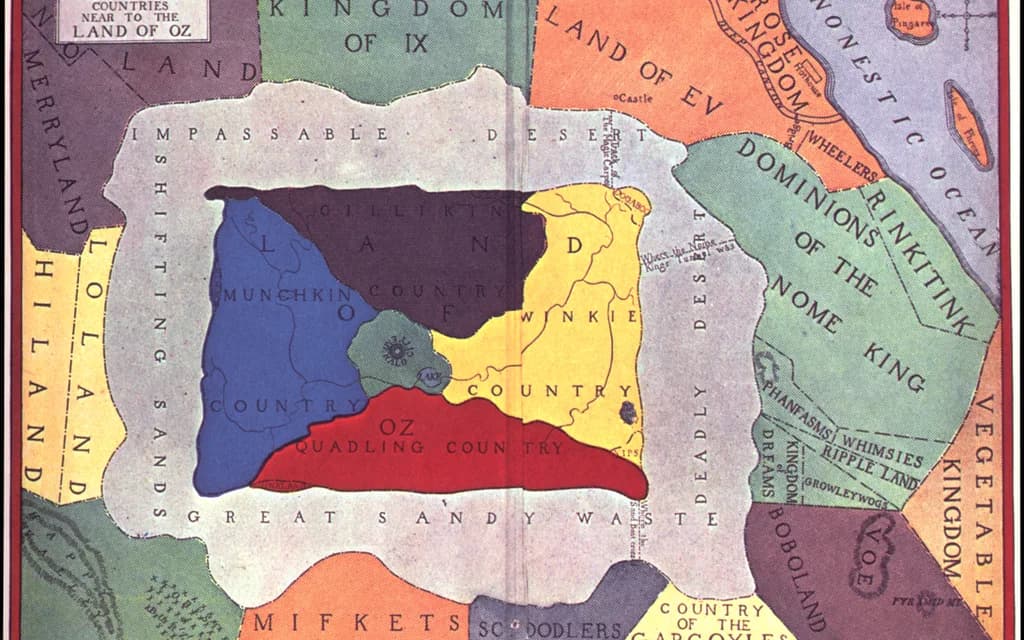
It is one of the most satisfying facts on the internet, and it goes like this. The yellow brick road is the gold standard. The silver shoes are the free-silver campaign, walking on top of it. Oz is the abbreviation for an ounce. The Emerald City is Washington, green as paper money. The Scarecrow is the farmer who thinks he has no brains, the Tin Woodman is the industrial worker dehumanised by the machine, and the Cowardly Lion is William Jennings Bryan, all roar and no bite. It fits beautifully. It is also, on the documentary evidence, almost certainly not what happened.
- The reading is from 1964, not 1900. A high-school history teacher invented it sixty-four years after the book.
- Baum backed the other side. In 1896 he published a poem supporting McKinley, the gold-standard candidate.
- Its own author walked it back. Littlefield later said there was no basis in fact for treating Baum as a Populist.
- One political commitment does show in the books, and it is not monetary policy.
One thing to clear up first, if the film is your only Oz: the shoes really are silver in the book, and the ruby slippers were invented for the 1939 film. The theory below is built on the book's silver, not on Hollywood's red.
Which does not make the reading worthless. It makes it a piece of criticism rather than a piece of history, and the difference matters, because it is nearly always repeated as history: as a secret Baum encoded, a key he hid, a thing your teacher did not know. He did not, and there is no key. What there is instead is a genuinely clever twentieth-century essay that has been mistaken for a nineteenth-century intention.
🟨 What the theory actually claims
That Baum wrote The Wonderful Wizard of Oz as a coded commentary on the 1890s money debate: gold versus silver, creditors versus indebted farmers, the argument that decided the 1896 election. Every major element of the book is assigned a referent, and the correspondences are tidy enough that people who hear it once tend to keep it for life — tidy enough that the Smithsonian's own history museum has a page laying the mapping out.
| In the book | What the theory says it stands for |
|---|---|
| The road of yellow brick | The gold standard |
| The silver shoes | Free coinage of silver, walking the gold road |
| The Emerald City | Washington, and paper greenbacks |
| The Scarecrow | The American farmer, told he has no brains |
| The Tin Woodman | The industrial worker, made mechanical by his labour |
| The Cowardly Lion | William Jennings Bryan: a great voice, no follow-through |
| "Oz" | oz., the abbreviation for an ounce of gold or silver |
The strongest single piece of textual evidence is real and worth stating fairly. Dorothy spends the entire book walking a gold road in silver shoes, and Glinda tells her at the end that the shoes could have taken her home on the first day if anyone had known what they did. As a picture of a country arguing about a monetary remedy it already possessed, that is close to perfect, and it is why the theory has survived every attempt to kill it.
The most serious version of the case is not a blog post either. In 1990 the economist Hugh Rockoff published “The ‘Wizard of Oz’ as a Monetary Allegory” in the Journal of Political Economy, reading the story as an informed commentary on the free-silver fight and working the correspondences out in professional detail. That paper is why the theory still has defenders with credentials, and anyone dismissing the reading out of hand should have to account for it.
What it contains, though, is a reading rather than a discovery. Rockoff shows that the story can be mapped onto the monetary debate with unusual neatness. He does not produce a letter, a diary line, an editorial or an interview in which Baum says he did it, because there is not one, and the gap between “this maps well” and “the author meant it” is the whole argument.
The trouble starts as soon as you ask the mapping to be consistent. The Emerald City is supposed to be greenbacks, but the book's point about it is that its greenness is a pair of locked spectacles rather than anything in the city itself, which reads as a joke about perception rather than about paper currency. The silver shoes are supposed to be the remedy the people already hold, and Baum has them fall off in mid-air and vanish into a desert, which is not how anybody argues for bimetallism. The Wizard, if he is a politician, is a politician who resigns, apologises, and hands power to a scarecrow.
Allegories tend to keep their referents pointing the same way. This one requires you to read some details closely and skate past others, which is the ordinary condition of good criticism and a poor sign in an argument about authorial intent.
🔍 Did Baum mean any of it?
There is no evidence that he did. Baum left letters, newspapers, plays, a stage adaptation of his own book and thirteen sequels, and in none of them does he claim a political meaning for Oz. The one thing he did say about his intentions is in the book's own preface, and it is about children rather than currency: he wanted a modernised fairy tale that kept the wonder and left out the moralising the old ones ran on.
Worse for the theory, the documented politics run the other way. Baum edited a newspaper in Aberdeen, South Dakota, where his editorials backed Republican candidates, and in the 1896 campaign he published a poem in support of William McKinley, the gold-standard candidate running against Bryan. The man the theory casts as a silver partisan was, on the record, on the gold side of the argument it says he encoded.
Baum's biographer and annotator Michael Patrick Hearn went through the archive and said so publicly in a 1991 letter to the New York Times, finding no evidence that the story is a Populist allegory. That is the state of the evidence and has been for over thirty years. What keeps the theory alive is not new documents, it is how good it feels to know a thing.
A small chronological point is worth adding, because it is rarely mentioned. Baum signed the introduction in Chicago in April 1900, three and a half years after the election the book is supposed to be commenting on, and published it into a country where the silver question was already losing its heat. Allegories are usually timelier than that.
🗳️ Was Baum political at all?
Yes, and in one documented direction: women's suffrage. He married Maud Gage in November 1882, which made him the son-in-law of Matilda Joslyn Gage, one of the most radical suffragists of the century, who stayed with the family every winter and is credited with pushing him to write his stories down.
In Aberdeen he served as secretary of the local suffrage club, a working role rather than an honorary one. This is the political reading that does have a paper trail, and it is visible in the books without any decoding. The most powerful being in Oz is a woman. The next most powerful is another woman. The one man with formal authority is a fraud who is exposed and leaves in a balloon. Dorothy is not rescued at any point in the novel; she does the rescuing, kills both wicked witches, and gets herself home. In 1900, when women in most of the United States could not vote, that is a distinctive set of choices for a children's book.
Gage is worth a paragraph of her own, because she is the reason the household Baum wrote in argued about these things at the dinner table rather than in the abstract. She co-authored the movement's own history with Elizabeth Cady Stanton, and she held positions radical enough that she eventually walked out of the National Woman Suffrage Association over its alliance with the churches and founded her own organisation instead. She then stayed with the Baums every winter for the rest of her life, and she sent her daughter suggestions for the stories being told in that house, one of which was to bring in a cyclone.
Historians of the period credit Gage directly with shaping the good-witch figures, and she is the reason the household Baum wrote in was one where these arguments were live. None of that requires a hidden code. It only requires noticing who in Oz is allowed to be competent.
🏫 Where the theory came from
From a classroom. In 1964 Henry Littlefield, then teaching high-school history in New York, published “The Wizard of Oz: Parable on Populism” in American Quarterly. He had been teaching the 1890s to teenagers who found the period airless, and he used a book they already knew to make the money debate stick. As pedagogy it worked immediately, and it kept working, into textbooks, into economics lectures, into everyone's uncle.
The route it travelled explains why it feels like established fact. A reading that entered the world as a classroom analogy got picked up by history textbooks in the following decades, and a textbook does not have a tone of voice for “one scholar's clever suggestion.” It states things. A generation of American students met the allegory as content to be learned rather than as an argument to be weighed, and then taught it to the next one. That is a very efficient way to manufacture common knowledge out of a hypothesis.
The part that almost never travels with the theory is what Littlefield said afterwards. Once Hearn's archival work was public, he accepted it, and his own summary of his position is the most honest thing anybody has said in the whole argument.
Whether Baum intended [the parable] or not, I have no idea. I almost don't care.
He also conceded there was no basis in fact for treating Baum as a supporter of Populist ideology. He had built a teaching tool rather than made a discovery, and he said so. The theory outran him anyway, because a coded meaning is a better story than a good lesson plan, and because the careful version of the argument now lives in historians' journals and anthologies rather than in anything anyone forwards.
So read the yellow brick road as an argument about money if it makes the book better for you. Plenty of good criticism starts exactly there, and Rockoff's does. The line worth not crossing is the one where a reading turns into a claim about what Baum intended, because that is the half his own archive contradicts.
The road itself is worth walking without any of this attached. In the book it is one instruction from a witch who cannot come with you, and after that it is just a long, badly maintained road with strangers on it.
The full 1900 text, preface included, is free at Project Gutenberg. For what Baum actually did with his witches, see who's who in the book.
Sources
- The Wonderful Wizard of Oz (1900), full text including Baum's introduction — Project Gutenberg
- So Was the Wizard of Oz an Allegory for Populism? — History News Network
- The "Wizard of Oz" as a Monetary Allegory (Journal of Political Economy 98:4, 1990) — University of Chicago Press
- Tale of a Parable — Littlefield, the 1964 essay and his later position — International Wizard of Oz Club
- L. Frank Baum — the Aberdeen years, the McKinley poem, the suffrage club — Wikipedia
- The Feminist Who Inspired the Witches of Oz — Smithsonian Magazine
- The Feminist of Oz — New-York Historical Society
- Populism and the World of Oz — Smithsonian National Museum of American History
Frequently asked questions
- Is the Wizard of Oz really about the gold standard?
- There is no evidence that Baum intended it. He never claimed a political meaning for Oz in any letter, newspaper column, play or sequel, and his biographer Michael Patrick Hearn went through the archive and reported finding none. The reading is a piece of twentieth-century criticism that has been widely mistaken for a nineteenth-century intention.
- Who invented the Wizard of Oz populism theory?
- Henry Littlefield, a high-school history teacher in New York, in an essay called The Wizard of Oz: Parable on Populism published in American Quarterly in 1964. He built it as a classroom device to make the 1890s money debate stick for teenagers, and it spread from there into textbooks and economics lectures.
- Did Baum support free silver and William Jennings Bryan?
- The documented record points the other way. As a newspaper editor in Aberdeen, South Dakota, Baum's editorials backed Republican candidates, and during the 1896 campaign he published a poem supporting William McKinley, the gold-standard candidate running against Bryan. The claim that he was a silver partisan circulates widely without primary documents behind it.
- Was L. Frank Baum a feminist?
- He was a working suffrage supporter, which is the one political commitment with a paper trail. He served as secretary of the suffrage club in Aberdeen, South Dakota, and in 1882 married Maud Gage, daughter of the radical suffragist Matilda Joslyn Gage, who lived with the family and is credited with shaping the books' good-witch figures.
- Does Oz stand for an ounce of gold?
- Only inside the 1964 theory. The abbreviation does fit, which is a large part of why the reading is so memorable, but the book never explains the name and Baum never linked the two. The ounce reading arrived with the rest of the allegory sixty-four years after the novel was published.
Enjoyed this one?