Is Milady de Winter a Villain — or the Musketeers’ Victim?
The only account of her early life comes from the man who tried to kill her, drunk, and he tells it in the third person until he forgets to keep it up.


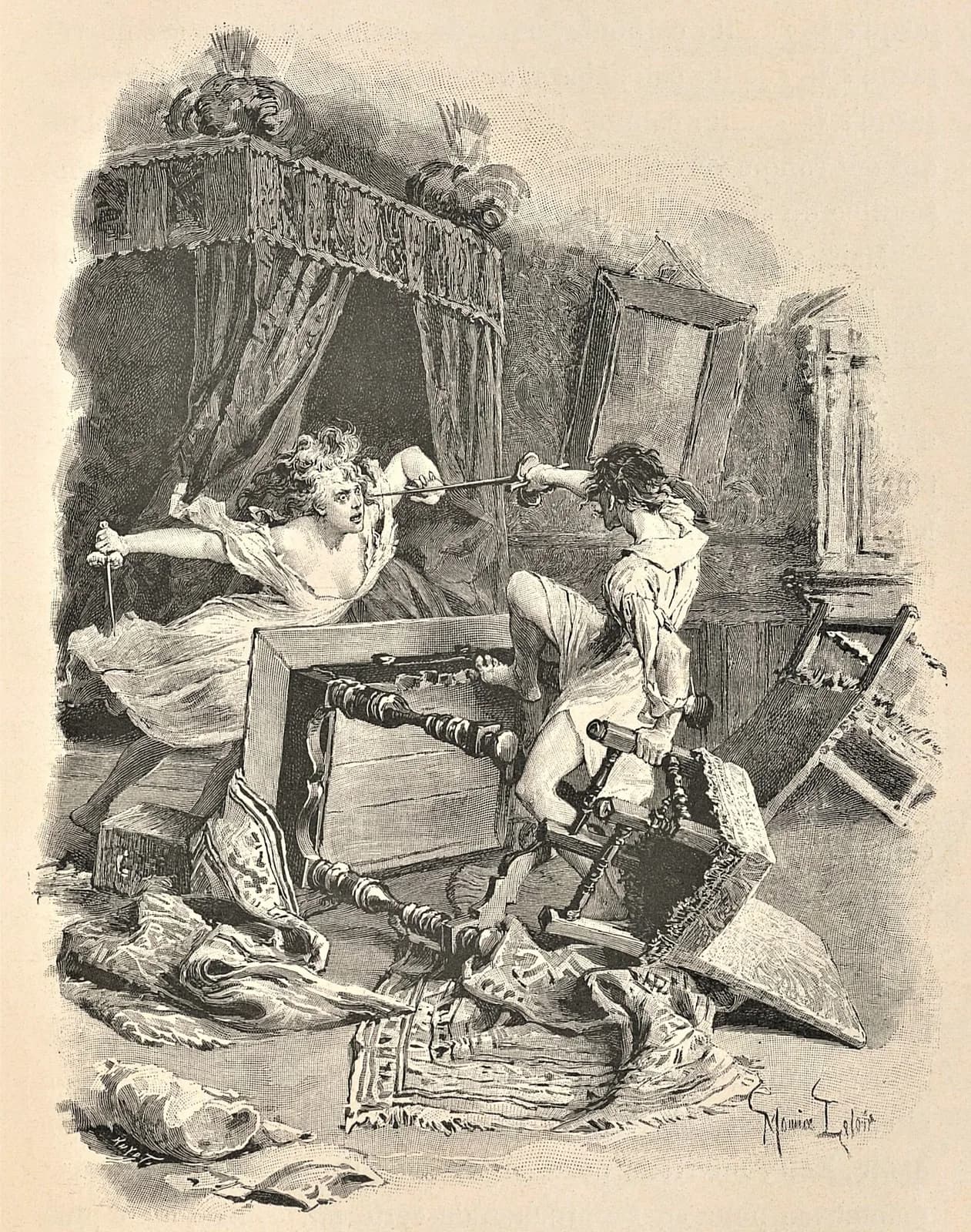
Spoilers below: this post discusses how Milady’s story ends and the argument readers keep having about it, though it never walks through the scene itself.
This is the argument the novel is least equipped to settle, because the only account we ever get of her early life is delivered by the man who tried to kill her, drunk, in the third person, as a story about a friend of his. It is also the argument the book keeps generating: her chapters are the ones readers remember, and the playable Three Musketeers gives her more doorways than any character except D’Artagnan.
⚜️ What happens to her at sixteen
Chapter Twenty-Seven is called “The Wife of Athos,” and Athos tells it as a story about a friend. A count of the highest nobility, he says, fell in love with a girl of sixteen. He married her and made her first lady of the province. Out hunting one day she fell from her horse and fainted; her husband cut her clothes open to let her breathe, and found something on her shoulder.
“A fleur-de-lis,” said Athos. “She was branded.”
What the count does next takes one sentence. He held the right of high and low tribunals on his own estates, so he tore her dress to pieces, tied her hands behind her back and hanged her on a tree. D’Artagnan asks whether that was a murder and Athos agrees that it was, then drains a bottle and slips, a few lines later, out of the third person and into the first. He has been telling his own story the whole time, and the narrator says so plainly.
- She was a child, and he was the court. Sixteen years old, married to a provincial magnate who held judicial power over his own land and used it on his own wife.
- There is no hearing. The brand is treated as a verdict already delivered by someone else, and nothing she might say about how it got there is ever asked for.
- We only have his version. Every fact about her youth in the novel reaches us through him, and he tells it while drinking through a stock of wine he has been working on all night.
🕵️ Why readers keep calling her the best in it
The part of the novel that changes most readers’ minds is her captivity in England, which Dumas gives five consecutive chapters. She is locked in a room with a guard, John Felton, who has been chosen precisely because he is a rigid Puritan and immune to her. She reads him, invents a persona that fits his convictions exactly, performs it for five days in front of a man watching for cracks, and walks out.
It is the most sustained piece of character work in the book, and it is conducted by a prisoner with no weapon, no ally and no exit. The chapter Dumas puts at the end of it is even titled after stagecraft, which is a fairly broad hint about what he thinks she is doing. Readers who arrive for the swordfighting usually report that these five chapters, and not the duels, are what stayed with them afterwards.
She is also, structurally, the antagonist of a book whose actual villain outranks everyone. Richelieu gives the orders. Milady executes them, takes the risk, absorbs the blame and ends up on the riverbank while the cardinal ends the novel handing out promotions. Any reading that calls her the evil in the story has to explain why the man directing her suffers nothing at all.
The Prisoner of Portsmouth is a doorway in the playable Three Musketeers: you are locked in with a guard who has been warned about you, five days to work with, and the choice of playing the penitent, the martyr or the wronged wife. Role-play The Three Musketeers →
⚠️ The subplot modern readers stop at
There is a stretch in the middle of the book, running from Chapter Thirty-Three, where D’Artagnan pursues Milady by first taking up with her maid, and then gets into Milady’s bed at night by letting her believe he is another man. It is written as a comic escapade, and the narrative treats it as one from the first page of it to the last.
It does not read that way now, and the people saying so are not academics: readers coming to the book for the first time from the films regularly describe D’Artagnan’s conduct in this sequence as coercive, and say it retired him as a hero for them on the spot. That is a real and current reaction to a real sequence in the text, and it deserves to be reported rather than managed. It is not a misreading, and it is not fixed by observing that the book is from 1844.
It matters here for one specific reason. When Milady discovers the deception she tries to have him killed, and that attempt is high on the list of crimes read out to her at the end. The book counts her response and does not count what provoked it. A reader who notices the asymmetry has not imported a modern standard from outside the book; the imbalance is on the page, built by Dumas and then left unweighed.
🔪 Why the ending is still argued about
Defenders of the riverbank scene make a coherent case. By the end of the book she has poisoned one woman, arranged an assassination, and tried repeatedly to kill D’Artagnan; the argument runs that Dumas draws her as something closer to a force than a person, and that the scene is the story closing an account rather than a court reaching a verdict. The counter-case is just as textual: the men who judge her hold no office, run no defence, and include the husband who hanged her the first time. The mechanics of that hearing are set out here, line by line.
Two smaller things readers keep turning up are worth a line each. The first is a coincidence of naming: du Maurier’s Rebecca also has a Mrs de Winter who is never given a first name, and people noticing both books often wonder whether that was deliberate. Nothing published establishes it, so it stays a coincidence worth enjoying rather than a literary reference. The second is a recurring theory that Dumas meant the whole novel as satire at the nobility’s expense. It is a reading, not a documented intention, and this round found no scholarly source for it.
Where that leaves the question is roughly where the character’s own long afterlife leaves it: adaptations have spent a century and a half rebalancing her, because the novel handed them a woman with a documented injury, no voice of her own, and the best five chapters in the book. Villain second is not an acquittal. It is an order of events, and the novel is the one that put them in that order.
Sources
- The Three Musketeers (Project Gutenberg eBook #1257) — Project Gutenberg
- Milady de Winter — Wikipedia
- Twenty Years After — Wikipedia
- Rebecca (novel) — Wikipedia
Frequently asked questions
- Who is the main villain in The Three Musketeers?
- Cardinal Richelieu gives the orders and ends the book handing out promotions, which is a strange position for a story's worst person. Dumas even titles a late chapter “Two Varieties of Demons,” as though inviting the comparison. The woman who carries out his instructions is the one the plot punishes.
- Is Milady evil?
- By the last act she has poisoned a woman and engineered an assassination, so the question is really about where the account starts. Athos gives the original charge against her in one clause — she had “stolen the sacred vessels from a church” — and the novel never asks her for a word about it.
- Why did Athos hang his wife?
- Because he found a brand on her shoulder and treated it as a conviction already handed down. He was a magnate with “the rights of high and low tribunals” on his own land, so he acted as court and executioner in the same hour, on a sixteen-year-old he had married a few months earlier.
- Who is Milady de Winter's son?
- Not a character in this novel at all. Readers mean Mordaunt, who appears in the 1845 sequel Twenty Years After, calls himself by that name after being stripped of his titles, and spends the book hunting the men who condemned his mother. Nothing about him is set up in the first book.
- Was d'Artagnan a hero, or does the book read differently now?
- Both are true readings of the same pages. The sequence first-time readers stop at begins in a chapter titled “Soubrette and Mistress,” and the objection they raise is about consent rather than period manners. It is a real reaction to a real stretch of text, and it does not go away on a reread.
Enjoyed this one?