The Three Musketeers Ending, Explained: What Happens to Milady (and Constance)
Google's results for this question are mostly about a film from 2023. The novel's own last act is bloodier, sadder, and has been sitting in the free text the whole time.


Full spoilers for the 1844 novel’s ending follow, including who dies, who kills them, and what becomes of everyone still standing.
What follows is the 1844 novel, chapter and line, from the free text. It is also the stretch where the playable Three Musketeers puts its hardest doorway, and running it yourself is a different experience from reading it. Search the question instead and you will mostly be handed a film: the top results for “Three Musketeers ending explained” are dominated by the second half of the 2023 French duology, which is a fine pair of pictures and ends somewhere else.
⚖️ Milady’s trial, and who runs it
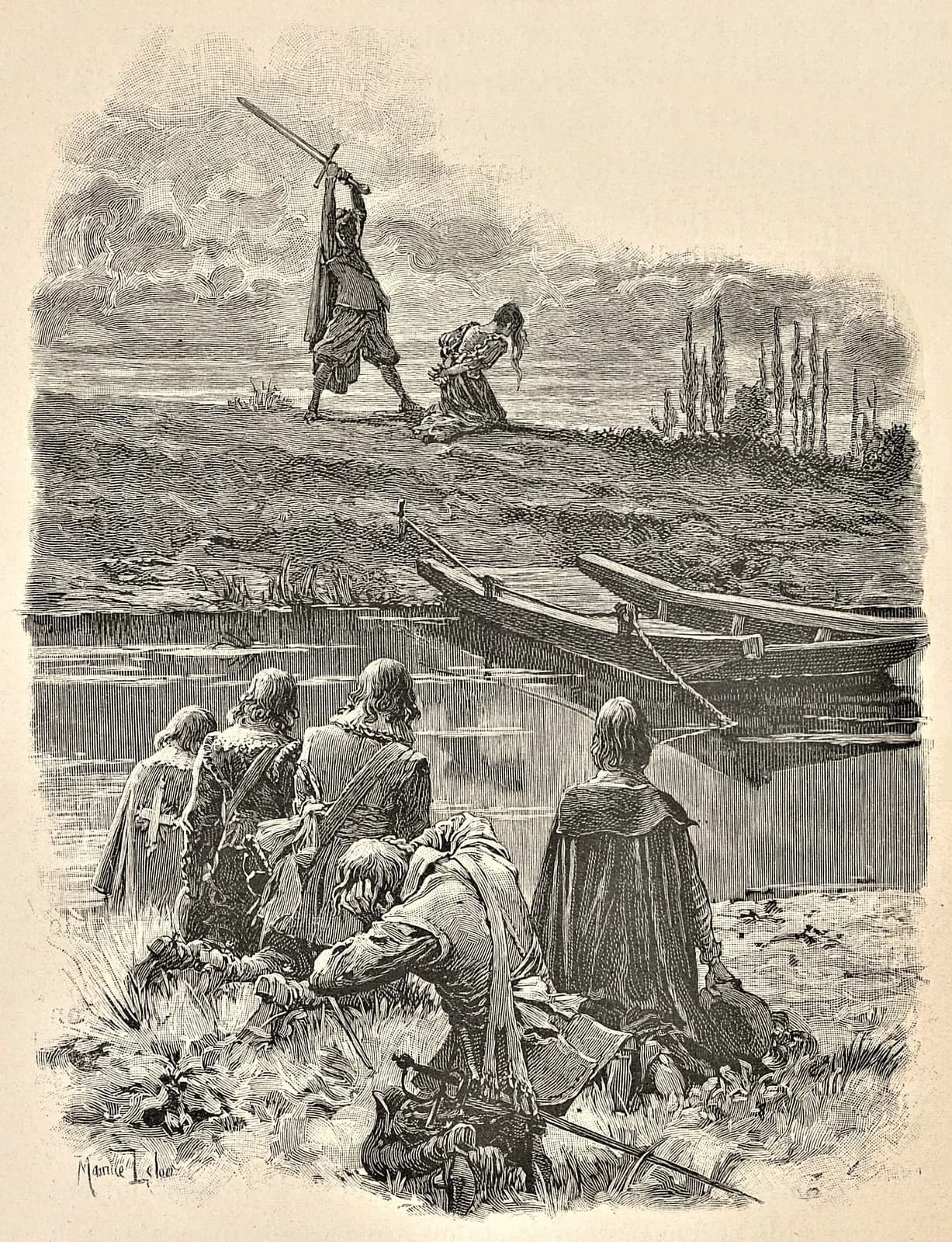
Chapter Sixty-Five of the free Gutenberg text is titled “Trial,” and the word is doing a lot of work. There is no court. The four friends, Lord de Winter and a man in a red cloak take Milady to a house by the Lys, near Armentières, and each of them states in turn what she has done to him. Athos presides. It is a hearing with no defence counsel, run by the people bringing the charges, in a country where none of them holds any judicial office.
The man in the red cloak is the point of the scene. He has been following the party since the previous chapter, and when he finally pulls the hood back Milady recognises him before anyone else does and screams his occupation twice: the executioner of Lille. He confirms it in his own words, and then produces the charge that outranks everybody else’s — she seduced his brother, a priest, ruined him, and the brand on her shoulder was put there by this man, on his own brother’s account.
- The verdict is unanimous and immediate. Each man declares death in turn and Athos passes sentence; there is no deliberation scene because Dumas does not write one.
- The executioner is a real official. He is not hired for the occasion. He holds the post at Lille and brings his own authority, which is what lets the scene call itself a trial.
- It happens across a river, deliberately. The party crosses the Lys to do it, putting the act outside the jurisdiction they started in.
Chapter Sixty-Six, “Execution,” is four pages long and almost entirely silent. She asks for a moment, she is given it, and the sentence is carried out on the far bank at night. The narration does not editorialise, which is why readers have been arguing about the chapter for a century and a half — and why that argument gets its own essay here rather than a paragraph in this one.
🗡️ The two deaths the film coverage skips
Buckingham dies first, and not in France. He is preparing a fleet at Portsmouth when John Felton, an officer with a grievance of his own that Milady has spent five chapters sharpening, is admitted to his rooms. The killing takes one sentence.
“Felton took advantage of this moment, and plunged the knife into his side up to the handle.”
Constance dies second, and hers is the one the adaptations tend to soften or move. She has been hidden in a Carmelite convent at Béthune for her own safety. Milady reaches her there, plays the friend for an afternoon, and gives her a poisoned glass; D’Artagnan and the others arrive minutes later and she dies in his arms with the convent’s door still open behind them. Later, when the crimes are read out to her face at the trial, that one is stated flatly: she poisoned Constance Bonacieux, who died yesterday evening.
The two deaths are the same mechanism seen twice. Milady never holds the knife and never holds the glass to anyone’s mouth by force. She works on Felton for five days of captivity until he does the thing himself, and she works on Constance’s loneliness and fear until she drinks willingly. Dumas gives the book’s two most consequential killings to a woman who, in both cases, is somewhere else when they happen.
The Judgment of the Lys is a doorway in the playable Three Musketeers: the hearing is yours to run, the executioner is already in the room, and you can press the charge, break it off, or let her answer. Role-play The Three Musketeers →
🎖️ What happens to the four of them
D’Artagnan is summoned by Richelieu, who has every reason to hang him and does the opposite. The cardinal takes back the blank pardon Milady once carried, writes a name into a different blank document, and hands it over: a lieutenant’s commission in the Musketeers, the rank the whole book has been about him not having. He tries to give it to each of his three friends in turn, and all three of them refuse it, which is the most characteristic thing any of them does.
The Epilogue then disposes of everyone in about two pages, and it is unsentimental to the point of comedy. La Rochelle capitulates on 28 October 1628 after a siege of more than a year. Porthos leaves the service and marries the wealthy widow he had been courting for money. Aramis travels to Lorraine, stops writing to his friends, and is later reported to have entered a convent, though nobody knows which. Athos stays a Musketeer under D’Artagnan’s command until 1633, then quits on the pretext of a small inheritance in Roussillon.
Two smaller endings are the ones that stay with people. D’Artagnan and Rochefort, who have been trying to kill each other since page one, fight three more duels; D’Artagnan wins all three, and after the third they shake hands and embrace without malice. And M. Bonacieux, the landlord whose wife has just been murdered, is careless enough to remind the cardinal that he exists. He leaves his house one evening for the Louvre and is never seen in his own street again, with the cardinal having promised he would never want for anything.
That is the ending: one execution, two murders, one promotion, and a minor character quietly disappeared in a subordinate clause. The friendship survives. The four of them end the book scattered across two provinces and a convent, which the sequels then spend twenty fictional years putting back together.
Sources
- The Three Musketeers (Project Gutenberg eBook #1257) — Project Gutenberg
- The Three Musketeers: Milady (2023 film) — Wikipedia
- Siege of La Rochelle — Wikipedia
- George Villiers, 1st Duke of Buckingham — Wikipedia
Frequently asked questions
- What happened to Milady de Winter in The Three Musketeers?
- She is tried at a house by a river and executed on the opposite bank. Dumas builds to it across three chapters, the first of which is titled “The Man in the Red Cloak” and exists purely to walk a stranger into the party without saying who he is until she recognises him.
- What happens at the end of The Three Musketeers?
- Everyone alive is dispersed in about two pages. The servants come off best of anybody: Mousqueton gets a magnificent livery and the satisfaction of riding behind a gilded carriage, and Planchet is made a sergeant in the Piedmont regiment by the man who spent the novel trying to kill his master.
- What happens to Constance in Three Musketeers?
- She is poisoned, in a chapter Dumas titles “The Drop of Water” after the method rather than the poison. She has been moved to a convent for her own protection, and the woman who finds her there spends an afternoon being kind to her first. Rescue arrives minutes too late.
- Will the Three Musketeers Milady have a sequel?
- That question is about the films rather than the book. The French production was conceived and shot as one two-part story at roughly 36 million euros a picture, and the second part concludes it; nothing beyond those two has been released. The novel does have sequels, and they are separate books.
- Who kills the Duke of Buckingham?
- John Felton, an officer of his own army, at Portsmouth. Dumas puts the date in the chapter title itself — “What Took Place at Portsmouth August 23, 1628” — which is unusual for him and signals that this part is history rather than invention. The queen refuses to believe the news for a day.
Enjoyed this one?