Is Mr Darcy a Red Flag? What Pride and Prejudice Actually Says About Him
The internet has spent a decade deciding Darcy is a warning label. Every item on the charge sheet is in Austen's text, and so is the answer to it.


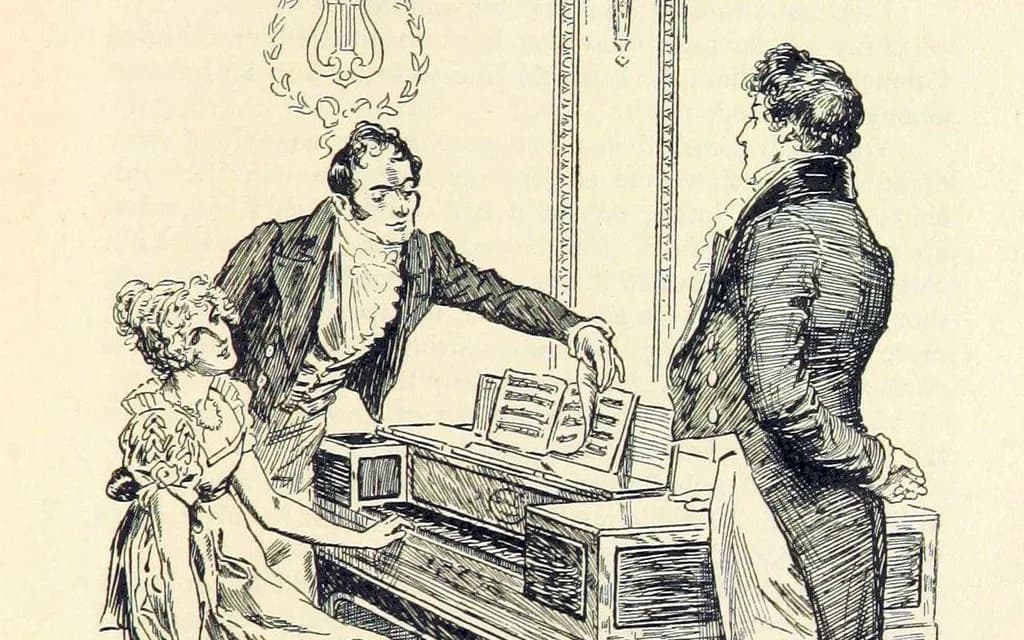
The internet has spent about a decade deciding that Mr. Darcy is a warning label. He is rude in public, he insults a woman within her hearing, he interferes in his friend's engagement, and he proposes by listing the reasons he should not want to. Every item on that charge sheet is in Austen's text. So is the answer to it, and the answer is better than either side of the argument usually allows.
- Chapter three is genuinely bad. Darcy calls Elizabeth tolerable, within earshot, and she repeats it as a joke for the rest of the evening.
- Elizabeth is never once afraid of him. Her own account of what he does to her is that it raises her courage.
- There is a real published argument. A 2023 book made the case that Darcy taught readers to romanticise coldness; a national magazine argued back within the month.
- The reading readers keep raising now. Whether Darcy reads as autistic is a live, searched question with a twenty-year paper trail behind it.
The evidence below is all Austen's, with the modern argument named and dated where it belongs. If you would rather test him yourself than read a verdict, the playable Pride and Prejudice will let you say the things Elizabeth only thinks.
🚩 The short answer: rude, yes; dangerous, no
He is unpleasant on the page for about two hundred pages, and Austen makes sure you see it happen rather than hear about it. At the Meryton assembly Bingley points Elizabeth out and tries to get his friend to dance with her. Darcy looks at her, catches her eye, looks away, and delivers the sentence the whole novel is built to answer.
“She is tolerable: but not handsome enough to tempt me; and I am in no humour at present to give consequence to young ladies who are slighted by other men.”
Austen does not soften what follows. Elizabeth is sitting close enough to hear it, and the narrator notes that she told the story afterwards, which is the detail that turns a snub into a running joke at his expense. A long stretch of the novel goes by before he is allowed to look sympathetic at all. That is a deliberate structure, and a reader who dislikes him at chapter three is reading correctly.
💬 Elizabeth is never afraid of him, and that is the point
The red-flag reading requires a woman managing a dangerous man, and that woman is not in this book. The clearest evidence sits in chapter thirty-one, at Rosings, where Darcy walks across the room and plants himself where he can watch Elizabeth's face while she plays. She sees him do it and says so, out loud, in company.
“You mean to frighten me, Mr. Darcy, by coming in all this state to hear me. But I will not be alarmed, though your sister doesplay so well. There is a stubbornness about me that never can bear to be frightened at the will of others. My courage always rises with every attempt to intimidate me.”
She is twenty years old. She tells Lady Catherine so, flatly, in chapter twenty-nine, and Darcy dates his own bad habits “from eight to eight-and-twenty,” which puts about eight years and a great deal of money between them. None of that changes how she talks to him. What Darcy does next in that scene is the tell: he laughs at himself, tells her she enjoys professing opinions that are not her own, and gets teased again for his trouble. A man who needed to be handled would not be allowed to be funny.
That is the structural answer to the question in the title. Austen wrote a heroine with no fear of him and gave her the last word in every exchange they have. A novel that wanted you to worry about Elizabeth would have written her differently.
🏛️ The character reference Austen buries in chapter forty-three
The novel does not ask you to take Elizabeth's word for Darcy, or his own. It sends her to Pemberley while he is away and puts her in front of the one witness with nothing to gain: Mrs. Reynolds, who has kept his house since he was four years old and does not know Elizabeth from any other tourist.
“I have never had a cross word from him in my life, and I have known him ever since he was four years old.”
Elizabeth's reaction to that sentence is the hinge of the second half of the novel. That he was not a good-tempered man had been her firmest opinion, and she almost stares at the housekeeper. Mrs. Reynolds keeps going anyway: he is the best landlord and the best master that ever lived, not one of his tenants or servants would give him a bad name, and the people who call him proud have mistaken a man who does not rattle away like other young men.
Austen chose her witness carefully. A servant's account of an employer is the one piece of testimony in this world that the employer cannot supervise, and Elizabeth understands that immediately, which is why it lands harder than anything Darcy has said in his own defence. Mrs. Gardiner even raises the obvious objection on the reader's behalf, that this fine account is not quite consistent with his behaviour to George Wickham, the officer whose grievance against Darcy Elizabeth has believed all winter. The answer to it arrives in chapter fifty-two, in a form nobody can argue with.
📚 The argument as it is actually being had
This is not only a comment-section debate. In 2023 the scholar Rachel Feder published The Darcy Myth: Jane Austen, Literary Heartthrobs, and the Monsters They Taught Us to Love, which argues that the brooding, withholding romantic lead Darcy standardised has done real damage to what readers expect from love. It is a serious book with a Gothic reading of Austen behind it, and it is the strongest version of the red-flag case.
Slate published the rebuttal in December of the same year, under the headline “No, Mr. Darcy isn't to blame for your bad relationships.” Chels Upton's objection there is not that Darcy is faultless; she grants that his pride is legendary enough to provide half the title. Her objection is to the premise that readers cannot tell fiction from instruction.
Both positions are worth having in your head, because Austen herself is on neither side. She gives Darcy the flaw, gives Elizabeth the speech that names it, and then makes him do the work of changing. The novel is not a recommendation and it is not a warning; it is an argument about how long it takes a proud person to hear a true thing about himself.
🧩 Why readers now ask whether Darcy is autistic
This question shows up in Google's own People Also Ask box for this topic, and it has a longer history than the search box suggests. In 2007 a speech pathologist, Phyllis Ferguson Bottomer, published So Odd a Mixture, which read Darcy and several other Austen characters as sitting on the autistic spectrum. The book reached the education press, where the National Association for the Teaching of English dismissed it as wonderfully absurd, and a books-blog rebuttal in the Guardian that spring made the general case against diagnosing fictional people at all.
Two things can be true here. Darcy's difficulty in company is written with unusual precision: he does not do small talk, he is fluent with people he knows and mute with people he does not, and he says himself that he lacks the talent of conversing easily with strangers. A modern reader recognising something in that is reading the text, not importing it.
The other true thing is that Austen had no such framework available in 1813 and cannot have written toward it. Whatever Darcy is, he is not a case study, and calling a fictional character autistic settles nothing about the character and nothing about autism. The honest position is that his reserve is drawn well enough to survive being read through a lens its author never held.
🔁 What actually changes him
One thing, and he names it himself. Elizabeth's refusal at Hunsford is the moment he later points to as the one that taught him something, and what he does about it is write it all down. The letter and its exact wording are the subject of their own essay, which quotes it properly.
Worth noticing is what the change looks like on the page. He does not become charming. He becomes useful: he answers the accusation, corrects the record, stops interfering, and then quietly does the one thing that cannot be repaid. Austen's idea of reform is behavioural, which is why it survives two centuries of readers who would otherwise have no patience for him.
The text is free at Project Gutenberg and every chapter number above was checked against it. For the structural joke Austen builds around him, his proposal has a twin, and if you want to know which screen Darcy the argument is usually about, the adaptations are compared here.
Sources
- Pride and Prejudice (1894 George Allen edition) — Project Gutenberg
- The Darcy Myth: Jane Austen, Literary Heartthrobs, and the Monsters They Taught Us to Love — Quirk Books
- No, Mr. Darcy isn't to blame for your bad relationships — Slate
- Austen's 'autistics' — Tes Magazine
Frequently asked questions
- Is Mr Darcy a red flag or a good partner?
- Austen writes him badly behaved for the first third and then makes him earn the rest. His first proposal, in chapter XXXIV, opens with the words in vain have I struggled, it will not do, and Elizabeth tells him he is the last man in the world whom she could ever be prevailed on to marry. Everything he does afterwards is corrective.
- Why was Mr Darcy so rude at the Meryton assembly?
- He arrived carrying a price tag. Chapter III says the report of his having ten thousand a year was in general circulation within five minutes of his entrance, and he then spent the evening refusing to be worth it: he danced only once with Mrs Hurst and once with Miss Bingley and declined to be introduced to anyone else.
- Is Darcy autistic in Pride and Prejudice?
- It is a reading rather than anything in the novel. Austen gives him a self-diagnosis in her own vocabulary instead: in chapter XI he tells Elizabeth his temper would perhaps be called resentful, and that his good opinion once lost is lost for ever. Phyllis Ferguson Bottomer's 2007 book So Odd a Mixture made the modern case.
- Does Elizabeth ever seem afraid of Darcy?
- No, and the last word on it is his. In chapter LVIII, after she has accepted him, Darcy tells her she taught him a lesson, hard indeed at first but most advantageous: by you, I was properly humbled. I came to you without a doubt of my reception. The novel puts the nerves on his side, not hers.
- Does anyone in the book call Darcy out to his face?
- His own cousin does. When Elizabeth asks at Rosings why a clever, well-educated man is so poor at recommending himself to strangers, Colonel Fitzwilliam answers for him: it is because he will not give himself the trouble. Darcy's reply is that he lacks the talent of conversing easily with people he has never met.
- Who argues that Mr Darcy is a bad romantic model?
- Rachel Feder made the scholarly case in The Darcy Myth (Quirk Books, 2023), and Slate published a rebuttal that December. Austen had conceded half of it two centuries earlier. In chapter XI Elizabeth tells him to his face that his defect is a propensity to hate everybody, and he replies that hers is wilfully to misunderstand them.
Enjoyed this one?