The Ending of Moby-Dick, Explained: Who Survives and How Ahab Dies
The chase runs three days, the ship goes down with everyone aboard, and one man is left floating on a coffin. Here is the machinery of how it happens.


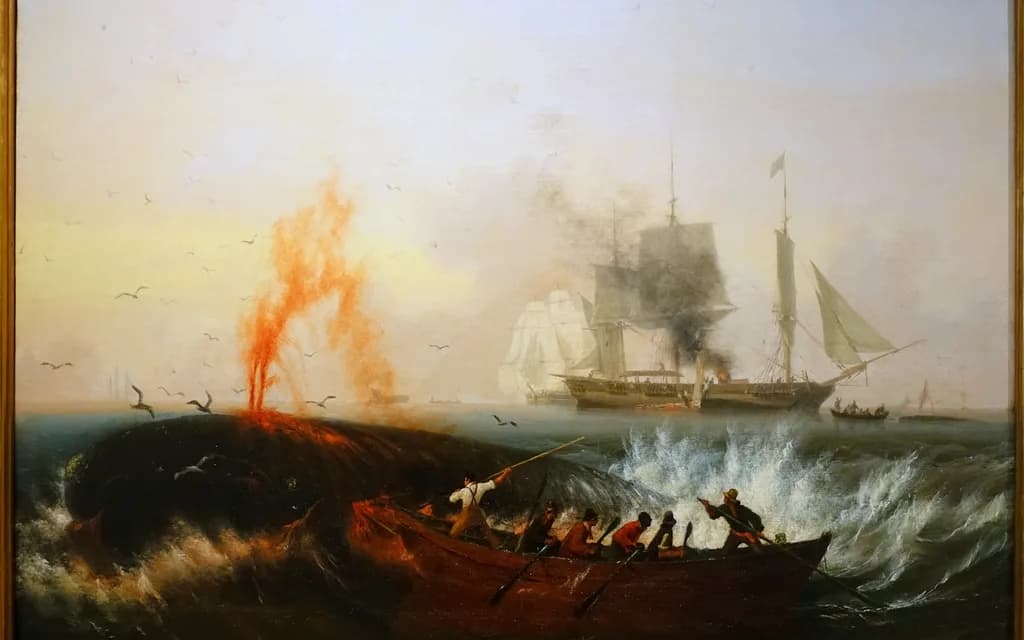
Spoilers for the last three chapters and the Epilogue of Moby-Dick.
The ending of Moby-Dick has been public property for over a century, and the book itself never treats it as a secret. The chase runs three days, the whale wins, the ship goes down with everyone aboard, and one man is left floating on a coffin. What people actually want explained is the machinery: how Ahab dies, why a corpse is strapped to the whale, and why the ship that finally picks Ishmael up is the one the Pequod had already refused to help.
- Ahab dies on day three, killed by his own harpoon line rather than by the whale directly.
- Fedallah dies on day two and reappears on day three, lashed to the whale by the ropes.
- The Pequod is rammed and sinks, and every hand except the narrator goes down with her.
- Ishmael survives on Queequeg's coffin and is picked up by a ship searching for its own lost boys.
Chapter by chapter, here is what happens. If you would rather sail into it than read the summary, the playable Moby-Dick stages the final chase as its own scene, with the outcome still open.
🌊 The three-day chase, day by day
Chapters 133, 134 and 135 are titled The Chase and numbered like rounds of a fight, and each day costs Ahab something he cannot replace.
On the first day the whale is raised by Ahab himself, the boats lower, and Moby Dick takes the bow of Ahab's boat in his jaws and shakes it the way a cat plays with a mouse before biting it in two. Nobody dies. The crew are pulled out of the water and the hunt resets.
On the second day the whale comes up under all three boats at once and scatters them. Ahab is hauled aboard the Pequod with his ivory leg splintered to pieces, and stands at the rail cut down to the stump, leaning on a shivered lance. Then the crew is mustered and someone notices that Fedallah, the harpooneer Ahab brought aboard privately, is not there.
On the third day the whale is sighted again, the boats go down again, and this time Moby Dick turns away from them and goes for the ship.
🪝 How Ahab actually dies
By rope, not by whale, and the book set that up eighteen chapters earlier. In Chapter 117 Fedallah gives Ahab three conditions: two hearses must be seen before he can die, the first of them not made by mortal hands; Fedallah will go before him as his pilot; and, as a final pledge, hemp only can kill him.
Ahab hears the last one as a joke about the gallows and declares himself immortal on land and on sea. Hemp is what whale-line is made of. On the third day Ahab throws his last harpoon at a whale already carrying the ropes of the two previous days, and the line does what fouled line does.
“The harpoon was darted; the stricken whale flew forward; with igniting velocity the line ran through the grooves;—ran foul. Ahab stooped to clear it; he did clear it; but the flying turn caught him round the neck, and voicelessly as Turkish mutes bowstring their victim, he was shot out of the boat, ere the crew knew he was gone.”
It takes one sentence and nobody in the boat sees it happen. The captain who spent a novel insisting on a personal quarrel with an animal is removed from the story by a mechanical accident of his own trade, silently, with his back turned. He gets a last speech before the throw, and no death scene at all.
Melville declines to say what the whale wants. Moby Dick is given one reason for going at the ship, that he seems to see in it the source of all his persecutions, and no motive beyond it; whether that reads as vengeance or as an animal defending itself for a third day is left open, and the case that he never starts anything is argued elsewhere in this series.
The crew get better deaths than he does, and Melville gives each of the officers a last line while the whale is bearing down. Starbuck, who has spent the book being right, says only that this is Ahab's work and asks God to stand by him. Stubb, who has spent the book laughing, keeps laughing: he tells the whale he grins at it, decides to die in his drawers, and finishes by asking for one red cherry before the end. Flask answers him with the smallest sentence in the disaster, hoping his mother has already drawn his part-pay, because the voyage is up and few coppers will reach her now.
The ship goes first. Moby Dick strikes the Pequod head on and she fills and sinks, and the last thing above water is the mainmast with Tashtego still on it, hammering the flag to the spar as it goes under. A sky-hawk that had been pecking at the flag gets its wing caught between the hammer and the wood, and is nailed there, and drowns with the ship. Then the sea closes and Melville ends the chapter by saying it rolled on as it rolled five thousand years ago.
👤 What happened to Fedallah, and the prophecy
Fedallah vanishes at the end of day two and is never seen alive again. On day three, as the whale rolls past the boats showing one flank, the crew see him: his half-torn body lashed round and round to the whale's back by the coils of the previous days' harpoon lines, his sable raiment in shreds, his eyes turned on Ahab.
Ahab reads it correctly, which is the horror of it. He has just been told he cannot die until he sees two hearses, the first not made by mortal hands, and here is a corpse borne on the back of a whale, going before him exactly as promised. His words are that this is the hearse Fedallah promised, and then he asks where the second hearse is.
The second hearse is the Pequod. Fedallah's terms in Chapter 117 were specific: the first hearse would not be made by mortal hands, and the visible wood of the last one must be grown in America. A corpse carried on a whale's back satisfies the first. An American-built ship, going down within the hour, satisfies the second. Every term of the prophecy is honoured and every term of it was heard wrong. Fedallah told him he would die by hemp and Ahab heard a promise of immortality, because the only rope he could imagine killing him was one held by a hangman.
🛟 How Ishmael survives
On a coffin, and the coffin was built for someone else. Earlier in the voyage Queequeg had a fever, ordered a coffin shaped like the dark wooden canoes his own people are buried in, then changed his mind about dying and left the box on deck; that whole scene belongs to the friendship it comes out of.
The conversion happens in Chapter 126, after the Pequod loses her actual life-buoy over the stern, and Ahab tells the carpenter to caulk the coffin, seal it and hang it in its place. Starbuck recoils at the phrase. The carpenter does the work while complaining that he is now sailing about with a graveyard, which is the last comic line in the novel and also a stage direction: the object that saves the narrator has been sitting in plain sight, rigged over the rail, for nine chapters. Ishmael is in the water because he was thrown from Ahab's boat before the end, so he watches the ship go down from outside the vortex. The suction pulls him in slowly, and at the centre of the closing whirlpool the sealed coffin breaks loose from the wreck below and shoots up beside him.
Melville takes his time over those few seconds, and the image he chooses is a wheel. The whirlpool has subsided to a creamy pool by the time it reaches him, and he circles inward towards a black bubble at the axis, turning, he says, like another Ixion, the figure from Greek myth bound for eternity to a spinning wheel. Then the bubble bursts and the coffin comes up. The novel's one survivor is saved by the buoyancy of a sealed box at the exact moment he is compared to a man condemned to revolve forever.
“Buoyed up by that coffin, for almost one whole day and night, I floated on a soft and dirgelike main. The unharming sharks, they glided by as if with padlocks on their mouths; the savage sea-hawks sailed with sheathed beaks.”
On the second day a sail comes up. It is the Rachel, and the Rachel is the ship the Pequod met in Chapter 128, whose captain came aboard to beg Ahab for help searching for a missing whaleboat with his own son in it. Ahab refused and sailed on. She is still quartering the same water, still looking for her own children, and what she finds instead is Ishmael.
The Epilogue is one page long and it opens with a line from the Book of Job: and I only am escaped alone to tell thee. Every one of the four narrators in that verse is a servant bringing Job news of a disaster he survived by accident. Melville puts it at the top of a chapter that exists to explain how a first-person novel can have a narrator when everybody dies.
The full 1851 text is free at Project Gutenberg, and the three chase chapters plus the Epilogue run about thirty pages. If you want the argument about whose fault all of this was, the case against the captain is here.
Sources
- Moby Dick; Or, The Whale (1851), full text — Project Gutenberg
- Moby-Dick — Wikipedia
Frequently asked questions
- Does anyone survive the sinking of the Pequod?
- One man. The Epilogue exists to explain how a first-person novel can have a narrator when the whole crew drowns, and it does so with an accident of rostering: after the Parsee disappeared, Ishmael was the man moved into the vacant place as Ahab's bowsman, which is why he is thrown out of the boat before the end rather than going down with the ship.
- How does Ahab die in Moby-Dick?
- His own harpoon line kills him. He darts, the line runs foul in the grooves, he stoops and clears it, and the flying turn catches him round the neck and pulls him out of the boat before the crew notice. Melville then follows the rope: the heavy eye-splice at its end whips out of the empty tub, knocks down an oarsman and disappears into the sea.
- What happened to Fedallah, the Parsee?
- He drowns on the second day of the chase, tangled in the harpoon lines, and only the crew's guesswork covers the gap: Stubb says he thought he saw the man dragged under, caught among the tangles of the captain's own line. On the third day the body reappears, lashed to the whale's flank by the same ropes, exactly as his prophecy promised.
- Why does the Rachel rescue Ishmael?
- Because she is still looking for her own. Her captain had come aboard the Pequod days earlier to beg Ahab for help searching for a lost whaleboat with his young son in it, and Melville notes that a second son of his was also among the missing crew. Ahab refused. The Rachel was still quartering that water when she found the survivor of his ship.
- What is the last line of Moby-Dick?
- The Epilogue ends on the ship that finds him: it was the devious-cruising Rachel, that in her retracing search after her missing children, only found another orphan. The chapter opens with a line from the Book of Job, and I only am escaped alone to tell thee, spoken in that book by servants bringing news of disasters they survived by chance.
Enjoyed this one?