Is Captain Ahab the Villain of Moby-Dick, Not the Whale?
The whale gets the title and does almost none of the choosing. Every violent thing he does happens inside a hunt already aimed at him.


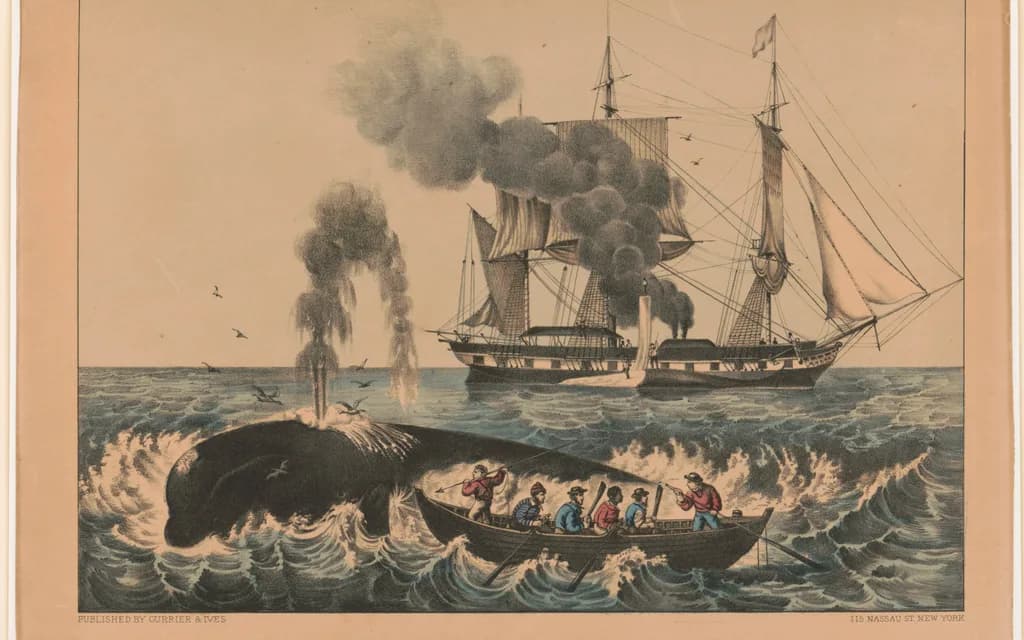
The whale gets the title, the poster and the reputation, and does almost none of the damage. Across the whole novel Moby Dick never once seeks out the Pequod. Every violent thing he does happens inside a hunt already aimed at him, usually with harpoons in his back, and the book is unusually careful about that order of events.
The order matters, because it is what turns a monster story into something harder. If the whale never starts it, the reader has to look at who does.
- Ahab lost the leg while attacking, knife in hand, in a boat he had already lost. Chapter 41 says so plainly.
- He converts a commercial voyage into a private hunt in Chapter 36, and pays the crew in advance with a gold coin.
- His first mate calls it blasphemy to his face in the same scene, and keeps sailing anyway.
- The whale answers persecution. Even the ship is rammed only on the third day of the chase.
Here is what the text actually supports, chapter by chapter. If you would rather argue it with him than read about it, the playable Moby-Dick puts you on the quarter-deck while the oath is still being sworn.
🐋 What the whale actually does
He defends himself, spectacularly, and only when hunted. Chapter 41 collects everything the fishery says about Moby Dick, and the signature move in every account is the same: when swimming ahead of his pursuers he turns round suddenly and bears down on the boats. That is a response to a chase, not the opening of one.
Nothing in the book gives him a record of hunting ships on his own account. The reputation is built out of that turn, and the language the fishery uses for it does a lot of work. Ishmael reports an unexampled, intelligent malignity, an infernal aforethought of ferocity, and treacherous retreats. Read the same behaviour without the adjectives and you get an animal that has learned what a whaleboat is and stopped running in a straight line. Every witness in that chapter is a man who was trying to kill him at the time.
The same chapter tells you how Ahab lost the leg, and it is not the story the reputation implies. Three boats were already stove and men were in the water when one captain seized a line-knife from his broken prow and went at the whale with a six-inch blade. That captain was Ahab. The whale swept his lower jaw beneath him and took the leg the way a mower takes grass.
The final chase keeps the pattern. Moby Dick spends three days being harpooned before he turns on the Pequod at all, and when he does, Melville gives you his reason in the sentence itself: he catches sight of the black hull and seems to see in it the source of all his persecutions. Whatever that is, it is not the stalking of one captain: he goes for the thing that keeps sending boats at him.
🎣 Ahab explains himself, once
Chapter 36 is the whole case in one scene. Ahab calls the crew aft, holds up a Spanish ounce of gold, tells them it is a sixteen dollar piece, and nails it to the mast for whoever raises the white whale first.
The men cheer. He has just spent an owner's ship and an owner's wages on an errand of his own, and he buys the crew's consent with sixteen dollars in front of witnesses. Then Starbuck objects, and Ahab does something he does nowhere else in the novel: he explains.
“All visible objects, man, are but as pasteboard masks. But in each event—in the living act, the undoubted deed—there, some unknown but still reasoning thing puts forth the mouldings of its features from behind the unreasoning mask. If man will strike, strike through the mask! ... To me, the white whale is that wall, shoved near to me.”
Read it slowly and the whale disappears from Ahab's own argument. He describes no animal with a history of assaults. What he describes is a barrier between himself and whatever sits behind the visible world, and the whale happens to be the piece of that barrier he can reach with iron. He says as much two sentences later: be the white whale agent, or be the white whale principal, he will wreak that hate upon him. Either will do, which makes the animal interchangeable.
The scene ends in ritual, and the staging is worth noticing because Ahab designed it. He calls for the great measure of grog, orders the mates to cross their lances in front of him and grips them where they meet, has the harpooneers detach the iron heads from their harpoons, and makes the three of them drink from the empty sockets. Drink and pass, he says, and the crew swears the oath out of the sockets of the weapons they will use. It is a communion service with the sacrament served in murder weapons, and every man aboard takes it.
That is the sentence that decides the villain question for most readers who get to it. A man avenging an injury has a target. A man who will accept an agent or a principal, indifferently, has a need.
⚖️ Starbuck says it to his face
The strongest argument against Ahab in the whole novel is not a modern reading. It is his own first mate, in the same chapter, in front of the crew.
“Vengeance on a dumb brute! ... that simply smote thee from blindest instinct! Madness! To be enraged with a dumb thing, Captain Ahab, seems blasphemous.”
Starbuck has the case complete by page 160 of a 600-page book: the animal acted on instinct, the grievance is imaginary, and pursuing it is a sin against the trade and against God. He is also a Quaker officer with a wife and a child at home, which is what makes the next part hard to watch. He states the objection, is overruled, and sails on.
Ahab beats him without answering the argument, which is the tell. He tells Starbuck that his one tossed sapling cannot stand up in the general hurricane, then turns to the deck and asks whether the crew stands one and all with him in this matter of the whale. They roar that they do. The objection was never going to be settled on its merits. It was going to be outvoted by a crew who had just watched a gold coin go up on the mast with their names on it.
Melville gives him one more chance, much later, and makes it worse. In Chapter 123 Starbuck stands outside the captain's cabin at night with a loaded musket in his hands, the same musket Ahab once pointed at him, and Melville writes that an evil thought strangely evolved out of that honest heart. He puts the gun back. Everyone who dies later dies after that moment.
🧭 So is Ahab evil, or is he damaged?
The book keeps both readings alive, and the evidence for damage is more physical than most summaries admit. Chapter 106 records that shortly before the Pequod sailed, Ahab was found face down and unconscious on the ground: the ivory limb had been driven back into him hard enough to all but pierce his groin, and the wound was cured only with extreme difficulty.
He boards the ship in pain that nobody on deck can see. There is also a set of victims the villain question usually forgets, and they are on shore. The Pequod belongs to two elderly Quakers, Peleg and Bildad, who appear in Chapter 16 doing the least sinister thing in the book: haggling over what share of the profits a green hand is worth, one offering Ishmael the three hundredth lay and the other holding out for the seven hundred and seventy-seventh. They are pious, comic and careful with money, and they have financed a voyage that will not be hunting for oil. Nobody tells them.
Against that, the novel puts his competence. Ahab is not raving. He navigates, he reads currents and whale migrations, he times a season, he forges a harpoon and tempers it, and he manages a crew of thirty men across two oceans while concealing his purpose from the owners who paid for the voyage. Whatever monomania is in the book, it is not a loss of the ability to plan.
Which leaves the reader roughly where Starbuck is: certain the errand is madness, unable to prove the man is mad. Melville never uses the word villain about him, and never lets him off either. The one judgment the book delivers, it delivers in the last three chapters, where the arithmetic of who dies is laid out plainly.
The full 1851 text is free at Project Gutenberg, and Chapter 36 is nine pages. If you are wondering whether the whale is supposed to mean something, the book spends a whole chapter refusing to say.
Sources
- Moby Dick; Or, The Whale (1851), full text — Project Gutenberg
- Moby-Dick — Wikipedia
Frequently asked questions
- Is Moby Dick, the whale, evil?
- The novel never says so in its own voice. Melville even devotes Chapter 45 to arguing that whales sinking ships is a documented hazard of the trade rather than a supernatural event, and lists real cases to prove it. The malice belongs to the hunters' accounts of the animal, and above all to the man hunting him.
- Why does Ahab hate the whale so much?
- Because the whale took his leg, and because he has decided that the injury means something. The crew's version of the event is casual: an old shipmate says only that the captain was dismasted off Japan, and that the ivory limb he stumps around on was carved at sea from the jawbone of a sperm whale. Ahab turns that into a case against the universe.
- Does Starbuck ever try to stop Ahab?
- Repeatedly, and he gets closest the day before the chase begins. In Chapter 132 Ahab stands at the rail and tells him that in forty years of whaling he has not spent three of them ashore, and that he widowed his own wife by marrying her. Starbuck begs him to steer for Nantucket. Ahab turns away and the hunt goes on.
- Which of Ahab's legs did the whale take?
- The book never says. Across 135 chapters Melville describes the ivory limb, the pivot-hole drilled in the deck for it, the way it clatters, and the wound it later reopens, without ever committing to left or right. Illustrators and film-makers have had to pick one, which is why different versions of Ahab limp on different sides.
- What does monomania mean in Moby-Dick?
- It was a nineteenth-century term for a mind sane in every respect but one, and Melville applies it to the captain rather than to the whale. He calls Moby Dick the monomaniac incarnation of the malicious agencies Ahab feels eating at him, and in the chase itself he simply writes monomaniac Ahab, as if it were a rank.
Enjoyed this one?