What Does the White Whale Symbolize in Moby-Dick? The Book Refuses to Pick
Study guides answer with a menu: nature, God, evil, the void. Every item can be supported from the text, which is the first clue that the question is wrong.


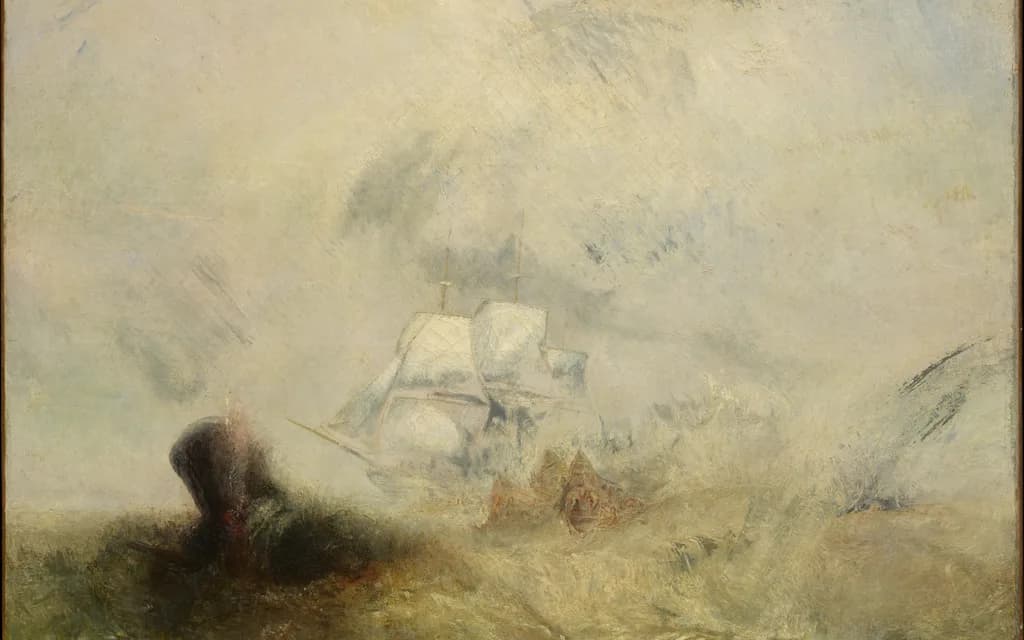
Study guides answer this question with a menu. The white whale stands for nature, or God, or the unknowable, or evil, or the void, or the blank page, or America. Every item on the menu can be supported from the text, which should be the first clue that something is off about the question.
Melville devotes an entire chapter to the colour, and spends most of it arguing the opposite case from the one the menu expects.
- Chapter 42 opens with a confession,not a thesis: the horror is “vague” and “nameless” and he almost despairs of putting it into words.
- Most of the chapter argues the opposite case, listing cultures where white means majesty, justice and holiness.
- The book does this on purpose elsewhere too: in Chapter 99 seven men read seven meanings off one gold coin.
- The modern idiom is a loan. Inside the novel the phrase always means an actual animal.
Here is what the chapter actually contains, why the monster reading keeps coming back, and where the modern phrase comes from. If you would rather test a meaning than be handed one, the playable Moby-Dick lets you stand at the try-works and say what you see.
🕯️ What Chapter 42 actually says
It opens by separating the whale from his colour. The obvious reasons to fear Moby Dick have been dealt with already, Ishmael says, and what remains is something else.
“It was the whiteness of the whale that above all things appalled me. But how can I hope to explain myself here; and yet, in some dim, random way, explain myself I must, else all these chapters might be naught.”
That sentence is doing two jobs. It states the subject, and it warns you that the writer is about to fail at it in public. Every reading of this chapter that comes back with a tidy symbol has quietly skipped the second half.
What follows is stranger than the study guides let on, because most of it argues the case against horror. Ishmael assembles a small anthology of whiteness as glory: the kings of Pegu who ranked Lord of the White Elephants above every other title, the snow-white charger on the Hanoverian flag, the imperial white of Austria, the Roman white stone that marked a joyful day, the ermine of a judge, the white belt of wampum given as the deepest pledge of honour, the Persian fire worshippers holding the white flame holiest, Jove taking the shape of a snow-white bull, the Iroquois sending a sacred White Dog as their purest envoy.
Only after building that case does he turn it over and ask why the same colour, in a shark, an albatross, a corpse or a whale, produces dread. His two exhibits are the white bear of the poles and the white shark, and his argument about them is precise. Neither animal frightens him merely for being dangerous, since plenty of dangerous creatures produce nothing like this particular dread. The whiteness heightens the fear rather than causing it, the way a pale surface makes whatever is under it worse.
This is why the study-guide menu is both correct and useless. Nature, God, the unknowable, evil, the void: each of those readings can be built out of real sentences, because the chapter was assembled to make each of them buildable. Ishmael never offers a thesis with supporting evidence. He shows a reader what it feels like to have an overwhelming reaction and no account of it, then hands over the whole pile of material he tried to explain it with.
He never resolves the two halves. The chapter ends with the question intact, which is the most honest thing in the book about meaning.
The refusal is not confined to Chapter 42, either. Thirteen chapters later Melville spends three chapters proving that nobody has ever managed to draw a whale correctly, and concludes that the great Leviathan is the one creature in the world which must remain unpainted to the last, and that there is no earthly way of finding out precisely what the whale really looks like. The only artist he half exempts is a French painter of whaling scenes whose name he spells Garnery, and even there the compliment is that the man must have been either a whaleman himself or very well taught by one. A book that cannot settle what its animal looks like is unlikely to settle what he means.
🐋 Is it a monster, or just a big animal?
Readers keep arriving at this from the monster direction, and the question has more textual support than a literature seminar usually admits. Is Moby Dick a monster in the modern sense, a creature of a scale that makes human intention irrelevant? The novel is not neutral on this. It uses the word Leviathan 122 times.
The reputation for stopping anything to deliver whale facts is earned, and this is where the facts start doing argumentative work instead of filling pages; the sixteen chapters you can genuinely skim are listed here, and Chapter 42 is not one of them.
Chapter 82 goes further and enrols the whale in mythology on purpose. Perseus, Ishmael claims, was the first whaleman, and the thing he harpooned off Andromeda's rock was Leviathan. Jonah, Hercules and Vishnu follow. The chapter is a joke about professional pride, and it works only because the reader already half believes that whales belong in that category.
Against that, the novel keeps handing you the plain animal. Chapter 41 describes Moby Dick by his markings, a snow-white wrinkled forehead and a high pyramidical hump, and notes that the name White Whale is literally justified by how he looks at noon in a dark blue sea. His famous malignity arrives with a qualifier: it is what the fishery reports of him, according to specific accounts, in the middle of hunts. Whether that adds up to intent is left to you, and the case that the whale never starts anything is here.
The book runs this experiment openly one more time, in Chapter 99. A gold coin is nailed to the mast and seven men walk past it. Ahab sees himself in it, Starbuck sees the Trinity, Stubb sees the zodiac and a joke, Flask sees a number of cigars, Queequeg compares it to his own tattoos, Fedallah bows to the sun stamped on it, and Pip conjugates the verb to look. Same coin, seven readings, no adjudication. That is the same move as Chapter 42, done in miniature and with the seams showing.
🗣️ Where the “white whale” idiom comes from
The modern sense is a loan from the novel, and it is not in the novel. The phrase white whale appears about a hundred times in Melville's text and every single instance means a whale that is white. Nobody in the book uses it the way a collector or a salesperson uses it now.
The figurative sense is a later borrowing, and dictionaries mark it that way: Wiktionary lists the literal beluga first, then gives an obsession, a monomania, and says outright that the figurative senses refer to Melville's 1851 novel. The word monomania is itself lifted from the book, where Melville uses it about Ahab rather than about the whale.
That drift matters more than it looks, because the modern idiom quietly settles the question the book left open. Calling a rare record or an unclosable deal your white whale means the pursuit is the point and the object is arbitrary. It is Ahab's reading, not Ishmael's: the thing itself has no meaning and the wanting supplies all of it. A century and a half of using the phrase casually has made Ahab's answer sound like the book's answer.
Melville does something more interesting than that. He gives you an animal that is genuinely white, a narrator who cannot explain why the colour frightens him, a captain who fills the gap with a private meaning, and a whole crew who each fill it differently. The whale is the empty space in the middle, and everyone on the ship builds something in it.
The full 1851 text is free at Project Gutenberg, and Chapter 42 is about thirteen pages. If you are still deciding whether the surrounding six hundred are worth it, here is which chapters you can skim.
Sources
- Moby Dick; Or, The Whale (1851), full text — Project Gutenberg
- white whale — Wiktionary
- Mocha Dick — Wikipedia
- Moby-Dick — Wikipedia
Frequently asked questions
- What does the white whale symbolize in Moby-Dick?
- Whatever the reader supplies, which the book treats as the point rather than as a dodge. Ahab gives the clearest demonstration in Chapter 36, when he says that whether the white whale is the agent or the principal makes no difference to him and he will wreak his hate on it either way. The meaning is imposed, not discovered.
- Why is Chapter 42 called The Whiteness of the Whale?
- Because the chapter is about the colour rather than about the animal. Ishmael tests the effect on other white things to see whether the dread survives the change of subject: an albatross seen at sea, and the White Steed of the Prairies, a milk-white horse that the plains tribes regarded with awe. He concludes that the colour itself is doing the work.
- Where does the phrase 'white whale' come from?
- From this novel, but not from anything inside it. The phrase appears about a hundred times in Melville's text and always means an animal that is white; the sense of an obsessive, unreachable target is a later borrowing that dictionaries trace back to the book. Wiktionary lists a second figurative sense too: a sports-card printing plate that is itself issued as a collectible.
- Is Moby Dick a monster or an animal?
- Melville describes him as an animal and lets other people supply the monster. Chapter 41 identifies him by a snow-white wrinkled forehead, a high pyramidical hump and a deformed lower jaw, which is the jaw that does the damage; everything supernatural about him arrives second-hand, in what the fishery says. Whether that adds up to malice is argued on its own terms elsewhere in this series.
- Was Moby Dick a real whale?
- A real whale contributed to him. Wikipedia names Mocha Dick, an albino sperm whale usually encountered near Mocha Island off the central coast of Chile, as part of the inspiration for the novel; a contemporary account called him white as wool. The book's other source is the loss of the whaleship Essex in 1820.
Enjoyed this one?