Treasure Island Ending Explained: What Happens to the Treasure
The treasure hunt fails, the treasure is recovered anyway by a route nobody planned, a large part of it is left on the island forever, and one man walks off with a fraction of it. The precise accounting, from the empty excavation to what becomes of everyone afterwards.


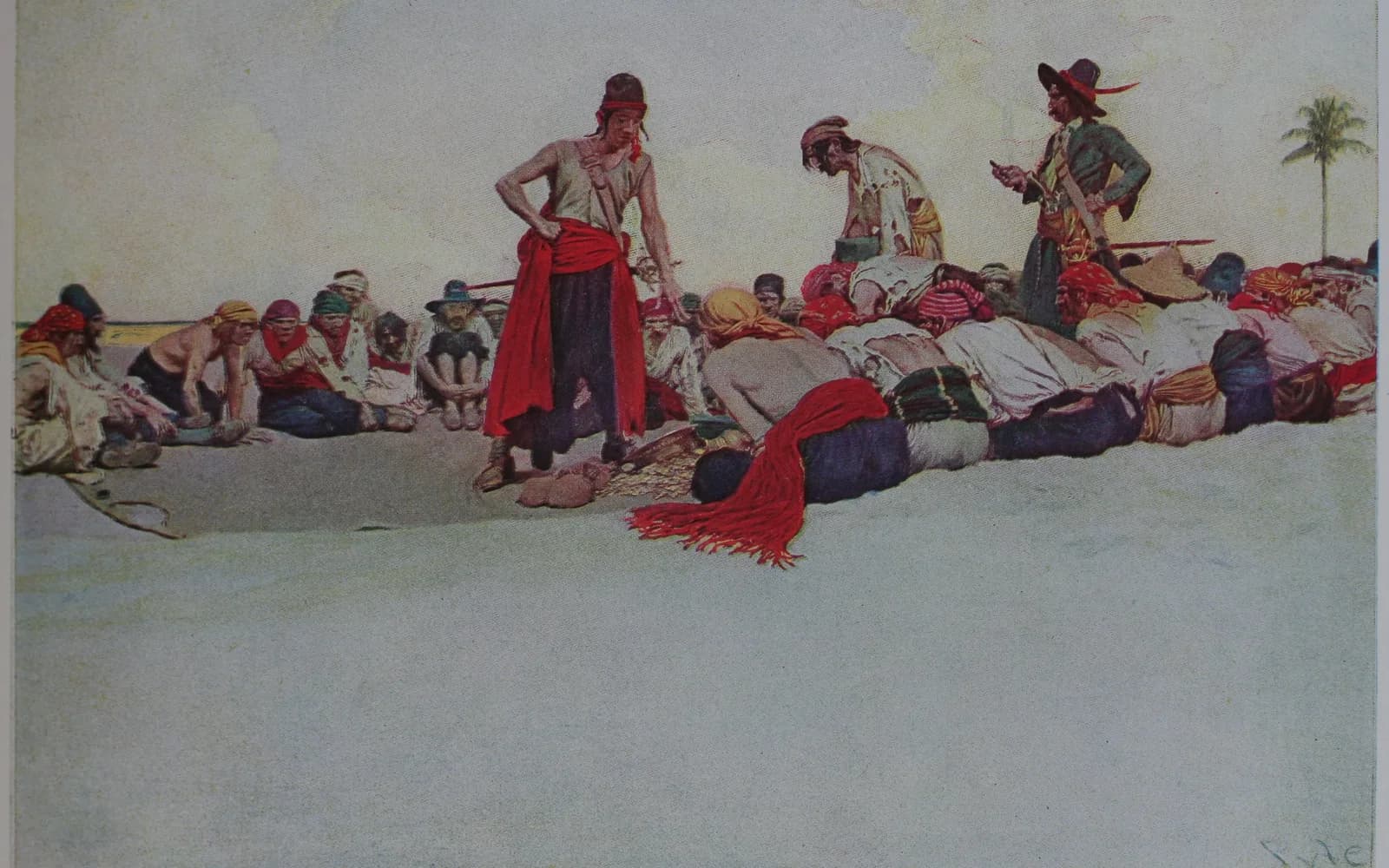
Spoilers for the whole novel, including the excavation, the division of the money and what becomes of everyone afterwards.
The question people actually arrive with is narrower than “how does it end.” It is: does anybody get the gold, and does the sea-cook get away with it. Both have exact answers in the text, and both are more interesting than the versions most readers carry around from films.
The short form is that the treasure hunt fails, the treasure is recovered anyway by a route nobody planned, a large part of it is left on the island forever, and one man walks off with a fraction of it. The same climb to the cache is a doorway in the playable Treasure Island, where you stand in the pit while the digging party works out what it is looking at.
⛏️ The excavation is already empty
The climax of the treasure hunt is an anticlimax, and Stevenson stages it deliberately. The digging party arrives at the spot the chart marks, and what is in front of them is a hole somebody else dug a long time ago, its sides already slumped and grown over. A broken pick and a few packing boards lie in the bottom. That is the entire haul.
“Before us was a great excavation, not very recent, for the sides had fallen in and grass had sprouted on the bottom.”
The gold is not lost. It was moved by the marooned man on the island, who found the cache during his three years alone and shifted the whole hoard to a cave on the far side, a sack at a time, on his own back, across dozens of walks. The novel gives this away with almost no ceremony, in a short retrospective paragraph after the fighting stops, which is characteristic: the most consequential act in the plot happens entirely offstage, performed by the character everyone treats as a lunatic.
The stated size of the hoard is seven hundred thousand pounds, a figure the mutineers repeat to each other like a charm on the way up the hill. It is worth holding that number next to what actually gets carried home, because the gap between them is the novel’s real verdict on treasure hunting.
💰 What comes home, and what stays buried
Three days of ferrying get the coin aboard the schooner. It is a huge quantity of money and a genuinely tedious job, described as such, with the narrator sorting English, French, Spanish and Portuguese pieces by hand and enjoying it more than any of the fighting.
What does not come home is the rest of it. The hoard included bar silver and a cache of arms, and both are left where they were buried, because the party is short-handed, the ship needs to sail, and nobody wants to spend another week on that island. The narrator closes the book by saying they are still there as far as he knows, and that nothing would induce him to go back for them.
“The bar silver and the arms still lie, for all that I know, where Flint buried them; and certainly they shall lie there for me.”
That is an unusual ending for an adventure story about buried treasure. The map worked, the expedition succeeded, and the narrator’s final position on the whole enterprise is that the remainder can rot. He says the worst dreams he has are still of the surf on that coast.
🏃 Silver leaves with one sack, not the gold
On the voyage home the party puts in at a port in Spanish America for hands, and while the others are ashore the sea-cook goes. The marooned man let him out in a shore boat and admits it afterwards, arguing that keeping him aboard would have cost somebody a life, which is not an unreasonable reading of the situation.
He does not leave empty-handed, and he does not leave rich. He cut through a bulkhead and took a single sack of coin, worth perhaps three or four hundred guineas, and that is the whole of his share. The narrator’s comment on this is one line long and says the party was pleased to be rid of him so cheaply.
So the answer to the recurring question is no. He gets a bag of money and a head start, not the treasure, and the book never tells you what he does with either. The last page gestures at a quiet life somewhere with an old companion and declines to confirm it, and whether that ending is a reward or a shrug is the argument taken up in the piece on whether Silver is a villain.
🏝️ The three men left alive on the island
Three mutineers survive the fighting and are still on the island when the schooner sails. They are not hanged, not shot and not taken home. The party leaves them there on purpose, and the reasoning is set out plainly: carrying them back to England means carrying them back to a gallows, and risking another rising on a short-handed ship is a poor trade.
- They are given stores. The doctor calls across the water to tell them where the powder, shot, tools and medicine were left for them. It is not an abandonment without provision, and the book is careful to say so.
- They beg.All three are on their knees on a sandspit with their arms up as the ship comes past, calling the crew by name, and the narrator says it went to everybody’s heart to keep going.
- One of them shoots. As the ship draws out of earshot, a man puts a musket to his shoulder and sends a ball over the deck and through the mainsail. Nobody is hit, and that is the last the reader sees of them.
This is the novel’s quietest piece of moral bookkeeping. The rescue party is not gentle, the mercy is calculated, and the men who receive it respond with a musket. Stevenson does not tell you how to feel about any of it.
⚓ What happens to everyone afterwards
The schooner reaches Bristol with five of the men who sailed in her still alive. The final chapter then spends a single paragraph on the rest of their lives, and the paragraph is funnier and sadder than the adventure it closes.
- The captain retires. He is done with the sea, which for the most professionally competent man in the book reads less like a reward than like a resignation.
- The one honest sailor rises. The crewman who left the mutineers and came over to the loyal party saves his money, studies his trade, and ends up mate and part owner of a ship, with a wife and children. He is the only person in the novel whose fortune is made by work rather than by a map.
- The marooned man loses everything. He is given a thousand pounds, spends or loses it in nineteen days, and is provided with a lodge to keep, the exact fate he had spent three years on an island dreading.
The narrator himself never states his own share. He says only that everyone had an ample one and used it according to their natures, which is the closest the book comes to a moral, and it is aimed at the reader rather than at any character. The complete text is free at Project Gutenberg if you want the last chapter in full.
Sources
- Treasure Island (Project Gutenberg #120) — Project Gutenberg
Frequently asked questions
- Does Jim get a share of the treasure?
- The novel never gives a figure for his cut. It says only that "all of us had an ample share of the treasure and used it wisely or foolishly, according to our natures," and then follows three other characters' fortunes instead of his. Any specific sum you have seen for Jim's share was invented somewhere else.
- Does Long John Silver escape with all the gold?
- No. He takes one sack of coin, worth perhaps three or four hundred guineas, and the rest of the recovered money goes home with the expedition. He slips away at a port on the voyage back, while the expedition's agent, Mr. Blandly, is still at home wondering whether to fit out a second ship and go looking for them.
- What happens to Jim's father in Treasure Island?
- He dies of a wasting illness in the opening chapters, unconnected to any pirate. The novel calls it a decline that took him off. Treasure Planet, Disney's science-fiction version, changes this: there the father walks out on the family, and Silver is written into the gap as the father figure Stevenson never makes him.
- Do the mutineers get punished at the end?
- No. Three survive and are left alive on the island on purpose. The narrator's phrase for the alternative is that carrying them home for the gibbet "would have been a cruel sort of kindness." The doctor shouts across the water to tell them where the stores were left, and one of them fires a musket after the ship anyway.
- What does Ben Gunn do with his share of the treasure?
- He is given a thousand pounds and it is gone in nineteen days. The novel is exact about it: he was "back begging on the twentieth." He is then given a lodge to keep on the squire's land, the fate he had spent three years on the island dreading, and ends up a well-liked local fixture and a notable singer in the church choir.
Enjoyed this one?