Did Treasure Island Invent Modern Pirate Lore?
The black spot, the treasure chart, the parrot and the shanty are not history Stevenson collected. Several are things he invented outright. Three famous pirate props are not in the novel at all, and the rolling pirate voice arrived sixty-seven years after it.


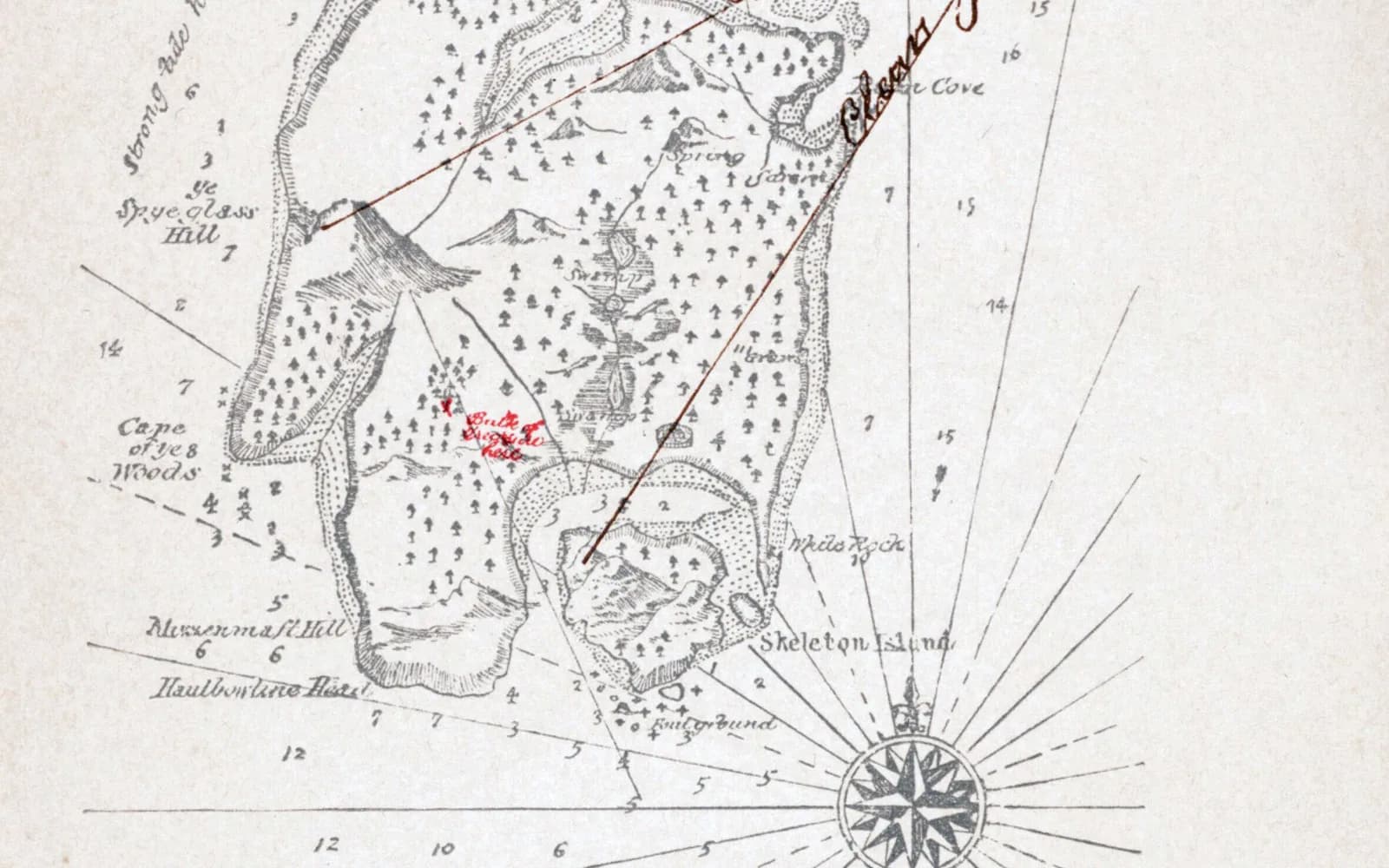
Almost everything an ordinary person believes about pirates arrives from one short adventure novel written for a boy’s amusement in 1881. The black spot, the treasure chart, the parrot, the bottle of rum and the shanty are not history that Stevenson collected. Several of them are things he made up, and the rest he borrowed and made famous.
This is the honest audit: what the book actually invented, what it took from somewhere real, and the three famous pirate props it never contained at all. Every one of those props is absent from the playable Treasure Island too, because it follows the novel.
⚫ The black spot: invented, twice used, no precedent
The black spot is a scrap of paper blackened on one side and pressed into a man’s hand. It arrives twice in the novel, and Stevenson thought enough of it to title two chapters after it: “The Black Spot” early, and “The Black Spot Again” late. The old sailor at the inn explains what it means in one line, and the explanation is the whole mechanism.
“That’s a summons, mate. I’ll tell you if they get that.”
As pirate history, it is not history. Wikipedia’s article on the device describes it as a literary device created by Stevenson, and The Writing Post’s survey of its literary origins says the same thing in almost the same words. Both raise exactly one possible ancestor, a Caribbean practice of showing a condemned man the ace of spades, and both hedge it: the word one uses is “might” and the word the other uses is “perhaps.” No record of real pirates serving a black spot has been produced by either.
The second use is the more interesting one, and it is the reason the device has survived. In the later chapter a black spot is served not by a court or an enemy but by a crew on its own leadership, which converts it from a death sentence into something closer to a vote. That is a piece of political machinery Stevenson invented for a children’s adventure and every pirate story since has borrowed.
🎵 The pirate song is four lines long
This is the finding that surprises people most, and it takes ten minutes with a search function to confirm. The shanty appears five times in Treasure Island. Its longest appearance is four lines. There is no fuller version anywhere in the novel, no second verse, and no chorus beyond the one everybody already knows.
“Fifteen men on the dead man’s chest— / Yo-ho-ho, and a bottle of rum! / Drink and the devil had done for the rest— / Yo-ho-ho, and a bottle of rum!”
Where did it come from? Not from sailors. Stevenson’s stepson said flatly that the piece was wholly original with Stevenson, and the record of the song is that he wrote the chorus and left the rest deliberately unwritten, to the reader’s imagination.
What he did borrow was three words. “Dead Man’s Chest” is a place in the Virgin Islands, and Stevenson found it in a list of West Indian names in Charles Kingsley’s travel book of 1871. He described the moment in a letter, and the word he used for what those three words gave him was “the seed.” The Writing Post quotes the letter directly.
The longer versions that circulate as authentic sea shanties are later and traceable. The best known is a three-verse poem called “Derelict” by Young E. Allison, published in 1891, eight years after the novel appeared. A reader who learned a full “Fifteen Men” from a folk album learned Allison, or somebody after him, not a shipboard tradition Stevenson wrote down.
🪙 “Pieces of eight” is real money and a borrowed joke
Here the novel is the borrower rather than the inventor. A piece of eight was an actual coin, the Spanish dollar, worth eight reales, which is what the phrase counts, and circulated across the Atlantic world for three centuries. Stevenson did not coin the phrase, and it turns up in his own treasure inventory alongside doubloons, louis d’ors and guineas, because that is what a Caribbean hoard would actually have contained.
What he invented was the delivery. He gave the phrase to a parrot, named the parrot after a dead buccaneer, and had it repeat the two words until people in the room want the bird covered with a cloth. The novel even supplies an origin story for the habit, in the sea-cook’s own boasting voice: the bird, he says, sailed with a real pirate captain and picked the phrase up at the salvage of wrecked treasure ships, where there were three hundred and fifty thousand of them.
Two cautions on that passage, both from the page. The claim that the bird is two hundred years old is the sea-cook’s boast in dialogue, not something the book asserts. And the parrot genuinely does sit on his shoulder in a later chapter, so that particular piece of iconography predates every film made of the book. It is one of the few stock pirate images this novel can be fairly charged with putting there on purpose.
🗣️ The voice is not Stevenson’s, but the vocabulary is
The rolling, rhotic pirate accent is genuinely a twentieth-century invention, and it has a single author. It belongs to Robert Newton, who played the sea-cook in the 1950 Disney film and exaggerated the West Country accent he grew up with; History.com traces the stereotype to that performance, and Looper puts it more bluntly still, crediting him with inventing and immortalising the voice in one film. The historian quoted in the first of those pieces adds the awkward part: real crews came from Wales, Scotland, Ireland, West Africa and France, and there is no evidence any of them sounded like that.
The words, though, are Stevenson’s. Search the novel and the whole vocabulary is already there, decades before any film. What is missing is exactly one item.
- In the book.“Matey” is used in the first tavern scene and repeatedly afterwards. “Shiver my timbers” appears five times, and a variant once. “Avast” and “belay” are both used as orders, by pirates and by officers alike.
- Not in the book.“Arr” as an affirmative does not occur once in the entire text. That single syllable, the one thing everybody performs on Talk Like a Pirate Day, is the film’s contribution and nobody else’s.
So the popular claim that pirate talk was invented by Hollywood is half right and often stated backwards. The dialect words came from a Scottish novelist who had listened to sailors. The accent that carries them came from an English actor from Dorset, sixty-seven years after the book was published.
🚫 Three pirate props the book never contains
The reverse audit is as useful as the forward one, because a surprising amount of what people credit to this novel is not in it.
- X does not mark the spot. The phrase never appears. The chart in the novel is marked with red crosses, described exactly that way each of the three times it is examined, and a cross on a chart is a surveying convention, not a secret code.
- Nobody has a wooden leg or an eyepatch. Neither phrase occurs anywhere in the text. The sea-cook has one leg and gets about on a crutch, which is mentioned two dozen times and is a completely different physical fact, and a different kind of character: a crutch is a thing that can be thrown.
- Nobody walks the plank. The plank is mentioned twice, and both times it is talk: once in the yarns a drunk sailor tells to frighten an inn, and once in the nightmares the narrator still has years later. No plank is ever rigged and nobody walks one.
One famous prop does survive the audit. The Jolly Roger is in the novel, named, flown, and struck by the narrator in a chapter titled after the act. The book calls it the black flag of piracy, which is how a Victorian reader would already have known it.
⚖️ The honest verdict
Stevenson was not the first person to write pirates. He was reading the same source almost everybody who writes pirates has read since: a 1724 book of pirate biographies published under the name Captain Charles Johnson, whose real author has never been established and is often but disputedly given as Daniel Defoe. Wikipedia’s account of that book names Stevenson and J. M. Barrie as two novelists who identified it as a major influence, and a piracy-history archive calls it the basis of nearly everything written about pirates since. Stevenson lifted a character name straight out of it.
What he added was the props and the grammar. A chart with a cross on it, a death sentence delivered on paper, a bird that repeats a coin’s name, and a chorus with no verses attached: none of those is a thing historians found in the record and novelists borrowed. They are things one novelist made, in a story he started to entertain a twelve-year-old on a rainy holiday, and the rest of the genre has been furnishing itself from that room ever since. The complete text is free at Project Gutenberg if you want to run the searches yourself.
Sources
- Treasure Island (Project Gutenberg #120) — Project Gutenberg
- Dead Man's Chest — Wikipedia
- Poetry analysis: "Fifteen Men on the Dead Man's Chest" — The Writing Post
- Black Spot (Treasure Island) — Wikipedia
- Marked for Doom: The Literary Origins of the Black Spot — The Writing Post
- The Origins of the Pirate Accent — History.com
- The Disney Film That Changed How We Think Pirates Talked In Real Life — Looper
- A General History of the Pyrates — Wikipedia
- A General History of Pyrates (1724) — The Golden Age of Piracy
- Spanish dollar — Wikipedia
Frequently asked questions
- What is the black spot, and is it real pirate history?
- A blackened scrap of paper pressed into a man's hand, and it is Stevenson's invention. He titles two chapters after it, III and XXIX. The one precedent his sources propose is a Caribbean habit of showing a condemned man the ace of spades, and both hedge it; no record of real pirates serving a black spot has been produced.
- Did Stevenson write the full "Yo Ho Ho" pirate song?
- He wrote four lines and stopped there. The three-verse version people sing is "Derelict" by Young E. Allison, printed in the Louisville Courier-Journal in 1891, eight years after the novel. Stevenson's stepson Lloyd Osbourne said the piece was wholly original with Stevenson, so the folk-song provenance you may have heard is backwards.
- What does "pieces of eight" actually mean?
- A real coin: the Spanish silver dollar, worth eight reales, which circulated across the Atlantic world for three centuries. Stevenson borrowed the term rather than coining it. The novel titles Chapter XXVII after the phrase, and the treasure inventory lists pieces of eight beside doubloons, louis d'ors and guineas, which is what such a hoard would really have held.
- Is pirate talk real, or invented by Hollywood?
- Both, in different halves. The words are Stevenson's: matey, shiver my timbers, avast and belay are all in the novel. The accent is Robert Newton's, from 1950. The historian Colin Woodard points out there are no recordings of real pirates and that crews came from all over the Atlantic, so there is no one accent to recover.
- Is Captain Flint a real historical pirate?
- No. Flint is fictional inside the novel and already dead when it opens; no chapter shows him alive. The castaway's account of the burial has him kill his own six-man working party, and the phrasing is blunt: "the six all dead--dead and buried." The parrot named after him is the only Flint any reader actually meets.
Enjoyed this one?