Is Treasure Island Worth Reading as an Adult, Not Just as a Kids' Classic?
Treasure Island is filed with the picture books and remembered as a story about a map and a parrot. The book is harder than that: a fast first-person adventure with more on-page death than its reputation admits, narrated by a boy who is often wrong about the adults around him.


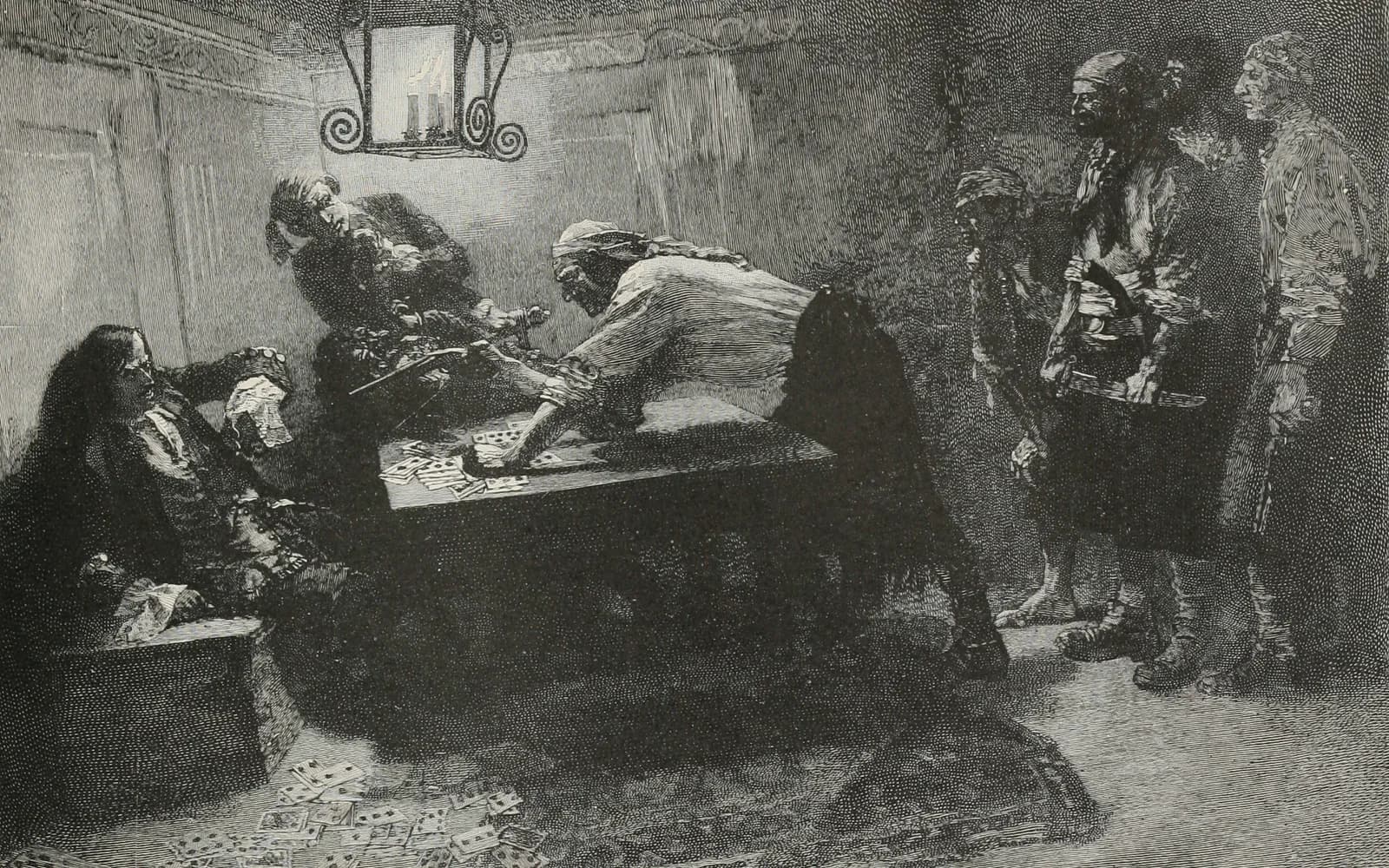
Treasure Island has spent a hundred and forty years on the wrong shelf. It is filed with the picture books and the abridgements, handed to nine-year-olds, and remembered by most adults as a story about a map and a parrot. The book itself is a great deal harder than that, and the gap between the two is the reason the question keeps getting asked.
What follows is the practical answer: what kind of book it actually is, how much violence sits on its pages, what a parent choosing it should know, and who is better off starting somewhere else. The same opening scene is a doorway in the playable Treasure Island, where you keep the inn while the sailor in the corner drinks.
🧭 What kind of book this actually is
The first surprise is the voice. Treasure Island is narrated in the first person by Jim Hawkins, and the novel opens by explaining why the narration exists at all: the gentlemen of the expedition have asked him to set the whole thing down, and he is doing it under instruction, with one detail held back because part of the treasure is still on the island. That framing runs the entire book. You are reading a young man’s official account of something that happened to him, written afterwards, with the confidence of hindsight laid over the fear he actually felt.
“Squire Trelawney, Dr. Livesey, and the rest of these gentlemen having asked me to write down the whole particulars about Treasure Island... I take up my pen.”
The second surprise is the pace. The chapters are short, most of them carrying one event each, and the prose is closer to reportage than to the furnished Victorian sentence readers brace for. Stevenson moves a man across a room in a line and a half. There is almost no landscape writing that does not also carry a threat, and no interior monologue that is not a boy deciding whether to run.
The third surprise is how much of the book happens before the ship sails. A reader expecting an island arrives at one late. What comes first is an inn, a lodger who pays badly and frightens the customers, a sea-chest nobody is allowed to open, and a village that quietly agrees to be afraid. That stretch is the best-built part of the novel and the part every adaptation compresses hardest.
🩸 Darker than the shelf label suggests
The body count is the thing that startles returning readers. Deaths arrive in every register the novel has: illness, accident, combat and deliberate murder, several of them in full view rather than reported from offstage.
- Illness. The old sailor at the inn is told twice by a doctor that he has had a stroke and will have another if he keeps drinking. He keeps drinking. The scene is clinical, the diagnosis is correct, and the death that follows is the most ordinary in the book.
- Accident. A blind man, fleeing in the dark from riders he cannot see, is trampled in the road. Stevenson gives him four words and moves on, which is exactly how violent death works in this novel.
- Combat.A stockade fight kills men on both sides, including one of the expedition’s own servants, shot as the party is still getting its stores ashore, and another who dies of his wounds afterwards under the doctor’s hands.
- Murder. One killing in this book is done in front of the narrator, by a character the narrator likes, and it is argued out at length in a separate piece on this hub because the whole moral question of the novel sits inside it.
The arithmetic at the end is blunter than any of the individual scenes. The schooner sails with a full crew and comes home with five of them alive. Stevenson does not dramatise that figure; he states it in passing in a sentence about reaching Bristol, and lets the reader do the subtraction. A book for children does not usually leave its arithmetic lying about like that.
There is also a man on the island who has been alone for three years when the story finds him, and who has been talking to himself long enough that his speech has come apart. He is treated as comic relief by several of the characters. He is not comic at all, and the modern reader notices that faster than the Victorian one was expected to.
👪 If you are choosing it for a child
This is a genuinely separate question from whether an adult should read it, and the search results for the two questions barely overlap. Parents and homeschoolers arrive looking for content warnings and a reading level; adults arrive asking whether it holds up. Both deserve a straight answer rather than the same one.
On content: the violence is frequent, sudden and unglamorised, the drinking is constant and consequential, and one scene involves a boy killing an adult in self-defence and being changed by it. There is a dedicated parents’ guide for the book if you want an age recommendation rather than a description.
On difficulty, which is the more common complaint: the plot is easy and the sentences are not. Sailors speak in period dialect with nautical vocabulary that is never glossed, and a young reader will stall on the speech long before the story loses them. Reading a chapter aloud solves most of it, because the dialect was built for the ear. An abridgement also solves it, at the cost of the things that make the book good.
The honest recommendation for a household is the unabridged text, read with someone, at an age where a murder in a wood can be discussed rather than skipped. Handing it to a child alone at seven is how the book got its reputation for being boring, which it is not.
🎯 Who should start here, and who should skip
Start here if you want a short adventure with an unreliable young narrator and a villain you will argue about afterwards. Start here if you bounced off longer Victorian novels and want proof that the period could also write lean. Start here if you have only ever met this story through a film, because the film you met has almost certainly resolved the book’s central question for you, and the book does not.
Skip it if what you actually want is a survival novel about self-reliance and ingenuity. Readers frequently pair this book with Robinson Crusoe and find the pairing disappointing in one direction or the other, because they are not doing the same job: one is about a man rebuilding a civilisation alone, this one is about a boy learning that charm and loyalty are different things. Skip it also if you dislike first-person narrators who withhold, because this one withholds constantly and is occasionally wrong on purpose.
One adaptation note, and only one, because the comparison has its own piece on this hub. If you find yourself hearing a rolling rhotic “pirate voice” in your head while you read, that voice is Robert Newton’s in the 1950 Disney film, not Stevenson’s prose; History.com traces the accent directly to that performance. The book’s sailors sound like sailors, which is stranger and better.
The complete text is free at Project Gutenberg if you want to test the first three chapters before committing an evening. Those three chapters are the whole argument in miniature, and if the inn does not hold you, the island will not either. If it does hold you and you want the next sea voyage, the essays on Twenty Thousand Leagues under the Sea cover a longer one with a captain who is a harder call than Silver.
Sources
- Treasure Island (Project Gutenberg #120) — Project Gutenberg
- Treasure Island — Parents' Guide and Book Review — Common Sense Media
- The Origins of the Pirate Accent — History.com
Frequently asked questions
- How long is Treasure Island?
- Six parts and 34 chapters. The parts carry titles rather than numbers: the first is "The Old Buccaneer" and runs from the inn to the night the captain's papers are opened, and the last covers the treasure hunt and the voyage home. Chapters are short, usually one event each, so the book moves faster than its length suggests.
- Is Treasure Island appropriate for kids?
- It depends more on reading level than on content, and Common Sense Media runs a dedicated parents' guide that gives an age recommendation. The content to know about: several deaths on the page, one of them a stabbing, and a narrator who kills a man in self-defence. The prose is the harder obstacle for most young readers.
- Is Treasure Island a difficult read?
- The plot is easy and the dialogue is not. Stevenson writes sailors in period dialect with unglossed nautical vocabulary, so a line like "keep your weather-eye open" arrives with no translation attached. Reading a chapter aloud fixes most of it, because the dialect was written to be heard rather than parsed.
- How many characters actually die in Treasure Island?
- At least six named ones die on the page, across several causes: illness, trampling, a stabbing, a musket ball, wounds that turn bad, and a man shot off the shrouds into the sea. Tom Redruth, the squire's old gamekeeper, is hit before the party has finished landing its stores. The ship sails with a full crew and reaches Bristol with five men alive.
- Was Treasure Island ever controversial or banned?
- No clear banned-book record turned up for it. It first ran as a magazine serial from 1881 under the pen name Captain George North, and Cassell published it as a book in 1883 with no scandal attached. The durable criticism is literary rather than moral: that an adventure about treasure hunting takes a surprisingly cold view of what treasure does to people.
Enjoyed this one?