Twenty Thousand Leagues Under the Sea Ending Explained: The Maelstrom, the Nautilus and Captain Nemo
The final chapter refuses to narrate the escape, and its narrator says so in the opening paragraph. Nobody is confirmed dead and nobody is confirmed alive.


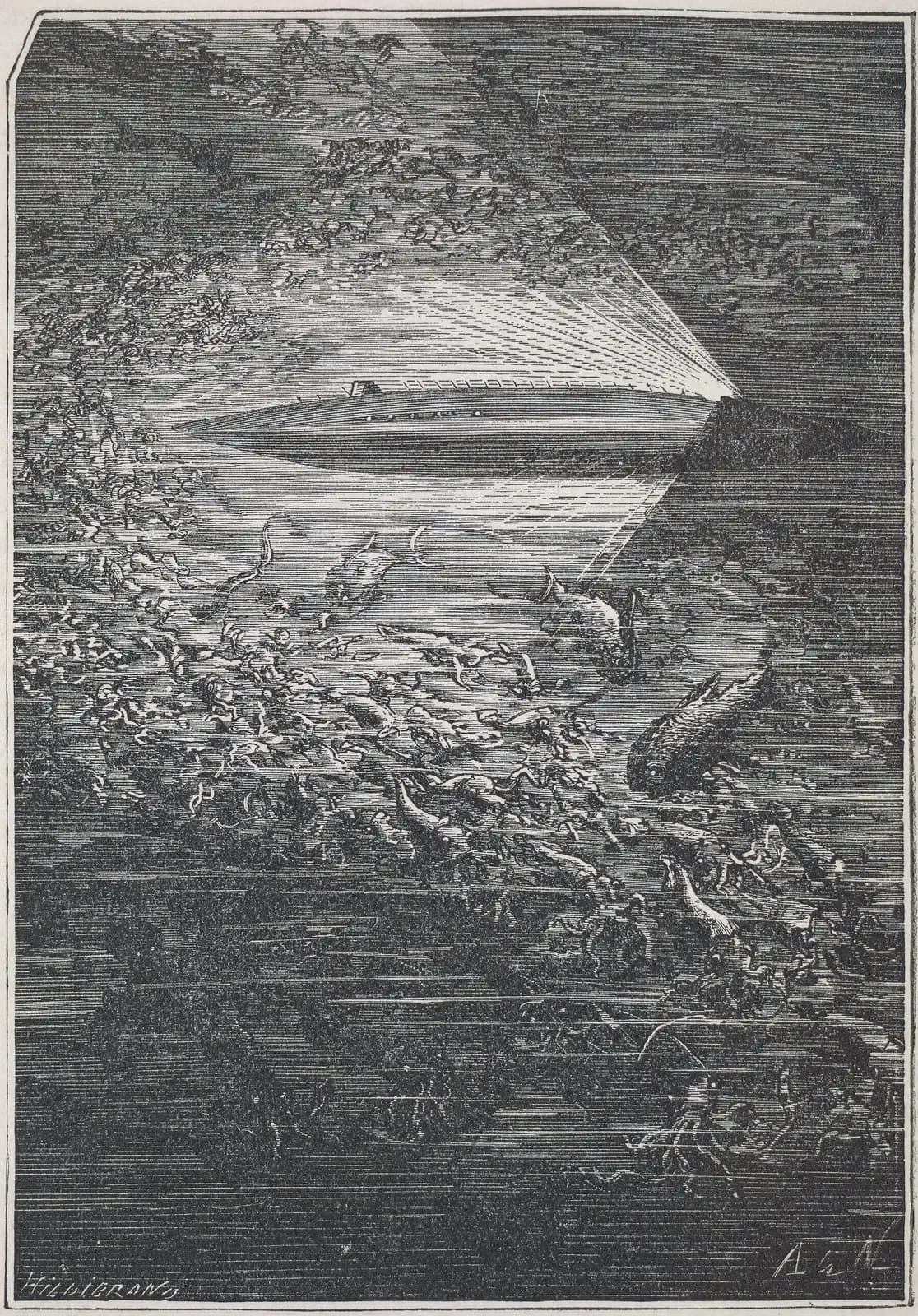
This is the rare famous novel whose final chapter refuses to answer the question it has spent six hundred pages building. Readers arrive at the last page expecting a death scene or a rescue and get a narrator waking up somewhere he does not remember travelling to, holding a manuscript he is not sure anyone will believe. What follows is the text’s own account of that, with line references, and the three same choices you face in the playable Twenty Thousand Leagues.
🌀 What happens in the final chapter
The three captives have spent the night in the ship’s small boat, waiting for a moment to detach it, when they realise the current has them. Ned Land is at the bolts, Conseil is holding on, and Aronnax hears the word that names the whirlpool being shouted somewhere above him before everything stops. The chapter that follows is titled “Conclusion,” and it opens by telling you that the most important sequence in the novel has not been narrated.
“What passed during that night—how the boat escaped from the eddies of the maelstrom—how Ned Land, Conseil, and myself ever came out of the gulf, I cannot tell.”
He comes round in a hut on the Loffoden Isles, in northern Norway, with both companions alive beside him and a fisherman’s family looking after the three of them. That is the whole of the rescue: no wreckage described, no swim to shore, no witness. Verne had a real place in mind for the whirlpool, the Moskstraumen off the Lofoten Islands, a genuine tidal system strong enough that sailors had been telling stories about it for centuries before he wrote.
🧭 The escape nobody witnesses
The missing scene is a deliberate structural choice rather than an oversight, and the novel makes that legible by keeping its narrator honest about the gap. Aronnax is a scientist writing a report; he has told you the pressure readings at four leagues down and the Latin names of fish he saw through a window, and the one thing he will not do is invent an account of an event he was unconscious for.
- No body, no wreck, no debris. The text gives you nothing physical to conclude from, which is exactly why the question has stayed open for readers for a hundred and fifty years.
- The narrator says so himself.“I cannot tell” is the sentence, and it is placed in the opening paragraph of the last chapter rather than hidden at the end of it.
- The captives are returned, not saved.Nobody rescues them on the page; they are simply on land in the next sentence, in someone else’s house, being looked after.
The Maelstrom is a doorway in the playable Twenty Thousand Leagues: you are in the detached boat with the current already turning, and you can work the bolts, hold on, or go back for something you left behind. Role-play Twenty Thousand Leagues →
⚓ Why the captain’s fate is left open
Because Aronnax asks the question in his own voice and then declines to answer it. The final pages hand you a list of things the narrator does not know, written by a man who has been ashore long enough to realise that nobody is ever going to tell him.
“But what has become of the Nautilus? Did it resist the pressure of the maelstrom? Does Captain Nemo still live?”
Ten lines later he answers his own questions with a wish rather than a fact, and the grammar does all the work: “if Captain Nemo still inhabits the ocean, his adopted country, may hatred be appeased in that savage heart.” Every clause in that sentence is conditional or optative. He hopes the vessel survived, he hopes the man aboard it has stopped, and the text takes care never to tell you whether either hope is warranted.
The version most people actually remember belongs to the cinema. Disney sent Nemo down with his ship on screen in 1954, and a companion piece here walks through what that changed rather than repeating the argument in this one. Whether the man on the page deserves the hope Aronnax extends him is a separate argument with its own evidence.
📜 The sentence the book actually ends on
A quotation from Ecclesiastes, put as a question, with the answer withheld one final time in the free English text. Aronnax says that two men alone of all now living have the right to reply to it, meaning himself and Nemo, and the sentence breaks off on a dash before either of them does.
“That which is far off and exceeding deep, who can find it out?”
That is the shape of the whole ending in one line. A book about a machine that can reach anywhere finishes by naming the one place its narrator cannot follow, and the man who could answer has gone back down where the question came from. Read it as a failure of nerve and it is unsatisfying; read it as the point, and the last chapter is doing exactly what the rest of the novel has been doing since the captives first came aboard.
Sources
- Twenty Thousand Leagues under the Sea (Project Gutenberg eBook #164) — Project Gutenberg
- Moskstraumen — Wikipedia
- Twenty Thousand Leagues Under the Seas — Wikipedia
- 20,000 Leagues Under the Sea (1954) — AFI Catalog of Feature Films
- 20,000 Leagues Under the Sea (1954 film) — Wikipedia
Frequently asked questions
- What happened at the end of 20,000 Leagues Under the Sea?
- The three captives are in the ship's small boat working at the bolts when the current takes them. The bolts give way, the boat is torn out of its groove and flung into the whirlpool, and the narrator's head strikes a piece of iron. He records nothing after that until he wakes ashore, so the last of the book's 46 chapters never narrates the escape at all.
- What was the monster in 20,000 Leagues Under the Sea?
- A submarine with a crew. The frigate Abraham Lincoln is sent out after a narwhal-like creature that has been holing ships, and what it finds is the Nautilus. The monster hunt ends when the hunters go over the side and are pulled aboard the thing they were hunting, early in the first part of the book.
- What is the message of 20,000 Leagues Under the Sea?
- Readers disagree, which is the design, but the closing pages point at limits rather than at wonder. Aronnax finishes his report having covered 20,000 leagues in under ten months, and the one subject he was never able to examine is the man who showed him everything else. He ends on a question from Ecclesiastes and leaves it open.
- Where is the maelstrom in 20,000 Leagues Under the Sea?
- Off Lofoten in Nordland, northern Norway, between the island of Moskenesøya and the island of Mosken. The real current is unusual in forming out in open water rather than in a strait, and it does so because a shallow ridge on the seabed amplifies and twists the tide as it passes over.
- Did Jules Verne invent the word maelstrom?
- No. It is a Nordic word built from the Dutch for grind and stream, and it entered English through Edgar Allan Poe's 1841 story “A Descent into the Maelström,” set on the same Norwegian coast. Verne, who wrote a study of Poe, sent the Nautilus into the place Poe had already made famous.
Enjoyed this one?