Twenty Thousand Leagues Under the Sea: Is It Worth Reading, and What Does the Title Mean?
Nearly everyone reads the title as a depth. The book gives the real number in its own closing pages, and it is the distance covered on a ten-month voyage.


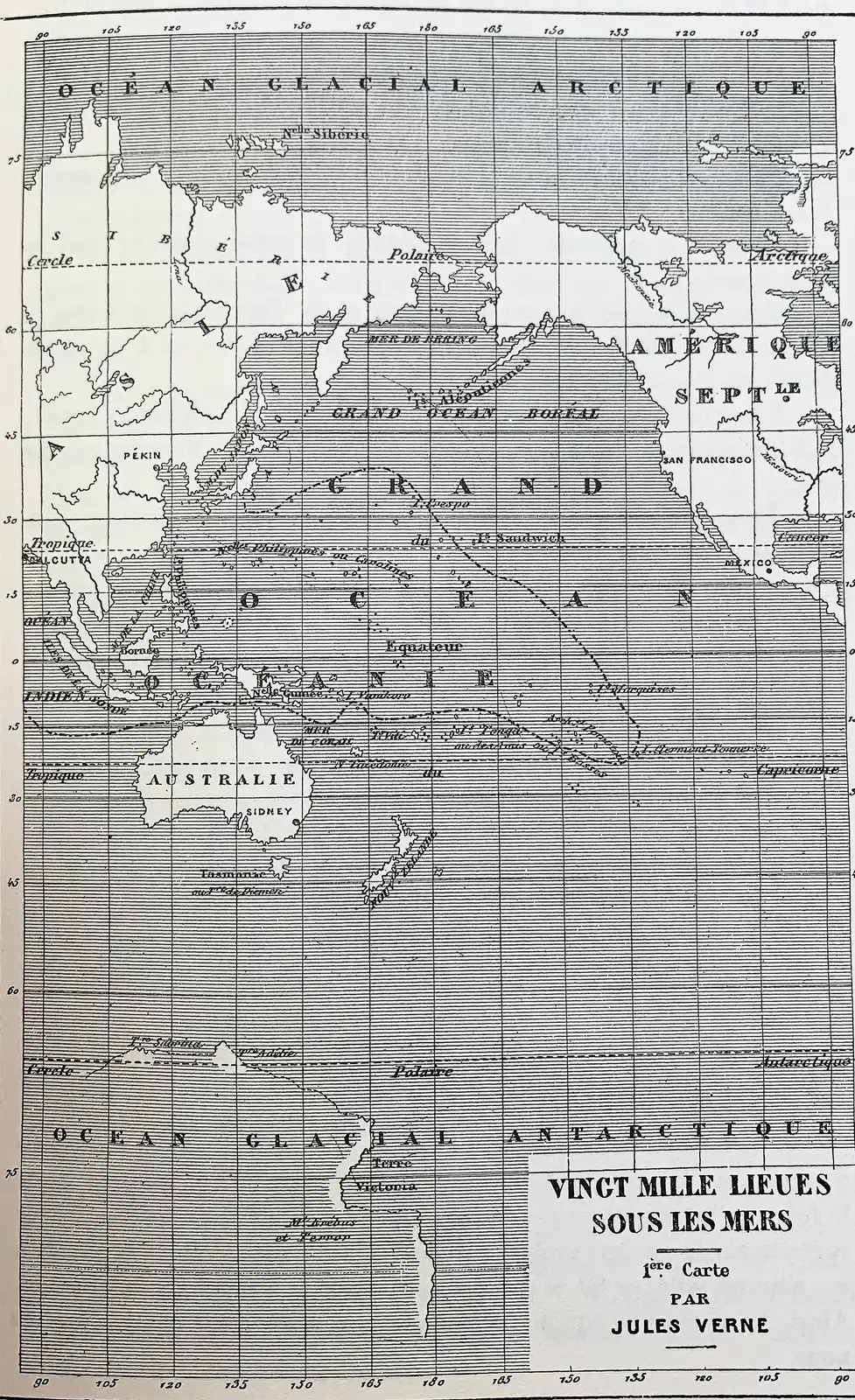
Almost everyone who picks this book up is expecting a dive, and the title is the reason. It sounds like a depth reading, it gets quoted like a depth reading, and the number is large enough that nobody stops to check it against a map. The book itself never makes that claim, and the correction is not buried in a footnote somewhere: the narrator states the real figure in his own closing pages, in the same breath he uses to describe what he has just survived. Everything below is checked against the free text the playable Twenty Thousand Leagues is built from.
🧭 What the twenty thousand leagues measure
Distance travelled, under water, on a single voyage. Professor Aronnax is writing up his account on the Loffoden Isles at the end of the book, defending his right to describe seas nobody else has seen, and he gives the number as a total for the trip rather than as a reading off a pressure gauge.
“…in less than ten months, I have crossed 20,000 leagues in that submarine tour of the world.”
The arithmetic makes the same point from the other direction. A metric league is four kilometres, so twenty thousand of them come to about 80,000 kilometres, which the standard reference on the novel describes as nearly twice the circumference of the Earth. Read as a depth, that number would put the Nautilus somewhere past the far side of the planet and well on its way into open space, which is roughly the objection readers have been raising to each other on forums for as long as forums have existed.
- The first edition’s maps run sideways. The original French edition carries two engraved route maps, and both trace a horizontal track across the oceans from one sea to the next.
- The French title is plural. Vingt mille lieues sous les mersis “under the seas,” a tour of several of them, which survives in the scholarly English title and got flattened to the singular everywhere else.
- Verne counts in metric leagues. Four kilometres each, the unit a French reader of 1870 would have assumed, not the longer nautical league an English reader might reach for.
🌊 How deep the Nautilus actually goes
Four leagues, which is sixteen kilometres in Verne’s units and deeper than any real trench, reached once during a controlled test dive that the crew treats as an extreme event rather than as routine business. The text hands you the figure in a single sentence and then moves on, which is why almost nobody remembers it.
“We had attained a depth of 16,000 yards (four leagues), and the sides of the Nautilus then bore a pressure of 1,600 atmospheres.”
Set the two numbers side by side and the whole misunderstanding resolves. Twenty thousand leagues is what the vessel covers in ten months of sailing; four leagues is the furthest down it ever goes, and the gap between the two figures is the difference between a journey and a plunge. Verne was writing before the deep-ocean trenches had been properly sounded, so his four leagues is a wild overshoot of anything a nineteenth-century hull could survive, and it is still nowhere near the title.
The Frigate's Departure opens the playable Twenty Thousand Leagues: you are loading gear onto the Abraham Lincoln to hunt something the papers are calling a monster, and you can help the harpooner stow his tackle or go and argue with the naturalists about what it is. Role-play Twenty Thousand Leagues →
📖 Whether it is worth reading, honestly
Yes, with a caveat that readers who loved it and readers who bounced off it both give you, which is that the adventure is interrupted for long stretches of catalogued marine biology. Aronnax is a professional classifier, the novel is narrated in his voice, and when he walks past an aquarium window he lists what is in it at the length a specialist would. Whole chapters go by in which the most dramatic event is a school of fish being correctly identified.
The set pieces, when they arrive, are worth the wait and are the reason the book has stayed in print for a century and a half. A submarine funeral in a coral forest, a treasure fleet lying on the floor of a Spanish bay, a walk to the sunken ruins of a city, a battle fought with axes on an open deck against something with tentacles. Read with that rhythm in mind and the slow passages stop feeling like a fault in the book and start feeling like the pace of a long voyage, which is what they were built to be.
- Go in expecting a nature documentary between the fights. The people who say they were bored to tears by pages of fish are not wrong about the pages; they are just reading it as a thriller.
- Pick an unabridged text. Several older editions cut hard, and the chapters they cut first are the ones carrying the science that makes the vessel feel real.
- The captivity is what carries it. Three men are held aboard by a host who feeds them well and will not let them leave, and that tension does more work than any of the monsters.
🚢 Where a first-timer should start
Start here rather than with the other famous Verne titles, because this is the one whose premise carries itself without any setup. A warship hunts a sea monster, the monster turns out to be a machine, and the hunters become its guests and its prisoners in the same afternoon. You need no familiarity with Verne, with the period, or with the rest of the Extraordinary Voyages to follow any of that.
One piece of shopping advice does matter, and it is the only one. The English text most freely available online, including the one this game was built from, is the version Rev. Lewis Mercier made for Sampson Low in November 1872, and it has a documented reputation problem that a companion piece here works through in detail. That free text is Project Gutenberg’s ebook #164, and reading it means reading the book most English speakers have always read; buying a modern annotated edition means reading a noticeably fuller one.
Sources
- Twenty Thousand Leagues under the Sea (Project Gutenberg eBook #164) — Project Gutenberg
- Twenty Thousand Leagues Under the Seas — Wikipedia
- Jules Verne — Wikipedia
- Lewis Page Mercier — Wikipedia
- 20,000 Mistranslations Under the Sea — Steven R. Southard
Frequently asked questions
- Is Twenty Thousand Leagues Under the Sea worth reading?
- Yes, if you want a voyage rather than a thriller. The novel tells you what kind of book it is early on, when the captain answers a guess about the size of his library by saying it holds 12,000 volumes and then walks his prisoner through it. Read it for the vessel and the captivity and the slow chapters stop being a fault.
- What grade level is 20,000 Leagues Under the Sea?
- It is usually shelved for readers of about twelve and up, and the difficulty is vocabulary rather than structure. The text runs to forty-six chapters split evenly into two parts of twenty-three, most of them short, and the hard words are nearly all Latin species names you can pass over without losing the story.
- In what order should I read Jules Verne books?
- Any order, because the Voyages extraordinaires stand alone. Verne was born in Nantes on 8 February 1828 and wrote the series for the publisher Pierre-Jules Hetzel, who issued the novels as one ongoing collection rather than as a sequence with a plot. Most reading lists still name this novel as the usual entry point, whichever order you end up settling on.
- When was Twenty Thousand Leagues Under the Sea published?
- It ran as a serial in Hetzel's fortnightly Magasin d'éducation et de récréation from March 1869 to June 1870, and the illustrated octavo edition followed in November 1871 carrying 111 engravings by Alphonse de Neuville and Édouard Riou. The first English translation, the Rev. Lewis Mercier version for Sampson Low, followed in November 1872.
- Was the Nautilus based on a real submarine?
- Partly. The standard reference on the novel records that Verne studied a model of the French navy's submarine Plongeur at the Exposition Universelle of 1867 and took the idea of a self-contained undersea vessel from it. Everything the Nautilus does beyond diving and surfacing was invented for the novel rather than copied from that model.
Enjoyed this one?