Alice in Wonderland, Book vs Film: From 1933 to Tim Burton, Ranked for Faithfulness
Six stagings of the same tea party, counting the one on the page. The most faithful is a television film, and the one that made a billion dollars is not an adaptation at all.


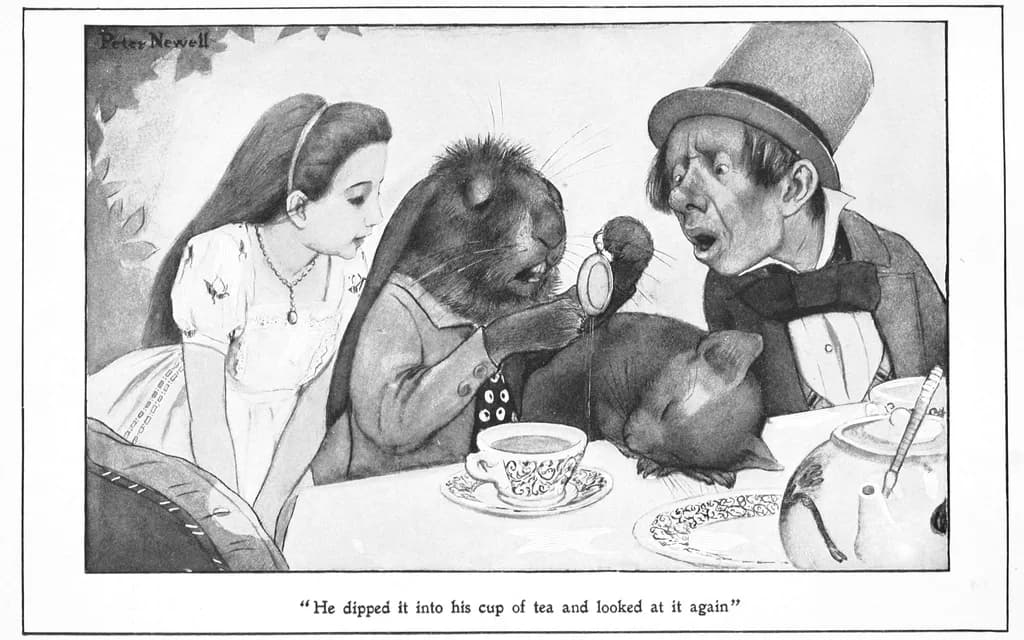
Six versions of the same tea party, counting the one on the page. Every screen Alice has to answer the same question the book never bothers with, which is what the story is for, and the answers have ranged from a faithful transcription with the stars hidden under papier-mache heads to a billion-dollar film in which Alice is nineteen and kills a dragon.
- The most faithful is a television film. The 1999 Hallmark version keeps the characters everyone else cuts.
- Disney's 1951 version lost money. About a million dollars, on release, and Walt blamed the story.
- Burton's 2010 film is a sequel, not an adaptation. It made just over a billion dollars anyway.
- Its own sequel lost about seventy million. And used almost nothing from the book it was named after.
The scene all six of them fight over is the tea party, and you can take your own turn at it: the playable Alice's Adventures in Wonderland seats you at that table with the Hatter, the March Hare and a Dormouse being used as a cushion.
📄 The short answer: faithfulness and quality are separate questions
The book is a set of twelve loosely joined episodes with no plot to speak of. Alice falls, shrinks, cries, argues with a caterpillar, meets a cat, sits down to tea, plays croquet with a flamingo, hears a pun-heavy autobiography from a turtle, and finally shouts at a court. Nothing causes anything. That is easy to read and very hard to film, because a film wants a spine, so every adaptation is really a decision about what spine to bolt on.
Rank them on scene coverage and dialogue and the order is one thing. Rank them on whether they are any good and the order changes. Both rankings are worth having, so the table below gives the first one and says where the second disagrees.
| Version | What it keeps, and what it does not |
|---|---|
| The book (1865) Twelve chapters | The benchmark. No plot, no villain to defeat, no lesson. The Queen orders beheadings that the Gryphon says never happen, and the story ends because Alice grows too big to be frightened. |
| Alice in Wonderland (1999) Hallmark, NBC, dir. Nick Willing | The fullest cast on screen: the Duchess, the Mock Turtle played by Gene Wilder, the Gryphon, the Caterpillar and the whole trial. It borrows from Through the Looking-Glass too, and it invents a stage-fright frame for Alice that Carroll never wrote. Four Emmys, including one for Charles Knode's costumes. |
| Alice in Wonderland (1933) Paramount, dir. Norman Z. McLeod | Wide scene coverage from both books and a cast list that reads as a joke: Cary Grant as the Mock Turtle, Gary Cooper as the White Knight, W. C. Fields as Humpty Dumpty. Almost all of them are unrecognisable under masks and padding, which is part of why it was a box-office bomb. Cut from ninety minutes to seventy-seven before the press saw it. |
| Alice in Wonderland (1951) Walt Disney, 75 minutes | Keeps the rhythm and most of the best jokes, drops the Duchess, the Mock Turtle, the Gryphon and the White Knight, and imports Tweedledum and Tweedledee, the Walrus and the Carpenter and the garden of live flowers from the sequel. Over thirty songs were written for it. |
| Alice in Wonderland (2010) dir. Tim Burton | A sequel wearing the first book's title. Alice is nineteen, the place is called Underland, there is a prophecy, and she kills the Jabberwocky, who belongs to the other book. Carroll's Red Queen and Queen of Hearts are welded into one villain. |
| Alice Through the Looking Glass (2016) dir. James Bobin | A time-travel story about the Hatter's family. The chess structure, Humpty Dumpty's lecture and the White Knight, the three things the 1871 book is actually made of, are essentially absent. |
🎞️ How the 1951 film was actually made
Disney's Alice was animated over live-action footage. The scenes were performed on camera first so the animators could study real motion, and the girl who performed Alice also voiced her: Kathryn Beaumont, born in June 1937, was thirteen and fourteen across the production. She did the same double duty for Wendy in Peter Pan, at one point suspended on wires to give the animators a flying body to draw from, and she was afraid of heights.
The end of that story is the part people find hardest to believe. Beaumont went to the University of Southern California, took a degree in education, and taught in Los Angeles elementary schools for thirty-six years. Disney named her a Legend in 1998, by which time she had spent five times as long in a classroom as she had in a recording booth.
“Yes, that's it,” said the Hatter with a sigh: “it's always tea-time, and we've no time to wash the things between whiles.”
That line is the reason the tea party survives every adaptation. It is a complete idea in one sentence, it needs no plot around it, and it translates to any medium that can put three characters at a table. What the versions differ on is whether the Hatter is frightening, tragic, manic or simply extremely rude, which is a casting decision rather than a textual one, because Carroll gives almost nothing away about him.
💸 What film almost ruined Disney?
People asking this usually expect Burton's name. The commercial answer runs the other way. Disney's own 1951 Alice cost about three million dollars and took around 2.4 million domestically on release, a loss of roughly a million, and Walt Disney's own verdict was that the film had no heart. It was not until the 1974 re-release, which took 3.5 million, that it started paying for itself, and the audience that rescued it was the psychedelic generation who had found the book in the meantime.
The 1933 version is the more interesting failure, because of what it was taken to prove. It came out at the end of December that year with twenty-odd Paramount contract players inside masks, and its collapse was read at the time as evidence that live-action fantasy could not carry a cinema at all. That verdict stood until Metro-Goldwyn-Mayer released The Wizard of Oz six years later and quietly reversed it.
Burton's 2010 film did the opposite. It cost two hundred million, opened to 116.1 million in a weekend and finished on 1.025 billion worldwide, which makes it one of the most commercially successful adaptations of any Victorian book ever made. Critics were not persuaded: it holds 51 per cent on Rotten Tomatoes across 274 reviews, whose consensus concedes the visuals and complains about the story. It still won two Academy Awards, for art direction and costume design.
📉 The sequel nobody remembers flopping
Alice Through the Looking Glass arrived in May 2016 with a hundred and seventy million dollars behind it and opened to 26.9 million, about a fifth of what its predecessor had managed six years earlier. It finished on 299.8 million worldwide, and The Hollywood Reporter's estimate was that the studio lost around seventy million on it. Reviews were worse than the first film's by a wide margin, at 29 per cent across 260 of them.
The interesting failure is not financial. A film named after Through the Looking-Glass could have taken the strangest premise in Victorian children's literature, a girl walking into a chess problem and being promoted to queen, and filmed it. Instead it built a time-travel plot about the Hatter's missing family. If you want to know what was sitting there unused, that is the subject of the essay on the sequel, and the two queens the films keep merging are sorted out in the character guide.
Every chapter reference above was checked against the free text at Project Gutenberg, and every box-office and award figure against Box Office Mojo, Rotten Tomatoes, the Television Academy and the Disney archive.
Sources
- Alice's Adventures in Wonderland (Project Gutenberg #11) — Project Gutenberg
- Alice in Wonderland (1933 film) — Wikipedia
- Alice in Wonderland (1951 film) — Wikipedia
- Alice in Wonderland (film) — D23, the official Disney fan club
- Outstanding Costume Design for a Miniseries or a Movie, 1999 — Television Academy
- Alice in Wonderland (2010) box office — Box Office Mojo
- Alice Through the Looking Glass (2016) box office — Box Office Mojo
- Alice in Wonderland (2010) — Rotten Tomatoes
- Alice Through the Looking Glass (2016) — Rotten Tomatoes
- Alice Through the Looking Glass (2016 film) — Wikipedia
- Alice in Wonderland (1999 film) — Wikipedia
Frequently asked questions
- Is Disney's 1951 Alice in Wonderland accurate to the book?
- Partly. It keeps the episode structure and most of the best exchanges, and it runs only 75 minutes, which is why so much goes: the Duchess, the Mock Turtle, the Gryphon and the White Knight are all absent. It was nominated for an Academy Award for Best Scoring of a Musical Picture, and much of what feels un-Carroll about it is imported from the sequel rather than invented.
- Who played the Mock Turtle in the 1933 Alice in Wonderland?
- Cary Grant, under a costume that made him unrecognisable. Paramount's version, released on 22 December 1933, was written by Joseph L. Mankiewicz and William Cameron Menzies and directed by Norman Z. McLeod, with Charlotte Henry as Alice and Edna May Oliver as the Red Queen. It was cut from ninety minutes to seventy-seven before the press saw it, and it failed commercially.
- Which Alice in Wonderland adaptation is the most faithful?
- The 1999 television film made by Hallmark for NBC, which keeps the characters the others cut: Ben Kingsley as the Caterpillar, Gene Wilder as the Mock Turtle, Peter Ustinov as the Walrus and Whoopi Goldberg as the Cheshire Cat, plus the full trial. It won four Emmy Awards that year, including Outstanding Costume Design for a Miniseries or a Movie for Charles Knode.
- Which is better, the 1951 or the 2010 Alice in Wonderland?
- The 1951 cartoon, if the question is the book. It holds 82 per cent on Rotten Tomatoes against Burton's 51, while the money ran the other way. Neither is pure Wonderland, though: Tweedledum, Tweedledee and the Walrus and the Carpenter, all in the 1951 film, come from chapter IV of Through the Looking-Glass.
- Is Tim Burton's Alice in Wonderland good or bad?
- It split its two audiences. Critics gave it 51 per cent on Rotten Tomatoes, while cinema-goers polled on opening weekend graded it A minus. It won two Academy Awards, for art direction and costume design. The dragon it ends on is not Carroll's: the word Jabberwock never appears in Wonderland.
- Why did Alice Through the Looking Glass flop in 2016?
- North America did not turn up. Of the 299.8 million dollars it took worldwide, only 77 million came from home against 222.8 million abroad, and reviews sat at 29 per cent. The book it is named after opens with a printed chess problem: White Pawn (Alice) to play, and win in eleven moves.
- Who voiced Alice in the 1951 Disney film?
- Kathryn Beaumont, who was thirteen and fourteen across the production. Carroll's Alice is a good deal younger: in Through the Looking-Glass she gives her own age twice, seven and a half exactly to the White Queen in chapter V and seven years and six months to Humpty Dumpty in chapter VI. Wonderland never states it.
Enjoyed this one?