Is Through the Looking-Glass Worth Reading After Alice? Yes, and It Is the Stranger Book
Humpty Dumpty, the White Knight, Tweedledum and Tweedledee and the Jabberwock are all in the second book, not the first. It also has a plot, and the plot is a chess game.


Half the things people remember from Alice in Wonderland are not in Alice in Wonderland. Humpty Dumpty, the White Knight, Tweedledum and Tweedledee, the Walrus and the Carpenter, the Red Queen and the Jabberwock all belong to the second book, published six years later, and it is the odder and more tightly built of the two.
- It is the longer of the two books. Twelve chapters again, and an entirely different shape.
- It has a plot, and the plot is a chess game. Alice is a pawn walking to the eighth rank.
- The famous lines are mostly here. Six impossible things before breakfast. Running to stay still.
- One chapter was cut before publication. The illustrator refused to draw it, and it stayed lost for a century.
One thing to be straight about: the playable book on Saylia is Wonderland, not the sequel. If you have not met Alice in the first book's courtroom yet, the playable Alice's Adventures in Wonderland is where the argument with authority happens; the sequel is where she wins one.
📄 The short answer: the sequel is the stranger book
Wonderland is a fall. Alice drops down a hole and things happen to her, one after another, until she wakes up. Looking-Glass is a walk. She climbs through a mirror into a country laid out in squares, is told at the start where she is going and how many moves it will take, and then goes there. The book has a destination, a promotion at the end of it, and a running joke about reversal that holds the whole thing together: in a mirror world you run to stay still, you scream before you prick your finger, and the cake is handed round before it is cut.
That structure makes it a better book for an adult and a worse one for a child, which is roughly the reception it has had for a century and a half. It is less frantic than Wonderland and much colder. It is also funnier in a drier register, because most of the jokes are about language rather than about being shouted at.
The book knows it is a sequel and refuses to repeat itself. There is no second rabbit-hole, no returning Cheshire Cat, no reprise of the tea party. What it offers instead is a pair of the White King's messengers called Hatta and Haigha, one of whom arrives fresh out of prison and eats bread and butter throughout, which is exactly what the Hatter was doing in the Wonderland witness box before the King had him removed. Carroll never says they are the same characters. He puts the detail on the page and leaves it there.
♟️ It is built on an actual chess problem
Open the book and before chapter one you get a cast list of pieces laid out in two columns, white and red, with Tweedledee and the Unicorn and the Sheep on one side and Humpty Dumpty and the Walrus and the Carpenter on the other. Then a chessboard diagram. Then a single line of instruction and eleven numbered moves, from Alice meeting the Red Queen to the last one, where Alice takes the Red Queen and wins.
“White Pawn (Alice) to play, and win in eleven moves.”
As a chess problem the list is a strange one. The two columns do not alternate cleanly, and by move nine Alice is becoming a queen while the other side castles, and by move ten she is castling while the Red Queen goes to Queen Rook's sixth for soup. As a table of contents it is exact, and that is what it is for. The chess frame is a promise to the reader that this book has rules, made by a man who lectured in mathematics, and the promise is kept: Alice moves square by square, every square is a chapter, and when she reaches the eighth rank she is crowned. Chapter nine opens with the crown already on her head and Alice scolding herself for lolling about on the grass now that she is a queen.
The best-known line in the book falls out of that same frame. Alice runs with the Red Queen in chapter two and gets nowhere, and the Queen explains the local physics without a hint of apology.
“Now, here, you see, it takes all the running youcan do, to keep in the same place. If you want to get somewhere else, you must run at least twice as fast as that!”
The evolutionary biologist Leigh Van Valen borrowed that passage in 1973 to name the Red Queen hypothesis, which is why a Victorian children's book is cited in papers about extinction rates. The White Queen's contribution in chapter five is the other line everyone quotes: half an hour of practice a day, she says, and she has managed as many as six impossible things before breakfast.
👑 Almost everyone you think is in Alice is in this one
Run the roll call against the first book and the misattribution is startling. Humpty Dumpty, who explains a poem word by word in chapter six and coins the word portmanteau while doing it, is here. So are Tweedledum and Tweedledee, the Walrus and the Carpenter, the Lion and the Unicorn, the Sheep who runs a shop, the gnat, the White Knight who keeps falling off his horse, and both queens.
The Red Queen is the one that causes the most confusion, because films keep fusing her with Wonderland's Queen of Hearts. They are different characters from different books, they behave nothing alike, and the character guide sorts them out. The Jabberwock arrives in chapter one, in a poem printed backwards that Alice has to hold up to a mirror to read, and the essay on Jabberwocky takes that poem apart properly.
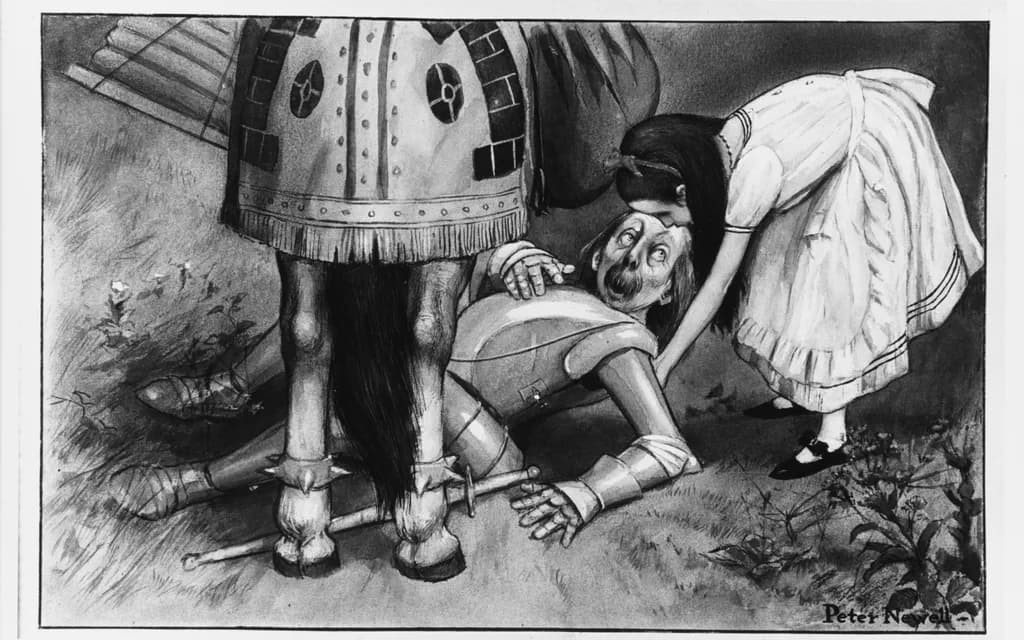
The White Knight is the reason a lot of readers rate this book above the first one. He is useless, endlessly inventive, permanently upside down in a ditch, and he is the only character in either book who is kind to Alice without wanting anything. Carroll gives him the closest thing either book has to an emotional scene, and then lets Alice walk away from it to be crowned.
The ending is the other thing readers remember. The book's last three chapters are wildly out of proportion: chapter nine, Queen Alice, is a long coronation feast that collapses into chaos; chapter ten, Shaking, is a paragraph in which Alice picks the Red Queen off the table and shakes her until she gets shorter and fatter and softer and rounder and the sentence simply stops on a dash. Chapter eleven, Waking, is one line long, and it finishes the sentence chapter ten broke off.
“—and it really wasa kitten, after all.”
A one-sentence chapter that completes the previous chapter's interrupted clause is the kind of joke you can only make in print, and no screen adaptation has ever found a way to do it. Chapter twelve then asks who was dreaming, Alice or the Red King, and refuses to answer.
🐝 The chapter the illustrator refused to draw
Around chapter eight there was once a passage of about fourteen hundred words in which Alice meets an elderly wasp in a yellow wig, complete with a poem in five stanzas. Tenniel killed it. His letter to Carroll is one of the great pieces of illustrator candour: he did not think Carroll brutal for asking, but the wasp chapter did not interest him in the least and he could not see his way to a picture, a wasp in a wig being altogether beyond the appliances of art.
Carroll cut it, and for a century nobody could prove it had ever existed. Then in 1974 Sotheby's in London offered a set of galley proofs carrying the passage, with the printer's instructions to remove it written in by hand, and Martin Gardner published the recovered text in 1977. It is the only substantial piece of either Alice book that was written, set in type and then deleted, and the reason it went is that one man decided it could not be drawn.
If you are coming to the sequel from Wonderland, the case for reading the first book is a good place to start, and the logic Carroll wired through both of them is the subject of the essay on his engineered nonsense. Every quotation above was checked against the free text at Project Gutenberg.
Sources
- Through the Looking-Glass (Project Gutenberg #12) — Project Gutenberg
- Through the Looking-Glass — Wikipedia
- The Wasp in a Wig — Wikipedia
- Red Queen hypothesis — Wikipedia
Frequently asked questions
- Should I read Through the Looking-Glass after Alice in Wonderland?
- Yes, in that order, though the books barely refer to each other. Its twelve chapters are Looking-Glass house, The Garden of Live Flowers, Looking-Glass Insects, Tweedledum and Tweedledee, Wool and Water, Humpty Dumpty, The Lion and the Unicorn, It's My Own Invention, Queen Alice, Shaking, Waking, and Which Dreamed It? Two of those last three are a page long.
- Is Humpty Dumpty in Alice in Wonderland?
- No, and the name appears nowhere in it: Humpty Dumpty occurs zero times in Wonderland's text. He owns chapter VI of Through the Looking-Glass, where he complains that Alice's face is too ordinary to remember, the two eyes, nose in the middle, mouth under, and says he would know her again if the eyes were on the same side of the nose.
- Who says "six impossible things before breakfast"?
- The White Queen, in chapter V. She is arguing that belief is a skill, and she backs it with her own biography: asked her age a page earlier she says she is one hundred and one, five months and a day, which Alice cannot believe, which is the whole point of the exchange.
- What is the Red Queen's race in Through the Looking-Glass?
- In chapter II Alice and the Red Queen run hand in hand until Alice is out of breath, and nothing around them moves: the things round them never change their places at all. When Alice says that at home you would get somewhere else, the Queen answers, a slow sort of country. The scene is the origin of the Red Queen hypothesis in biology.
- Was a chapter cut from Through the Looking-Glass?
- Yes. About fourteen hundred words in which Alice meets a wasp in a yellow wig were set in type and cut at Tenniel's request. The published book runs straight past the join: at the end of chapter VIII Alice says now for the last brook, and to be a Queen, jumps it, and finds something very heavy on her head, which turns out to be a golden crown.
- Is Through the Looking-Glass longer than Alice in Wonderland?
- Yes, by about three thousand words. The gap is not spread evenly: chapters VIII and IX, the White Knight and the coronation feast, run past four thousand words each, while chapter X comes to fifty-six words and chapter XI to nine. Wonderland has no chapter above about 2,600.
Enjoyed this one?