What Does "Jabberwocky" Actually Mean? Lewis Carroll's Nonsense Poem, Word by Word
A poem of invented words that everyone understands anyway, with an explanation Carroll wrote into his own sequel and delivered through an egg.


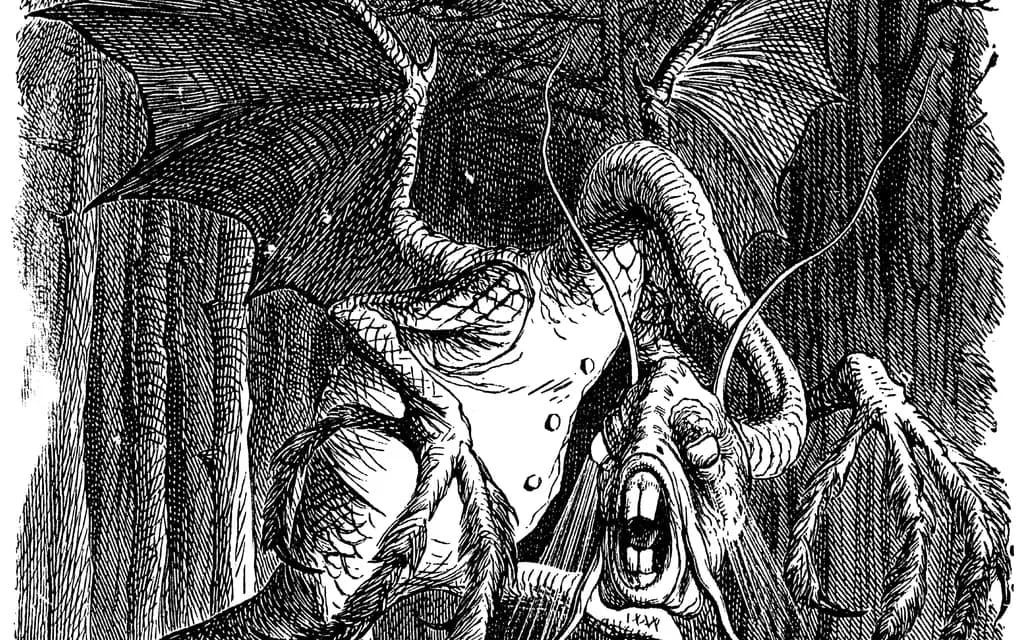
Almost every word in the first stanza of Jabberwocky is invented, and almost every reader understands the poem anyway. That is the trick, and Carroll was so pleased with it that he wrote an explanation into his own sequel five chapters later, delivered by an egg.
- Carroll glosses it himself. Humpty Dumpty walks Alice through the first stanza, word by word.
- Only the first stanza gets explained. Vorpal, frumious and Bandersnatch are never defined at all.
- The grammar is completely intact. You can parse every line without knowing a single noun in it.
- It is not in Alice in Wonderland. It opens the sequel, printed backwards, in a mirror.
Wonderland has its own department of invented language, and you can argue with it directly: the playable Alice's Adventures in Wonderland includes the Mock Turtle's school curriculum, where the subjects are Reeling and Writhing and the branches of Arithmetic are Ambition, Distraction, Uglification and Derision.
📄 The short answer: gibberish with a working skeleton
Read the opening stanza as a grammarian rather than a reader and it resolves instantly. “Twas brillig” is a time. “The slithy toves” is a definite article, an adjective and a plural noun. “Did gyre and gimble” is a compound verb. “In the wabe” is a prepositional phrase locating the action. You know exactly what shape of thing is happening, and you know it before you know what a tove is.
The rest of the poem then hangs an entirely conventional adventure on that frame. There are seven stanzas: the opening, five of story, and the opening again at the end, unchanged, so the poem closes on the same afternoon it began. Alice's own review, delivered on the page a few lines later, is the honest one, and Carroll adds that she did not like to admit even to herself that she could not make it out at all.
“It seems very pretty,” she said when she had finished it, “but it's ratherhard to understand!”
🔤 The first stanza, word by word, in Carroll's own gloss
Everything in this table comes from chapter six of Through the Looking-Glass, where Alice asks Humpty Dumpty to explain the poem and he obliges at length before losing interest and changing the subject to his own verse. One entry is hers rather than his: Alice guesses the wabe and he confirms it.
| Word | What Humpty Dumpty says it means |
|---|---|
| brillig | “four o'clock in the afternoon—the time when you begin broilingthings for dinner.” |
| slithy | “lithe and slimy”, and his example of a portmanteau: “there are two meanings packed up into one word.” |
| toves | “something like badgers—they're something like lizards—and they're something like corkscrews.” They nest under sun-dials and live on cheese. |
| gyre | “to go round and round like a gyroscope.” |
| gimble | “to make holes like a gimlet.” |
| wabe | Alice guesses “the grass-plot round a sun-dial” and he confirms it: so called, he says, because it goes a long way before it and a long way behind it, at which point Alice adds “and a long way beyond it on each side.” |
| mimsy | “flimsy and miserable”, and, he notes, another portmanteau. |
| borogove | “a thin shabby-looking bird with its feathers sticking out all round—something like a live mop.” |
| rath | “a sort of green pig.” |
| mome | He is not sure. He thinks it is short for “from home”, meaning the raths had lost their way. |
| outgrabe | “something between bellowing and whistling, with a kind of sneeze in the middle”, and you will hear it done in the wood yonder. |
Notice what is missing. The words most people can actually quote come from the later stanzas, and not one of them is defined anywhere in either book: the Jubjub bird, the frumious Bandersnatch, the vorpal blade, the manxome foe, the Tumtum tree, uffish thought, the tulgey wood, and the blade going snicker-snack. Carroll explains the stanza that needs it least and leaves the memorable half alone, which is probably why it stayed memorable.
🪞 Is Jabberwocky in Alice in Wonderland or Through the Looking-Glass?
The sequel, and the confusion is understandable, because adaptations pull freely from both books. Jabberwocky appears in chapter one of Through the Looking-Glass, published in December 1871, six years after Wonderland. Alice finds it in a book in the mirror room and cannot read a word, because everything in that room is reversed, and then works out for herself that it is a looking-glass book and holds it up to a glass.
That staging is doing real work. The first thing the sequel asks Alice to do is decode a text, and the first thing she decodes is a poem she then cannot understand. Wonderland opens with a fall; this one opens with a reading problem, and the whole book runs on that difference.
For everything else the sequel has and Wonderland does not, the essay on Through the Looking-Glass is the one to read, and the characters people routinely file under the wrong book are sorted in the character guide.
🌍 How do you translate a poem with no words in it?
Sixty-five languages have tried. The problem is precise: the grammar is ordinary English and has to survive, while the vocabulary is invented and cannot be looked up, so a translator has to coin new words that behave correctly in the target language and sound as though they have always existed in it.
The solutions are worth knowing about. Frank L. Warrin turned “Twas brillig” into “Il brilgue” in French. D. G. Orlovskaya's 1967 Russian version, Barmaglot, is the one Russian readers quote, and it renders the Bandersnatch as Brandashmyg. The linguist Chao Yuen Ren invented Chinese characters for his version rather than borrowing existing ones. Satyajit Ray, better known for the films, made a Bengali version. M. L. West published one in Ancient Greek in 1964, and there is a Latin one.
Douglas Hofstadter used the poem to make a point about how much a word's ancestry carries: a French translator choosing between a Latin-rooted coinage and an earthier one for slithy is choosing between two different jokes, not two spellings of the same one. Carroll built a machine for exposing that, and it still works in sixty-five languages.
✒️ Why a poem made of invented words is still assigned in schools
Carroll had been working the idea for a long time. The opening stanza exists in a version from about 1855, roughly sixteen years before the book, written out in mock-medieval spelling and printed in a family magazine called Mischmasch under the title Stanza of Anglo-Saxon Poetry. The tone of the joke is already there: it is a pastiche of a heroic fragment, complete with thorns standing in for the word the.
Two of the poem's coinages went on to become ordinary English words, listed in dictionaries and credited to Carroll, and the essay on Carroll's engineered nonsense tells that story in full. The larger point is the one Humpty Dumpty makes in passing while defining slithy: a portmanteau packs two meanings into one word, and once you have the trick you can build a vocabulary out of it. That is why the poem is taught. It is the cleanest demonstration in English of how much meaning lives in grammar and sound rather than in the dictionary.
It is also why it survives being read aloud badly, in classrooms, by people who have no idea what a borogove is. The poem does not need them to know. If you want the book the poem opens, start with the case for reading Wonderland first. Every line quoted above was checked against the free text at Project Gutenberg.
Sources
- Through the Looking-Glass (Project Gutenberg #12) — Project Gutenberg
- Jabberwocky — Wikipedia
Frequently asked questions
- What does Jabberwocky mean?
- A monster-slaying ballad in invented vocabulary and ordinary grammar, seven stanzas and twenty-eight lines. Jabberwocky is the poem; the Jabberwock is the creature. The father's warning names three dangers, the Jabberwock, the Jubjub bird and the frumious Bandersnatch, and the son fights only the first, which is the whole plot.
- Is Jabberwocky in Alice in Wonderland or Through the Looking-Glass?
- Through the Looking-Glass, chapter one, printed in mirror writing so that Alice has to hold the book up to a glass. Carroll had written the opening stanza about sixteen years earlier for a family magazine called Mischmasch, under the title Stanza of Anglo-Saxon Poetry, in mock-medieval spelling: bryllyg, slythy, gymble.
- What words did Lewis Carroll invent in Jabberwocky?
- Dozens, and two of them stuck. Chortle, which dictionaries gloss as a blend of chuckle and snort, and galumph both entered standard English credited to Carroll. Neither is glossed inside the book: Humpty Dumpty explains the first stanza only, and both words come from the fifth and sixth.
- What is a Bandersnatch?
- Carroll never says. The word appears three times in Through the Looking-Glass and is never defined: once in the poem, where the son is warned to shun the frumious Bandersnatch, and twice from the White King in chapter VII, that a minute goes so quick you might as well try to stop a Bandersnatch, and that catching the Queen would be like catching a Bandersnatch.
- What is the famous line from Jabberwocky?
- Two compete, and both are in chapter one of Through the Looking-Glass. The opening, "Twas brillig, and the slithy toves / Did gyre and gimble in the wabe", which is also the closing stanza because Carroll repeats it word for word at the end. And the warning that starts the plot: "Beware the Jabberwock, my son! / The jaws that bite, the claws that catch!"
- What is a portmanteau word?
- Humpty Dumpty's own metaphor, in chapter VI: two meanings packed up into one word, like a portmanteau. He runs it twice and stops. Slithy is lithe and slimy, mimsy is flimsy and miserable, and he throws in borogove as a thin shabby-looking bird with its feathers sticking out all round, something like a live mop.
- What are toves in Jabberwocky?
- Humpty Dumpty says they are something like badgers, something like lizards and something like corkscrews, that they make their nests under sun-dials, and that they live on cheese. He supplies that level of detail for eleven words of the first stanza, then loses interest, asks who has been repeating all that hard stuff to Alice, and changes the subject to his own poetry.
Enjoyed this one?