Alice in Wonderland isn't nonsense — it's a math teacher's logic puzzle (2026)
Lewis Carroll taught mathematics at Oxford for 26 years. Read Alice in Wonderland knowing that and the nonsense reorganizes itself: every weird image has a rule under it. Here's the engineered logic hiding in a children's book.


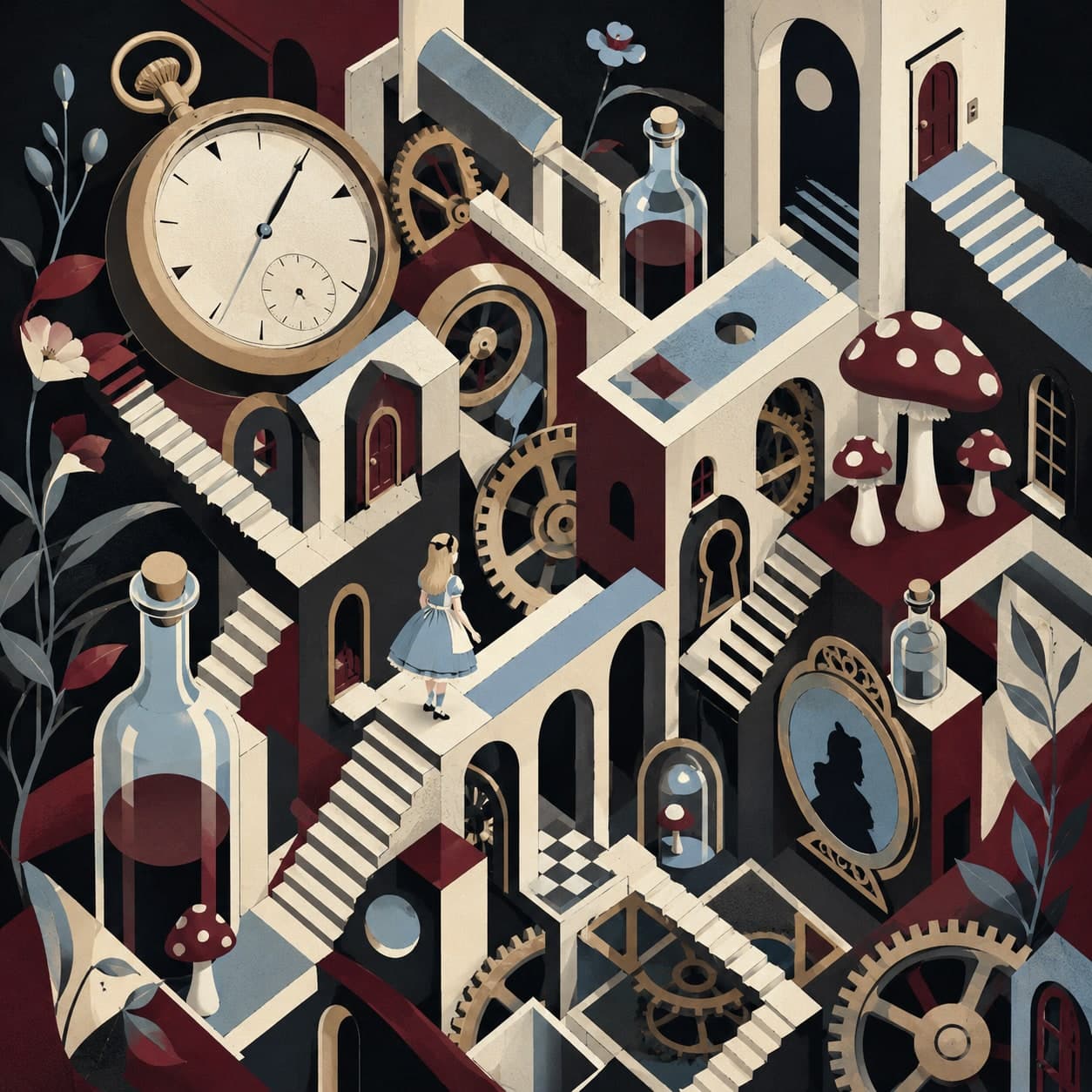
Here is the fact that rewrites the book: the man who wrote Alice's Adventures in Wonderland taught mathematics at Oxford for twenty-six years. “Lewis Carroll” was the pen name of Charles Lutwidge Dodgson, a logician who lectured at Christ Church and wrote real math under his own name. Read the book knowing that, and the “nonsense” stops looking random. Every weird image has a rule under it. It isn't a dream a man scribbled down — it's a logic puzzle he dressed up as whimsy.
- Carroll was a working mathematician. Twenty-six years lecturing at Oxford — the nonsense is engineered, not accidental.
- The jokes are structured.The Mock Turtle's school subjects are a syllable-perfect parody of a real curriculum.
- He invented words you still use.“Chortle” and “galumph” are his coinages, now in the dictionary.
- He left a riddle unanswered for thirty years — on purpose — then answered it with a joke spelled backwards.
🎩 The Oxford mathematician behind the nonsense
On 4 July 1862, on a rowing trip with the young daughters of an Oxford dean, Carroll improvised a story to keep a ten-year-old named Alice Liddell entertained. She asked him to write it down. Three years later that afternoon became Alice's Adventures in Wonderland (1865) — the most-quoted children's book in English, from a man whose day job was rules. He never set out to write a book at all.
It was logic. Twenty-six years at Oxford, and what lit him up was rules. Every joke he writes is structured. Engineered nonsense.
🧮 Every joke has a rule under it
Take the scene most readers skim. When Alice meets the Mock Turtle, he lists the subjects he studied at school — and on a first read it's pure gibberish. Read it slowly and it snaps into focus: it's a syllable-for-syllable parody of a real Victorian curriculum.
| What the Mock Turtle says he studied | What Carroll is actually naming |
|---|---|
| Reeling, Writhing | Reading, Writing |
| Ambition, Distraction | Addition, Subtraction |
| Uglification, Derision | Multiplication, Division |
Every word is targeted: reeling and writhing are what you do while a teacher takes you apart. Carroll wrote classroom satire and disguised it as wordplay so kids would laugh and teachers couldn't object. Then he tops it: Alice asks why lessons are called lessons, and the answer is “because they lessen from day to day.” A logician's pun that also happens to be the entire job of a school, compressed into one line.
The lessons lessen, that's the whole job of a teacher in one line. Twelve years of school in three words.
That's the pattern for the whole book: a surface that reads as silly, with a rule sitting underneath it. Once you can see the engine, you can't stop seeing it.
Engineered nonsense. I think that's the through line, right? Every weird image in this book has a rule under it. Show me the engine.
🔤 The words Carroll invented that you still use
The same mathematician's habit shows up in his vocabulary. When Carroll needed a word that didn't exist, he built one — and two of them outlived him into everyday English. “Chortle” (chuckle + snort) and “galumph” (roughly gallop + triumphant) are portmanteau words he coined in his poem “Jabberwocky.” Both are now listed in the Oxford English Dictionary. (A nice piece of trivia for pub night: “Jabberwocky” is actually in the 1871 sequel, Through the Looking-Glass, not Wonderland — but the word-building instinct is the same one running underneath Alice.)
They all live in the same part of your throat. He just found a gap in the language and patched it.
That “find the gap, fill it” move is exactly how a proof works — spot what's missing, supply the piece that has to go there. Carroll was running mathematician's logic on the English language, and the patches held.
That's really how a math proof works, too. Find the gap, fill it. He's running mathematician brain on a children's poem.
🐦 The riddle he refused to answer for 30 years
At the Mad Hatter's tea party, Carroll plants the book's most famous riddle: Why is a raven like a writing-desk? Generations of readers have tried to crack it. The twist is that there was nothing to crack — Carroll built it to have no answer at all, and then watched the letters pour in for decades. When he finally relented, in the preface to the 1896 edition, the answer was a joke at the riddle's expense (documented in full by The Straight Dope):
Because it can produce a few notes, though they are very flat; and it is never put with the wrong end in front.
And here is the detail only a logician would bury: Carroll originally spelled “never” as nevar — which is raven backwards. A proofreader decided he knew better, “corrected” the spelling, and quietly deleted the entire joke. Thirty years of demand, answered with a pun hidden inside a misspelling.
That is the most petty academic move I have ever heard, and it works. It's the most remembered non answer in English literature.
So the math jokes are the surface, and the architecture is an Oxford logic don writing a children's book where every piece of nonsense has a rule under it — quietly, the whole time. Half the slang and imagery you reach for came out of that one engineered afternoon. A Trojan horse with a PhD.The Wonderful Wizard of Oz hides the same kind of engineered logic, 1900s politics dressed as a children's adventure. Peter Pan runs rules under its nonsense too — how a child qualifies as lost, how a boy is measured for his tree — and six essays on what Barrie actually wrote are collected there.
Sources
- Lewis Carroll — Wikipedia
- Jabberwocky — Wikipedia
- Why is a raven like a writing desk? — The Straight Dope
- Alice's Adventures in Wonderland (1865 text) — Project Gutenberg
- Alice's Adventures in Wonderland — reader reviews — Goodreads
Frequently asked questions
- Was Lewis Carroll really a mathematician?
- Yes. “Lewis Carroll” was the pen name of Charles Lutwidge Dodgson, who won the Christ Church Mathematical Lectureship at Oxford in 1855 and held it for the next 26 years. He wrote real mathematical works under his own name and Alice under the pseudonym. The logician's habit of mind — define your terms, follow the rule to its absurd conclusion — is the engine under the book's nonsense.
- Is Alice in Wonderland actually nonsense?
- Not in the way it looks. Almost every “nonsense” moment is built on a precise rule. The Mock Turtle's school subjects (Reeling, Writhing, Ambition, Distraction, Uglification, Derision) are a syllable-for-syllable parody of Reading, Writing, Addition, Subtraction, Multiplication, Division. The joke that lessons are called lessons “because they lessen from day to day” is a logician's pun. The surface is whimsy; the structure is engineered.
- What words did Lewis Carroll invent?
- Carroll coined “chortle” (a blend of chuckle and snort) and “galumph” (roughly gallop plus triumphant) in his poem “Jabberwocky” — which appears in the 1871 sequel Through the Looking-Glass, not the 1865 Wonderland. Both are portmanteau words, and both are now listed in the Oxford English Dictionary. You use his inventions without knowing they're his.
- What is the answer to “Why is a raven like a writing desk?”
- Originally there was no answer — Carroll said the Mad Hatter's riddle “had no answer at all.” After years of readers demanding one, he supplied a joke answer in the preface to the 1896 edition: “Because it can produce a few notes, though they are very flat; and it is never put with the wrong end in front!” He first spelled “never” as “nevar” — which is “raven” backwards — but a proofreader “corrected” it and erased the pun.
- Who was the real Alice in Alice in Wonderland?
- Alice Liddell, the young daughter of the dean of Christ Church, Oxford. Carroll first improvised the story for her and her sisters during a boat trip on 4 July 1862, then wrote it down at her request. The book that grew out of that afternoon was published as Alice's Adventures in Wonderland in 1865.
Enjoyed this one?