What you missed in Alice in Wonderland as a kid — and can't unsee as an adult (2026)
At nine, Alice in Wonderland is a girl having a weird day. At thirty, it's a precise account of losing control of your body, your identity, and the rules — disguised as a children's book. Here's what you missed the first time.


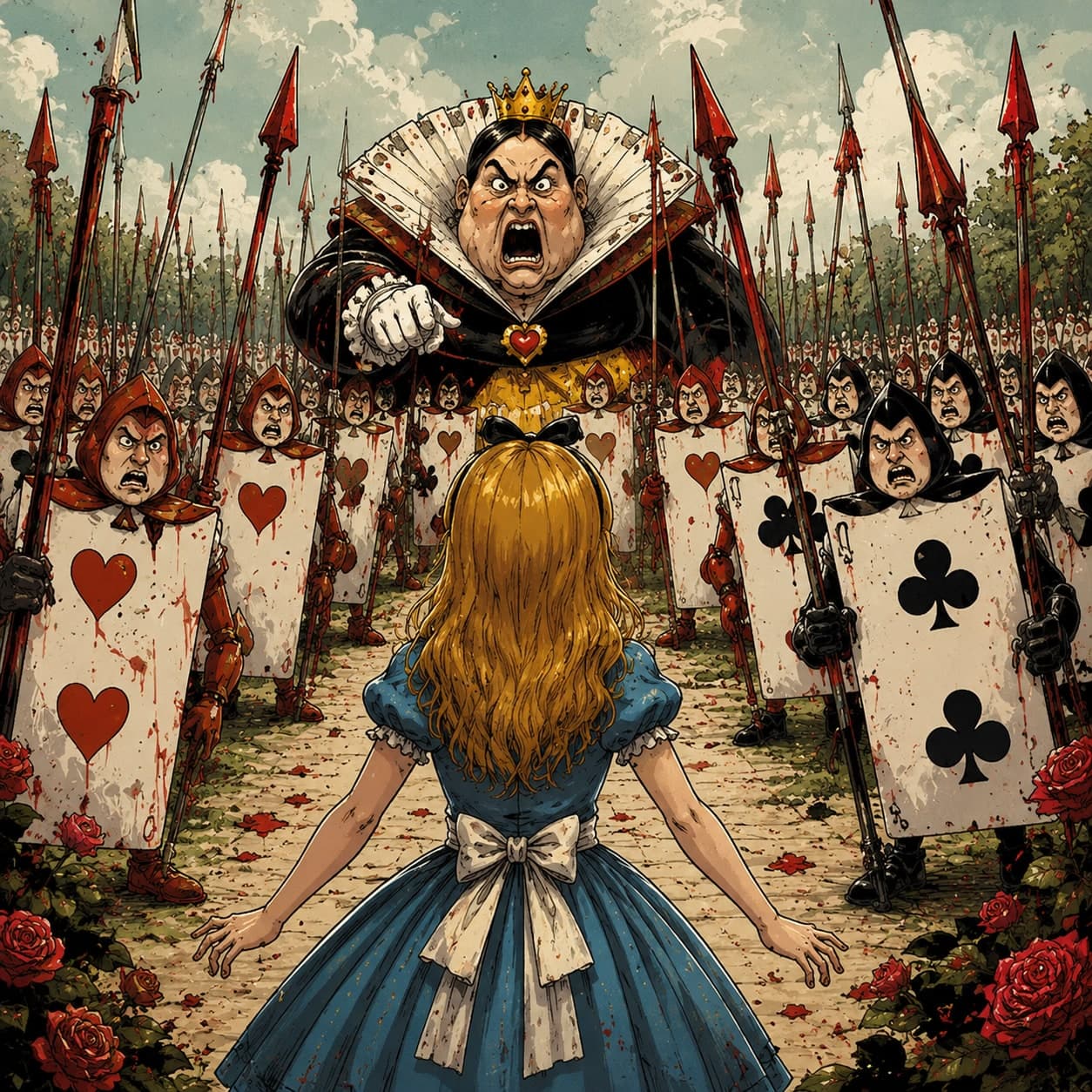
Most of us read Alice's Adventures in Wonderland once, around nine, and filed it under “whimsical children's book.” Open it again as an adult and it quietly becomes something else: a precise account of losing control of your body, your identity, and the rules — with the danger that a kid sails right past. It's the same words on the page. You're the variable that changed.
- It's two different books. At nine you read the surface; at thirty the same chapters read as memoir.
- The size changes are puberty.A body doing things you didn't ask for, on a schedule you didn't pick.
- It's darker than you remember.Live execution orders and near-death scenes, in a kids' book.
- The trial is a kangaroo court.“Sentence first — verdict afterwards” is every rigged meeting you've sat in.
🔍 Why it's a completely different book at thirty
The clearest way to feel the shift is to read a chapter aloud. The jokes don't change; your reaction to them does. At nine, Alice is a girl having a strange day. At thirty, you've been some version of Alice — too big for the room, too small to be heard, handed rules nobody explained — and the book knows it.
I bailed on it at nine. It floored me at thirty. Different book, completely different book. At nine you can't see it. At thirty you can't unsee it.
📏 The size changes are puberty
Alice changes size more than a dozen times — ten inches tall, then nine feet, unable to fit through a door she could walk through a page ago. As a kid it's a fun special effect. As an adult it's the most accurate description of adolescence in the book: your body rearranging itself without your consent. And right in the middle of it, a Caterpillar leans in and asks the worst possible question — “Who are you?” — while Alice is already wondering “Who in the world am I?”
The size changes are the body doing things you didn't ask for, on a schedule you didn't pick.
The critic Merve Emre, writing in The Point, catches the same struggle in Carroll's prose: Alice keeps trying “to concentrate herself into ‘one respectable person’” even as her hands and feet threaten to get away from her. That is the whole project of growing up, and Carroll put it on the page in 1865. Alice names the feeling herself, in a line that does nothing to a child and lands like a weight on an adult:
I almost wish I hadn't gone down that rabbit-hole.
☠️ It's far darker than you remember
The thing nobody warns you about on the re-read is the body count the book keeps threatening. The danger is constant; it just hums under the comedy where a nine-year-old can't hear it. Other readers notice the same shift — Wonderland starts to feel less like a playground and more like a place where the adults have stopped reading the labels.
| What you saw at nine | What you see at thirty |
|---|---|
| A girl makes a big puddle of tears | Alice nearly drowns in her own tears (chapter 2) |
| The Queen yells a funny catchphrase | A standing execution order: “Off with her head!” |
| Alice tries a cake and a drink | A child consuming unlabeled substances, unsupervised |
| Cards run around shouting | A trial where the verdict is decided first |
Carroll hands a child a story whose background hum is “you might die” — and it doesn't scare them, because at nine you don't have death anxiety yet. You have wonder anxiety. The horror was always there in the ink; you just grew the eyes to read it.
⚖️ The trial is every kangaroo court you've sat in
The book ends in a courtroom, and it's the part that hits hardest as an adult. The Knave of Hearts is “tried” in a proceeding where the Queen demands “Sentence first — verdict afterwards!” It's a logician's joke about how an unjust process actually runs: the outcome is already in the room before anyone speaks. If you've ever walked into a meeting where the decision had clearly been made, you know the scene from the inside.
HR meeting, no agenda. Sat down and the verdict was already in the room. I just hadn't been told yet. They were waiting on me to say something so they could nod and write it down. I remember thinking, this isn't a meeting. It's the trial scene.
Then comes the release. Alice grows back to full size, looks at the whole court, and says the line the entire book has been building toward: “You're nothing but a pack of cards!” She finally out-sizes the system and sees it for what it is. That's why the book rewards a re-read — the metaphor scales with whoever's holding it.
Anyone who's ever realized their boss was bluffing recognizes that line. That's why the book grows with you.
Published in 1865, and people are still living different versions of that arc — the body that won't cooperate, the room that's rigged, the moment you finally see it for what it is. What you missed at nine is still waiting for you. It's a short afternoon's read. Bring the book. Dorothy's Wonderful Wizard of Oz runs the same rigged-system reveal from the other side, worth reading right after this one. Little Women rewards the same kind of adult re-read, once you notice what Jo actually gives up. So does Peter Pan, where the last chapter turns out to be about the woman at the window rather than the boy outside it.
Sources
- Alice's Adventures in Wonderland (1865 text) — Project Gutenberg
- Into Wonderland — The Point Magazine
- Alice's Adventures in Wonderland — book review — Keeping Up With The Penguins
- Alice's Adventures in Wonderland — Wikipedia
- Alice's Adventures in Wonderland — reader reviews — Goodreads
Frequently asked questions
- Is Alice in Wonderland a children's book or is it for adults?
- Both, and it reads as two different books depending on when you open it. As a child you experience the surface — talking animals, a tea party, a girl who grows and shrinks. As an adult the same pages read as a sharp account of identity, bodily change, and arbitrary authority. Carroll wrote it for a ten-year-old, but the structure rewards a thirty-year-old.
- What do the size changes in Alice in Wonderland mean?
- Read as an adult, Alice's constant shrinking and growing maps cleanly onto adolescence: a body doing things you didn't ask for, on a schedule you didn't pick. She is nine inches tall, then nine feet, can't fit through the door, and is asked to declare an identity she doesn't have yet. The Caterpillar's “Who are you?” is the worst possible question to ask someone in that state — which is exactly the point.
- Why is Alice in Wonderland considered dark?
- Underneath the whimsy it runs on threat. The Queen of Hearts is issuing live execution orders (“Off with her head!”) in a children's book; Alice nearly drowns in her own tears, drinks from an unlabeled bottle, and eats a cake just because it says “Eat me.” At nine the danger doesn't register; at thirty it reads as a child in an unsupervised place where the adults aren't reading the labels.
- What does the trial scene in Alice in Wonderland represent?
- The trial of the Knave of Hearts is institutional satire from a logician who watched real courts cut corners. The Queen's “Sentence first — verdict afterwards!” is a joke about how an unjust process actually works: the outcome is decided before the hearing begins. Anyone who has sat in a meeting where the decision was already made recognizes it instantly.
- Why does Alice in Wonderland get better when you re-read it?
- Because the central metaphor scales with the reader. The book ends with Alice growing to full size and declaring the court “nothing but a pack of cards” — she finally out-sizes the system and sees it for what it is. A child reads that as the dream collapsing; an adult reads it as the moment you realize the authority intimidating you was bluffing. The book grows as you do.
Enjoyed this one?