Every place Alice in Wonderland is hiding in pop culture — and you quote it weekly (2026)
You quote Alice in Wonderland constantly without noticing — every time you say “down the rabbit hole” or “red pilled.” Here's the trail from an 1865 children's book to the Matrix, a 1967 rock anthem, every portal story since, and the names in your cryptography textbook.


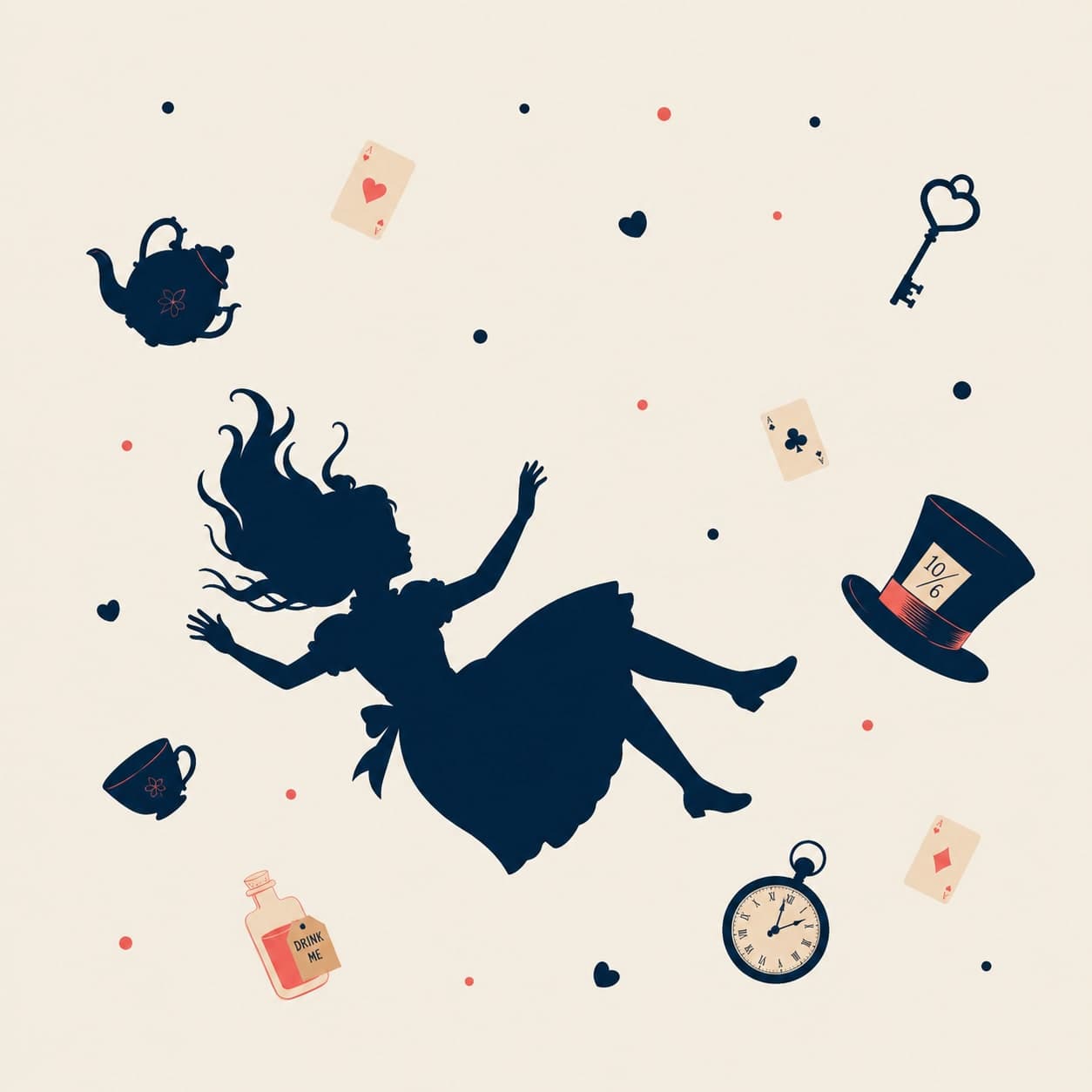
You quote Alice's Adventures in Wonderland all the time — you've just never noticed. Say you went “down the rabbit hole” on a research binge, or that a choice felt like getting “red pilled,” and you're reaching, secondhand, for an 1865 children's book. Once you start looking, a Victorian math teacher's afternoon story turns up everywhere: in The Matrix, in a 1967 rock anthem, in every portal movie since, even in the names in your cryptography textbook.
- “Down the rabbit hole”means what it means today because of Carroll — now it's the phrase for getting lost online.
- The Matrix quotes Wonderland out loud. Morpheus literally name-checks Alice and the rabbit hole.
- “White Rabbit” is Alice set to music — written by a man who would have called the police on the sixties.
- Every portal story descends from it — and even cryptography borrowed the cast.
| The reference you reach for | Where it actually comes from |
|---|---|
| “Down the rabbit hole” | Chapter 1 of Alice in Wonderland (1865) |
| “Red pilled” / The Matrix | Morpheus quoting Wonderland directly |
| “White Rabbit” (Jefferson Airplane) | Alice imagery, start to finish |
| “Alice and Bob” in a crypto paper | The book's stand-in characters, borrowed |
🐇 “Down the rabbit hole” — what it really means
Start with the phrase you say the most. Chapter one of Alice in Wonderland is literally titled “Down the Rabbit-Hole,” and Carroll spends a whole page on Alice drifting slowly down, past shelves and jars of marmalade. The words existed before him — but the meaning we use now is his invention: falling into something strange where time stops mattering. In 2026 that's the phrase for getting swallowed by the internet — the 2 a.m. Wikipedia spiral, the autoplay you didn't choose. He invented the texture of falling into something, and we've been borrowing it ever since.
💊 The Matrix is Alice in Wonderland in leather
The Matrix doesn't hide its source — it says it out loud. Morpheus tells Neo, “You take the red pill, you stay in Wonderland, and I show you how deep the rabbit hole goes”, and a beat earlier, “I imagine right now you're feeling a bit like Alice.” The red and blue pills are the “Drink me” bottle and “Eat me” cake in leather jackets. The reason the reference works on a modern audience is that nobody needs it explained.
So my brain reached for “red pilled” to describe picking a database, and a room full of engineers nodded. Same book.
🎸 Jefferson Airplane's “White Rabbit”
In 1967, Grace Slick built “White Rabbit” almost entirely out of Alice imagery — pills that make you larger and smaller, the hookah-smoking caterpillar, “go ask Alice.” Most people heard it as a drug song and stopped there, which is exactly the deadpan irony of it. The source material was written by a Victorian mathematician ordained in the Church of England — a man who would have been horrified by the entire sixties scene he ended up scoring.
A psychedelic anthem written by a man who'd have called the police.
🌀 Every portal story descends from Alice
The bigger footprint isn't a single quote — it's a whole genre. The shape of “an ordinary person falls into a parallel world that runs on dream logic, and may not get back” is the Alice template: Coraline, Pan's Labyrinth, Spirited Away, the Upside Down in Stranger Things, the dream-layers of Inception. Carroll's deeper change was tonal.
Before Carroll, fairy tales went somewhere magical. After Carroll, they go somewhere wrong, and the audience just gets it. Nobody needs the rules explained, because Alice already taught us how a wrong world works.
That's why the references land without a footnote. The book did the teaching a century before the movies arrived — and it's still doing it. As one host put it, the rabbit hole didn't close when the book ended:
My dad read me chapter one when I was seven, the slow drift down. He'd do the voice and slow his reading till I was half asleep. Every time I'm tabs deep at midnight on a Wikipedia rabbit hole, I hear him slow that voice. Same book.
🔐 Even cryptography runs on Alice
Here's the one that surprises people who do this for a living. “Alice and Bob” are the default placeholder names for two parties exchanging a secret message — used across cryptography, physics, and game theory. They were introduced in a 1970s public-key cryptography paper and have been the field's standing cast ever since. One more place a Victorian children's book quietly named the characters.
One afternoon on a rowboat in 1862 became the source code for The Matrix, a number-one anthem, every portal story since, and the names in your crypto homework.
Alice is not the only Victorian book that now survives mostly as quotations. A Christmas Carol did the same thing twenty-two years earlier, and our essays on Dickens's ghost story follow its two most-repeated lines back to the pages they actually sit on.
That's the strange afterlife of one improvised story: it stopped being a book you read and became a language you speak. Half the internet quotes this 1865 book every week — including you. Worth opening the original at least once. It's a short, slow drift, all the way down.
Sources
- Alice's Adventures in Wonderland (1865 text) — Project Gutenberg
- Down the rabbit hole — Wikipedia
- Red pill and blue pill — Wikipedia
- White Rabbit (song) — Wikipedia
- Alice and Bob — Wikipedia
- Alice's Adventures in Wonderland — book review — Keeping Up With The Penguins
Frequently asked questions
- Where does the phrase “down the rabbit hole” come from?
- From chapter one of Alice's Adventures in Wonderland (1865), where Carroll spends a whole page on Alice drifting slowly down past shelves and jars of marmalade. The words existed before him, but the meaning we use now — falling into something strange where time stops mattering — is his. Today it's the phrase for getting swallowed by the internet at 2 a.m.
- Is The Matrix based on Alice in Wonderland?
- It's soaked in it, on purpose. Morpheus tells Neo, “You take the red pill, you stay in Wonderland, and I show you how deep the rabbit hole goes,” and earlier, “I imagine right now you're feeling a bit like Alice.” The red and blue pills are the “Drink me” bottle and “Eat me” cake in leather jackets. The film never hides the source.
- Is Jefferson Airplane's “White Rabbit” about Alice in Wonderland?
- Directly. Grace Slick built the 1967 song out of Alice imagery — pills that make you larger and smaller, “go ask Alice,” the hookah-smoking caterpillar. It was widely heard as a drug song, which is the deadpan irony: the source material was written by a Victorian mathematician ordained in the Church of England, who'd have been horrified by the whole scene.
- What stories were influenced by Alice in Wonderland?
- The “ordinary person falls into a parallel world that runs on dream logic” template descends from Alice: Coraline, Pan's Labyrinth, Spirited Away, the Upside Down in Stranger Things, the dream-layers of Inception. Carroll's deeper change was tonal — before him, fairy tales went somewhere magical; after him, they go somewhere wrong, and the audience just gets it, because Alice already taught us how a wrong world works.
- Who are Alice and Bob in cryptography?
- Alice and Bob are the standard placeholder names for two parties exchanging a secret message, used across cryptography, physics, and game theory. They were introduced in a 1970s public-key cryptography paper and have been the field's default characters ever since — one more place a Victorian children's book quietly named the cast.
Enjoyed this one?