The Best Crime and Punishment Movie or TV Adaptation, Compared
Every screen version has to solve the same problem: the murder is over by page eighty and the rest is two men talking. Only one of them gives it the time.


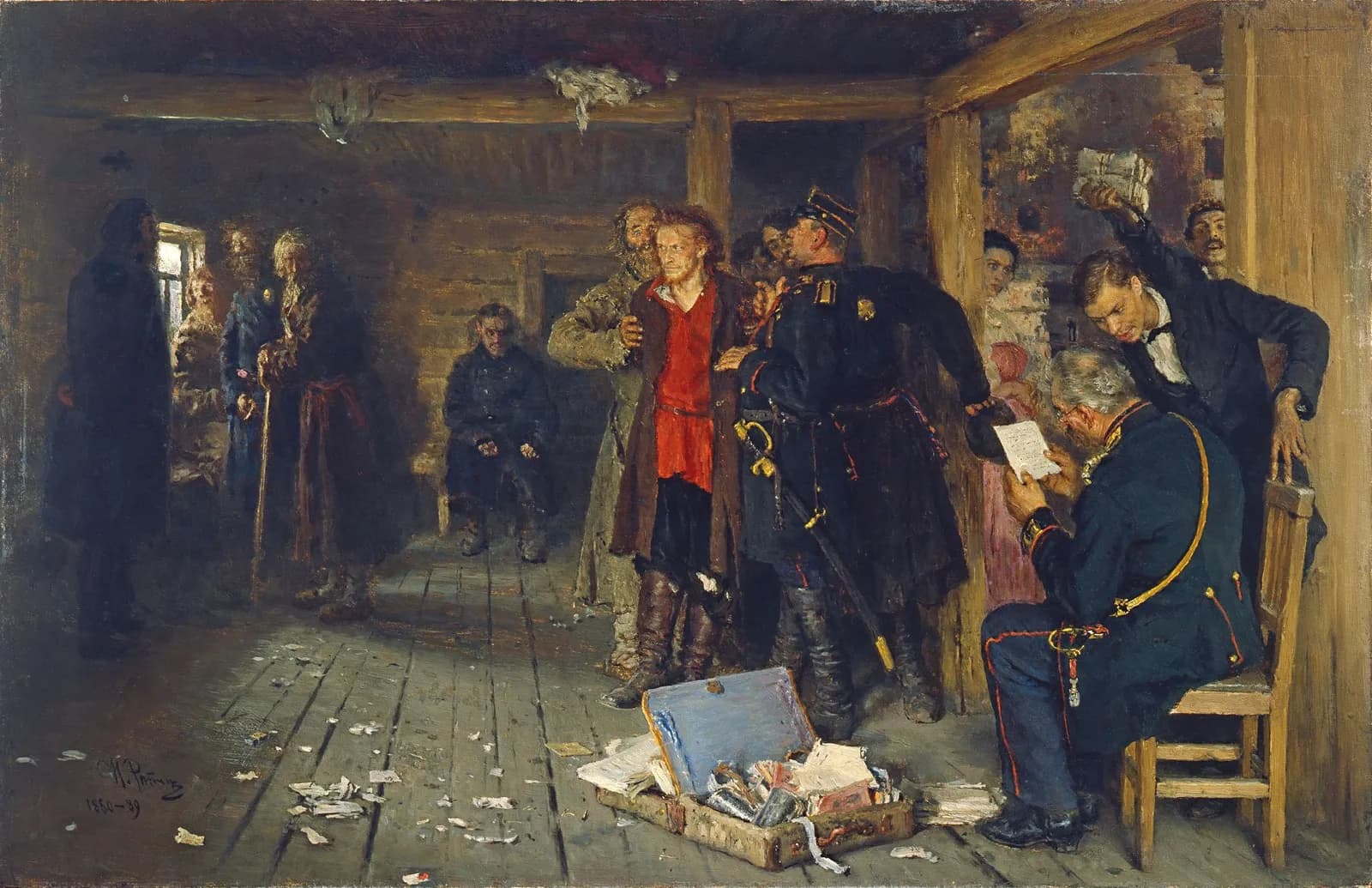
This book is unusually hard to film, and the reason is structural rather than technical. The murder happens early, the murderer is named immediately, and the remaining five parts are interior. Anything that compresses it turns into a manhunt. If you would rather be inside the interior part than watch someone else act it, the playable Crime and Punishment puts you in the rooms the adaptations keep cutting.
The 1979 BBC serial, and why it still holds up
The BBC made a three-part version in 1979, directed by Michael Darlow, with John Hurt as Raskolnikov and Timothy West as Porfiry Petrovitch, per the adaptations record in the novel’s own reference entry and the title record at IMDb. It is also the hardest of the major versions to find on a streaming service, so a reader who wants to check this verdict should expect to hunt for a disc or a library copy.
What it has is length used correctly. Three episodes is enough room to let the interrogation scenes run at conversational speed, which is the only speed at which they work: Porfiry’s method is delay, and a ninety-minute feature cannot afford delay. Hurt plays Raskolnikov as physically unwell rather than romantically tormented, which is what the text actually describes, and West plays Porfiry as somebody enjoying his job. Their scenes together are the reason viewers still hunt this version down decades after it aired.
The detail even good summaries get wrong
There is a specific error that keeps appearing in condensed versions of this story, including video summaries that are otherwise careful, and it is a useful test of any adaptation you are considering. The final confession is routinely staged as a confrontation with Porfiry, the detective who has been circling for five hundred pages. In the novel it is not. Raskolnikov confesses at an ordinary police office in front of Ilya Petrovitch, an assistant superintendent with no idea what is coming (gutenberg-2554 l.21478-21499).
You can see why the change is tempting. Handing the confession to Porfiry pays off the relationship the audience has been watching, and it makes the detective the protagonist of his own story. It also destroys the point. Dostoevsky deliberately denies his investigator the scene, because a confession extracted by the clever policeman is a procedural ending, and the novel wants a moral one. The full ending, including the sentence, is set out separately and carries spoilers.
What every version has to cut
Ranking adaptations of this novel is mostly a question of what each one decided to lose, because no screen version has ever carried all of it. Three things go first, in roughly this order.
- The interior. Most of this book happens inside one head, in a running argument nobody else hears. Film can show a man sweating; it cannot show him constructing a justification and watching it fall apart in the same paragraph.
- The Marmeladov family.The tavern, the yellow ticket, Katerina Ivanovna dying of consumption with three small children in a rented room — the strand that gives the novel its moral weather is usually reduced to Sonia alone.
- The article.The scene where the detective reads the murderer’s own published theory back to him is talky, abstract and hard to stage, and it is also the hinge of the book. Versions that keep it tend to be the ones worth watching.
The Tavern Confession is the scene actors keep asking for: Marmeladov, drunk, telling a stranger exactly what his family has been reduced to. You are the stranger, and you can listen, walk out, or give him money you do not have. Role-play Crime and Punishment →
The other versions worth knowing about
This novel has been filmed for ninety years and in at least four languages, and the useful way to sort the versions is by how much room each one gives the talking.
- The 2002 BBC Two serial. Two episodes, John Simm as Raskolnikov and Ian McDiarmid as Porfiry, per its own reference entry. Sharper and more modern in its camerawork, and the shorter format shows: the investigation compresses into something closer to a police drama.
- The Soviet two-part film.Lev Kulidzhanov’s version with Georgy Taratorkin is the most literal reading of the book on film and the most patient, documented at its own entry. It is also the one that looks most like Petersburg, for obvious reasons.
- The 1930s pair. A French film and a Hollywood one appeared in the same year, both listed in the adaptations record linked above. The Hollywood version is the interesting failure: it keeps the detective and the murderer and throws away the interior.
How to pick, if you only watch one
Start with the 1979 serial if you can find it, because it is the version that understood what the book is: two men talking in rooms, one of whom knows. Take the 2002 serial if you want something faster-moving and easier to stream. Take the Soviet version if you have already read the novel and want to see its Petersburg rather than somebody’s idea of it.
What no screen version really manages is the thing that makes Marmeladov’s tavern monologue unbearable on the page. He introduces himself by rank — “Marmeladov—such is my name; titular counsellor” (l.540) — and then works his way down to the question the whole novel is built on.
“Do you understand, sir, do you understand what it means when you have absolutely nowhere to turn?”
On screen that lands as a good actor doing a drunk scene. On the page it is a man asking a stranger a question that stranger is about to answer with an axe, and the free Garnett text at Project Gutenberg will give it to you in ten minutes of reading.
Sources
- Crime and Punishment — film and television adaptations — Wikipedia
- Crime and Punishment (1979 TV mini series), title record — IMDb
- Crime and Punishment (2002 TV series) — Wikipedia
- Crime and Punishment (1970 film) — Wikipedia
- Crime and Punishment, translated by Constance Garnett (Project Gutenberg #2554) — Project Gutenberg
Frequently asked questions
- What is the best film adaptation of Crime and Punishment?
- The 1979 BBC serial, on the strength of its length and its casting. It runs to roughly 225 minutes across three parts, which is more screen time than any single-film version can give the interrogations, and it puts Siân Phillips in as Katerina Ivanovna alongside Hurt and West.
- What movie is based on Crime and Punishment?
- Several are. The one people usually mean is the 1935 Columbia picture directed by Josef von Sternberg, with Peter Lorre as Raskolnikov and Edward Arnold as the inspector. It is the earliest English-language version most viewers can still find, and it is also the one that cuts the most.
- Which version of Crime and Punishment is best?
- Best depends on what you want from it. For fidelity, the 1979 serial. For accessibility, the 2002 BBC Two pair, directed by Julian Jarrold and adapted by Tony Marchant, which went out on consecutive nights in February 2002 and is the easiest of the lot to stream today.
- What are some movies that adapted the novel?
- A French film and a Hollywood one in the same year of the 1930s, the Soviet two-parter that runs about 221 minutes, the 1979 BBC serial, and the 2002 BBC Two version. In the Soviet film Innokenty Smoktunovsky plays Porfiry, opposite Georgy Taratorkin as Raskolnikov.
- Who played Raskolnikov in the 1979 BBC version?
- John Hurt, with Timothy West as Porfiry Petrovitch and Siân Phillips as Katerina Ivanovna, directed by Michael Darlow. At roughly 225 minutes it is the longest version on this list, and the length is most of why it works: the interrogation scenes are allowed to run at conversational pace.
Enjoyed this one?