Crime and Punishment vs. The Brothers Karamazov: Where to Start with Dostoevsky
The argument about which of the two is greater will outlive everyone having it. Which to read first is a much duller question with a much clearer answer.


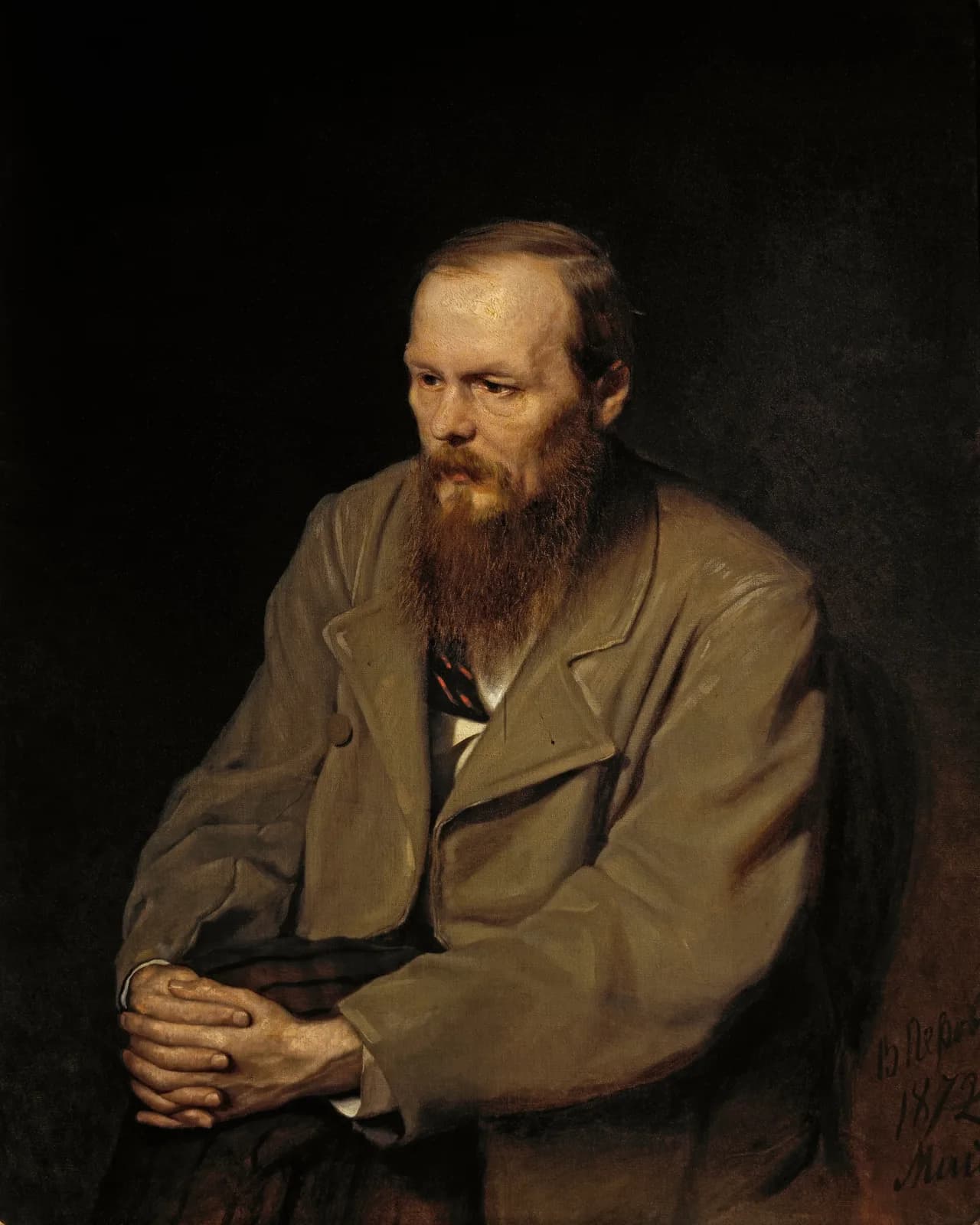
If you would rather walk into the first one than open it, the playable Crime and Punishmentstarts where the novel does, in a pawnbroker’s front room. Both novels are free in Constance Garnett’s translation, which is the one most English readers have met: Crime and Punishment at Project Gutenberg and The Brothers Karamazov in the same place.
Why this one goes first
The two books are usually presented as rivals, and the argument about which is greater has been running for a century and will outlive everyone currently having it. That argument is not the same question as which to read first, and the second question has a much less interesting answer. Crime and Punishment is the easier entry for structural reasons that have nothing to do with quality.
- One plot, running forward. A man commits a murder in the first part and spends the rest of the book failing to live with it. There is nothing to hold in your head.
- A cast you can count. Roughly eight people matter. Karamazov opens with a family history and expects you to keep three brothers, a father and a servant distinct from the first chapter.
- It is genuinely suspenseful. The detective knows and cannot prove it, which turns five hundred pages of interior monologue into something with a clock on it.
What it is actually like to read
The reputation of nineteenth-century Russian fiction as slow and forbidding attaches itself to this novel by association, mostly with War and Peace, and it does not survive the first chapter. The opening sentence is a man leaving his room in hot weather, and what follows is closer to a crime novel than to anything on a syllabus.
“On an exceptionally hot evening early in July a young man came out of the garret in which he lodged”
The real obstacle is not difficulty, it is names. Russian characters arrive with a first name, a patronymic, a surname and at least one diminutive, and the same person will be Rodion Romanovitch in one scene and Rodya in the next. Nobody is being clever at your expense; that is simply how people were addressed, and the variation tracks who is speaking and how close they are. Write six names on a card, look at it twice in the first fifty pages, and the problem goes away for good.
- Rodion Romanovitch Raskolnikov is Rodya to his family. The formal form appears on 78 lines of the Garnett text and the diminutive on 120, and which one a character reaches for tells you how close they think they are.
- Avdotya Romanovna is Dounia, his sister, and Pulcheria Alexandrovna is his mother. Each of them is named on roughly a hundred lines under the formal form alone.
- Sofya Semyonovna Marmeladov is Sonia, and Dmitri Prokofitch is Razumihin, whose first name and patronymic turn up on only 22 lines because almost nobody in the novel is formal with him.
Five names, three forms each, and that is the entire difficulty most readers report. The prose itself is short-sentenced, conversational and frequently funny; there is no dense historical apparatus to get through and no long digression on agriculture waiting in part four. What Dostoevsky asks of a reader here is attention to a handful of people over a few hundred pages, which is a different demand from endurance.
The Pawned Watch is the opening scene: the stairs counted, the watch in your pocket, and the old woman on the other side of the chain. You can pawn it, argue about the price, or ask her the questions the novel's young man asks, and none of that commits you to anything yet. Role-play Crime and Punishment →
What to expect if you go to Karamazov next
Readers who take both tend to describe them as doing different jobs rather than competing, and the ones who name a favourite are usually naming whichever they read second, when they had the vocabulary for it. The difference is one of shape. Crime and Punishment is one man’s nervous system for six hundred pages. The Brothers Karamazov is an argument, staged across a family, about whether anything is forbidden if nobody is watching — which is Raskolnikov’s question, handed to several people at once so they can disagree about it in public.
That is why the order recommends itself. You meet the question in its sharpest, most personal form first, in a book that gives you a body on the floor by page eighty, and you meet it again later in a book that has the room to take it apart properly. The theory Raskolnikov builds to justify himself is the clearest single statement of that question anywhere in Dostoevsky.
The part of his life people get wrong
Something worth knowing before either book, because it is repeated online in a dozen slightly different versions. Dostoevsky was arrested in April 1849 for belonging to the Petrashevsky Circle, a discussion group, sentenced to death, taken to a square in December of that year, and told he was about to be shot. The reprieve had already been signed and was read out at the last possible moment, which was the point of the exercise. He then served four years of hard labour at Omsk, in Siberia, and wrote about the convicts he met there for the rest of his life. Both the standard biographical record and Britannica carry that sequence.
The part that is genuinely unsettled is the epilepsy. It is often presented as having started in the prison camp, which would make a tidy story, and it is also often traced back to his adolescence and the death of his father. The published accounts disagree, and at least one of them flags the early reports as unreliable, so the honest position is that the timing is not established. What is established is that he had it, that he gave it to a character in a later novel, and that the near-execution and the camp are documented facts rather than embroidery.
Sources
- Crime and Punishment, translated by Constance Garnett (Project Gutenberg #2554) — Project Gutenberg
- The Brothers Karamazov, translated by Constance Garnett (Project Gutenberg #28054) — Project Gutenberg
- Fyodor Dostoevsky — arrest, mock execution, Omsk — Wikipedia
- Fyodor Dostoyevsky, Russian novelist — Encyclopaedia Britannica
Frequently asked questions
- Which Dostoevsky novel should I read first?
- Crime and Punishment, for the same reasons a first thriller beats a first family saga: one plot, a small cast, and a detective who already knows. If you want something shorter still as a taster, Notes from Underground is short enough to finish in an evening and carries the same argument in miniature.
- Is Crime and Punishment a difficult read?
- No, and its reputation is borrowed from longer Russian novels it has nothing to do with. It came out as a monthly serial in The Russian Messenger across 1866, written to keep subscribers coming back month after month, and it reads like it. The hard part is the naming conventions, not the prose.
- What is the best order to read Dostoevsky?
- Crime and Punishment, then The Idiot or Demons, then The Brothers Karamazov last. Karamazov goes last because he wrote it last: it was finished in 1880 and he outlived it by months. Reading in publication order follows one argument he kept reopening rather than four unrelated books.
- Which Dostoevsky book is the easiest to read for a beginner?
- Crime and Punishment among the full-length novels, because the plot does the work of pulling you through. Notes from Underground is easier again on sheer length, though it is a harder voice to sit with. Both are free in Garnett's translation, so trying one costs an evening and nothing else.
- What is Dostoevsky's darkest book?
- Opinions differ and this post is not going to settle it. Demons usually gets named for political cruelty, Notes from Underground for self-disgust, and The Brothers Karamazov for its chapter on the suffering of children. Crime and Punishment is the most physically grim and the only one whose last page uses the word regeneration.
Enjoyed this one?