“I Wanted to Become a Napoleon”: What Raskolnikov’s Real Motive Was
He carried the stolen purse across Petersburg to bury it under a stone, and never opened it. Whatever he went up those stairs for, it was not the money.


The opening move — a student with a plan, a pawnbroker, a staircase he has already counted — is also the first doorway, The Pawned Watch, in the playable Crime and Punishment, where the decision is yours rather than his. Everything quoted below comes from Constance Garnett’s translation, which is out of copyright and free at Project Gutenberg, and every quotation carries its line number in that file.
What the Napoleon line actually says
Raskolnikov murders an old pawnbroker, Alyona Ivanovna, with an axe in the first part of the novel, and then kills her half-sister Lizaveta because she walks in on him. None of that is a secret the book keeps; it happens early and in full view, and the remaining five parts are about what the act does to the man who committed it. The question the book actually withholds is why he did it, and he gives the answer himself, much later, in a rented room, to the one person he has told.
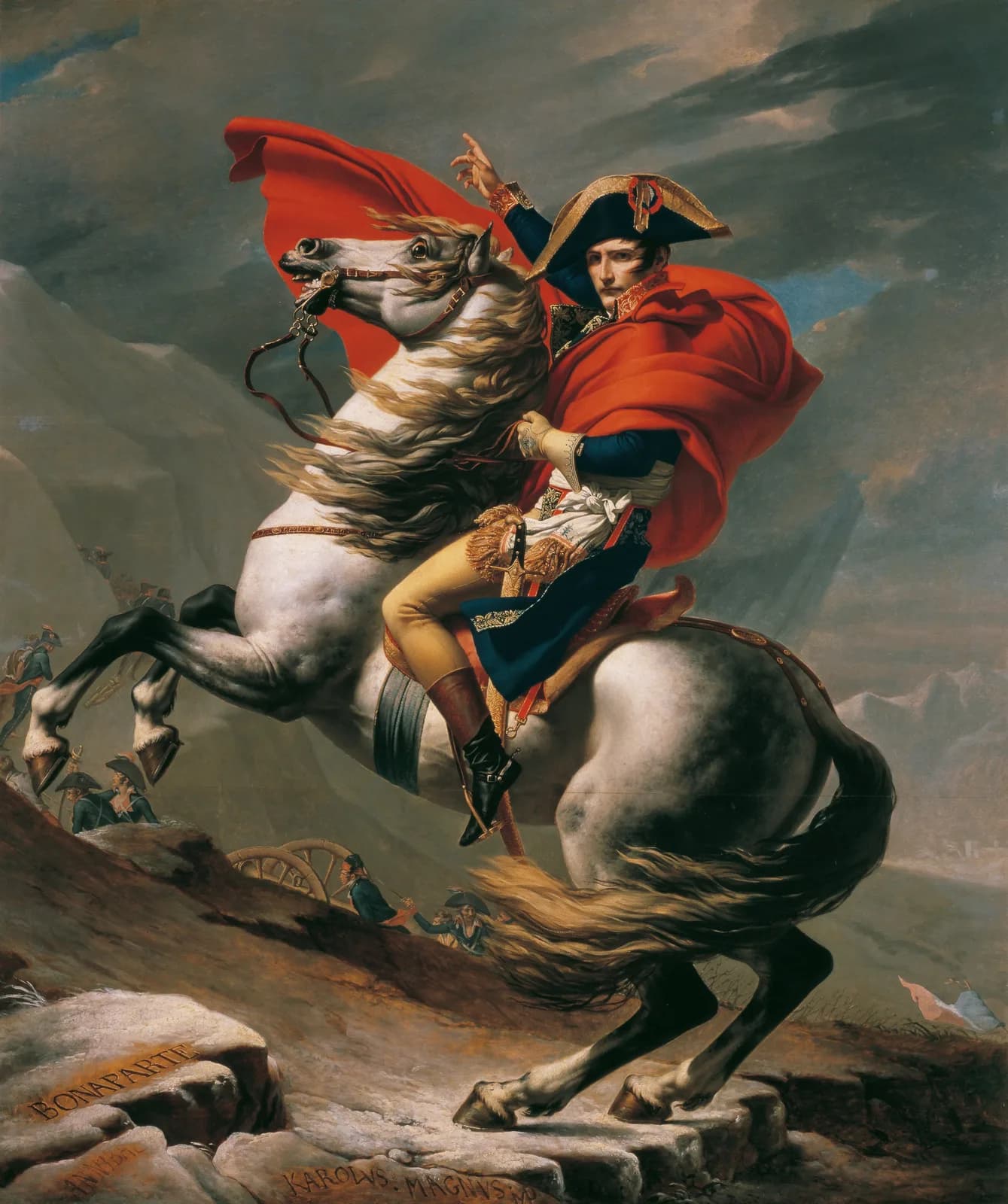
“Yes, that’s what it was! I wanted to become a Napoleon, that is why I killed her.... Do you understand now?”
The line is spoken to Sonia Marmeladov, and the tone matters as much as the content: he arrives at it as if he has just worked it out, having already offered her two or three other explanations in the same conversation. He has tried poverty. He has tried his mother and sister. He has tried the idea that the money would have paid for a hundred good deeds. The Napoleon sentence is the one he stops on, and the reason it reads as the true answer is that it is the only explanation that costs him something to say.
The theory behind it, in his own published words
This was not a private fantasy. Months before the murder, Raskolnikov published an article on crime in a Petersburg review, and the detective investigating him has read it. Porfiry Petrovitch produces it in conversation, in front of witnesses, and summarises it back to its author with the pleasantness of a man handing someone a loaded object.
“In his article all men are divided into ‘ordinary’ and ‘extraordinary.’ Ordinary men have to live in submission, have no right to transgress the law... But extraordinary men have a right to commit any crime and to transgress the law in any way, just because they are extraordinary.”
Raskolnikov corrects him, and the correction is the whole argument. He says he never claimed extraordinary people are obliged to break laws, only that such a man has “an inner right to decide in his own conscience to overstep” an obstacle, and only when his idea requires it (l.10628-10638). That is a far quieter claim than Porfiry’s summary, and it is also the more dangerous one, because it moves the licence from the statute book into the private judgement of whoever is holding the axe. The full argument about where that idea came from, and who gets credited with it online, is laid out separately here.
The Axe Falls puts you on the pawnbroker's landing with the axe under your coat and the door already open. You can go through with it or turn around on the stairs, and the scene does not stop you either way. Role-play Crime and Punishment →
The proof he never wanted the money
People who have only heard about this book tend to remember it as a story about a poor student who kills a moneylender for her cash. The novel goes out of its way to close that reading off, twice, and both times in the text’s own words rather than a critic’s.
- He buried the takings and left them there.In the same confession scene he tells Sonia that “the things—chains and trinkets—I buried under a stone with the purse next morning in a yard off the V---- Prospect. They are all there now” (l.16790). He had carried them across the city to hide, not to spend.
- The court could not make it add up either.The trial narration records that the lawyers and judges were “very much struck” that he had hidden the purse “without making use of” it, could not remember what the trinkets were, and did not even know how many there had been (l.21529-21545).
- He never opened the purse. The same passage records that he had no idea what was inside it, which the court found frankly incredible in a man who had otherwise confessed to everything in plain, cooperative detail.
A robbery that ends with the proceeds under a rock in a courtyard is not a robbery. It is an experiment whose subject was the experimenter, and the property was only ever the part of it that would stand up in a police report.
What the theory cost him
The novel is unusually careful about not handing you a diagnosis. It gives you one word, spoken by a doctor who is not being asked for a verdict. Zossimov, pressed on whether his patient is insane, says the suggestion has been exaggerated, and that what he sees is “some fixed idea, something approaching a monomania” (l.8415-8418) — a nineteenth-century term for a mind healthy everywhere except on one subject, which it cannot leave alone.
That is a precise description of what the article did to its author. Raskolnikov is lucid about money, about his sister’s engagement, about his friend’s kindness and his mother’s letters. He is not lucid about the one question of whether the rules apply to him, and the murder is what happens when a man decides to settle a theoretical question with an experiment he cannot repeat. Dostoevsky knew something about that kind of pressure at first hand: he was arrested with the Petrashevsky Circle in April 1849, marched out to a mock execution in December of that year, and served four years of hard labour at Omsk before writing any of his major novels, as both the standard biographical record and Britannica set out.
What the Napoleon line finally tells you is that the experiment returned a result. He wanted to know which category he belonged to, he took the only test he could think of, and the answer arrived immediately and never changed: an extraordinary man would not have spent the next six parts of the novel unable to eat, unable to sleep, and unable to stop confessing to people who had not asked.
Sources
- Crime and Punishment, translated by Constance Garnett (Project Gutenberg #2554) — Project Gutenberg
- Crime and Punishment — publication history — Wikipedia
- Fyodor Dostoevsky — arrest, mock execution and Siberian exile — Wikipedia
- Fyodor Dostoyevsky, Russian novelist — Encyclopaedia Britannica
Frequently asked questions
- What is Raskolnikov's most famous quote?
- “I wanted to become a Napoleon, that is why I killed her”, said to Sonia in Part V. It carries so much weight partly because Napoleon is named only 13 times in Garnett's entire translation, and this is the one place where Raskolnikov applies the name directly to himself, out loud, to another person.
- What is Raskolnikov's theory?
- That people divide into ordinary ones, who must obey the law, and extraordinary ones who may overstep it when a great idea requires it. He published it as an article called On Crime, and the novel makes a small joke of the fact that he sent it to the Weekly Review and it came out in the Periodical Review instead.
- What is Raskolnikov's motive for killing the pawnbroker?
- Money is the answer he gives first and abandons fastest. In the same confession scene he works through the theory, then the Napoleon line, then lands somewhere smaller and worse: “I did the murder for myself, for myself alone” (l.17030). That is as close to a settled motive as the novel ever gets, and it arrives after three other answers he could not hold.
- What is the most famous line from Crime and Punishment?
- The Napoleon confession is the most quoted. The line most often lifted out of context is Raskolnikov defending his own article: “Pain and suffering are always inevitable for a large intelligence and a deep heart” (l.10848). He says it about extraordinary men, minutes before the detective asks him who decides which men qualify.
- Why did Raskolnikov hide the stolen money instead of spending it?
- Because the money was never the point of it. He buried the purse and the trinkets under a stone the next morning and never opened the purse, which turned out to hold 317 roubles and 60 copecks. At the trial the court found that detail harder to believe than the murder itself, and said so.
Enjoyed this one?