The Best Peter Pan Movie Adaptations, Compared to Barrie’s Book
The film most people name first is a sequel Barrie never wrote, and the book it orbits gives its villain a send-off no screen version has matched since.


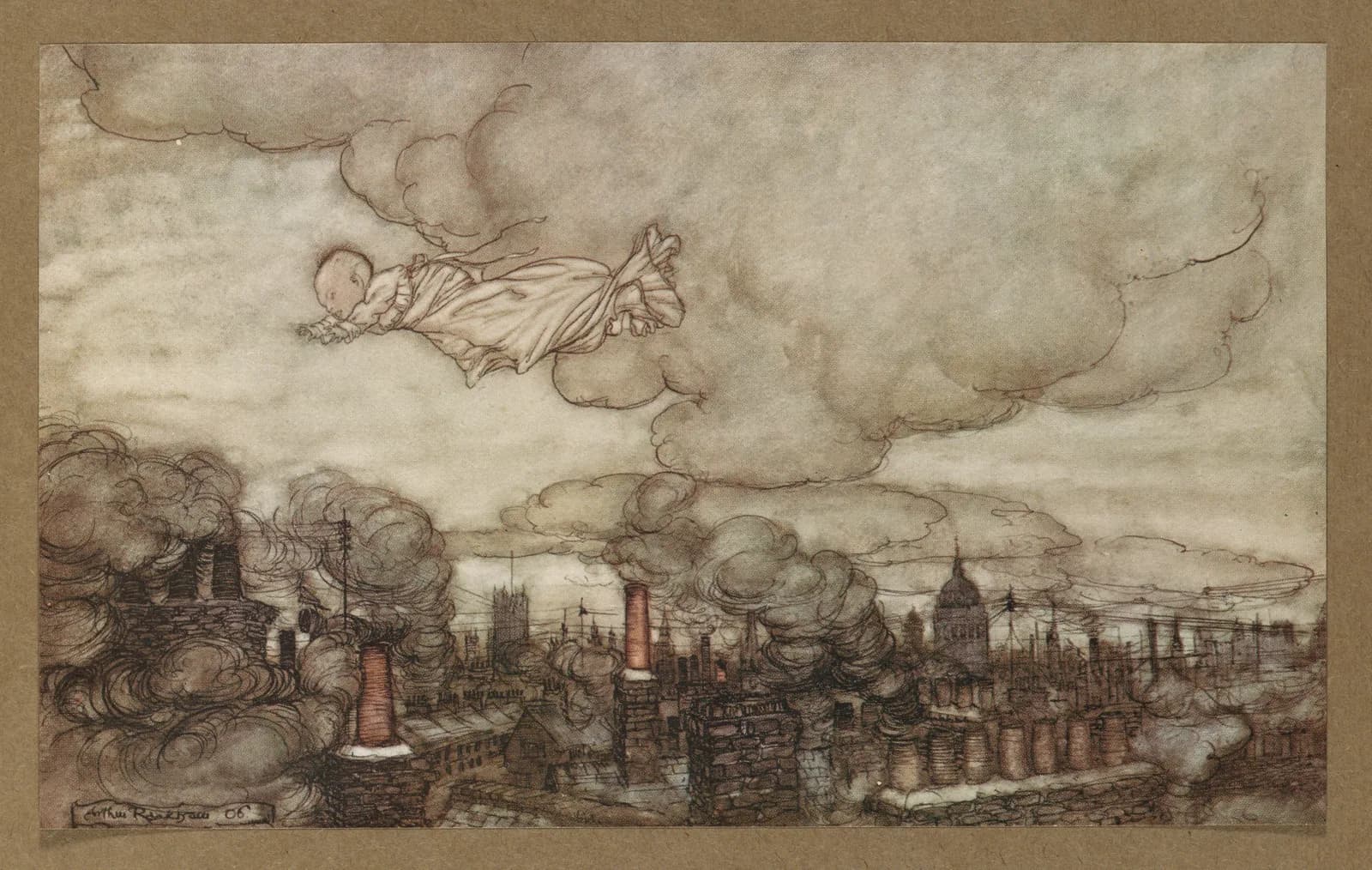
Four screen versions dominate the argument, and they are doing four different jobs. If you would rather run the scenes yourself than watch somebody else’s, the playable Peter Pan keeps the pirate material in a doorway called The Deck of the Jolly Roger. Below, each version is set against what Barrie actually wrote, with every quotation drawn from the free text at Project Gutenberg and a line number attached.
The favourite that is not an adaptation
Ask which Peter Pan film people love and the answer comes back Spielberg, in threads and rankings and in the affection of a whole generation who saw it young. It is also the one entry on the list that never attempts Barrie’s story, as the film’s own published record makes clear: it is a modern-day sequel with an invented premise, picking up long after the novel has finished.
The premise is the tell. A grown Peter has forgotten Neverland completely and has to be dragged back into it, which is a story Barrie could not have written, because forgetting in the novel is Peter’s permanent condition rather than a problem to be cured in the third act. The film is about recovering something; the book is about a boy who cannot keep anything.
None of this counts against the film so much as against the label it gets given, because what people are praising when they call it the best Peter Pan film is a sequel’s emotional engine rather than any fidelity to the source it grew out of.
What the book’s villain gets
Here is where every screen version so far has left something on the table. Barrie’s Hook is not a cackling obstacle; he is a man in the grip of a code, and the code is the thing the novel takes seriously. His obsession is good form, meaning behaviour, and the duel is agony for him because he can see that the child beating him has it without effort (l.5330).
“I’m youth, I’m joy... I’m a little bird that has broken out of the egg.”
Barrie then does something no pantomime has ever attempted. The narrator stops the action to say goodbye to him by name, in the second person, as an equal: James Hook, thou not wholly unheroic figure, farewell (l.5374). He even explains that the crocodile’s clock was stopped deliberately so that Hook would not hear it coming, and calls that a little mark of respect from us at the end (l.5380).
The death itself is a victory Barrie hands him. Hook manoeuvres Peter into kicking him off the bulwark rather than stabbing him, so that the boy commits the one breach of form available, and the last thing he says as he drops is his verdict on it: bad form, cried jeeringly, and he went content to the crocodile (l.5391). A villain who wins the argument on the way down is a strange thing to inherit and none of the films have known what to do with it.
The Deck of the Jolly Roger puts you on Hook's ship with his crew around you and his code in play. You can fight him, out-argue him about form, or let him talk, and the scene takes all three seriously. Role-play Peter Pan →
The ticking clock is Barrie’s
One detail everybody assumes came from the cartoon is in the original, word for word, and Hook explains it himself to Smee in the fifth chapter. The crocodile that took his hand followed him from sea to sea afterwards, licking its lips for the rest of him, and the only reason it has never finished the job is an accident.
“That crocodile would have had me before this, but by a lucky chance it swallowed a clock which goes tick tick inside it, and so before it can reach me I hear the tick and bolt.”
So the ticking does far more work than the visual gag the cartoons make of it. It is the engine of Hook’s entire psychology in the novel, a countdown he can hear approaching and flee from, and it comes with a piece of cruelty the films leave out because it belongs to the man standing next to him rather than to the animal.
Where the major versions diverge
| Screen version | What it does with Barrie |
|---|---|
| Peter Pan, Walt Disney Productions, 1953. Directed by Hamilton Luske, Clyde Geronimi and Wilfred Jackson. | Sets the character’s look for everyone after it, and compresses the plot hard. It also carries the tribe material straight over from the book, which is why it now streams with a content advisory. |
| Hook, directed by Steven Spielberg, 1991. Robin Williams as the grown Peter, Dustin Hoffman as Hook, Julia Roberts as Tinker Bell. | An original sequel rather than an adaptation: a middle-aged man who has forgotten he was ever Peter Pan, with almost no event in common with the novel. |
| Peter Pan, directed by P. J. Hogan, 2003. Jeremy Sumpter, Rachel Hurd-Wood, Ludivine Sagnier, Jason Isaacs. | The closest to the book. It is the first live-action theatrical release to cast a boy as Peter, and its Captain Hook, Jason Isaacs, plays Mr Darling as well. |
| Peter Pan & Wendy, directed by David Lowery, 2023. Jude Law, Alexander Molony, Ever Anderson, Yara Shahidi, Alyssa Wapanatahk. | A sombre retelling that reworks the material the 1953 film inherited: Tiger Lily is played by an Indigenous actor and the Lost Children include girls. |
Every row above comes from the public record for that film, starting with the 2003 film’s record (which also carries its box office, about 122 million dollars worldwide against a 130 million dollar budget, and Roger Ebert’s three-and-a-half-star review), and the 2023 film’s, with Variety on Jude Law’s casting. The 1953 film’s advisory is covered in full in our essay on what is still in the text.
Two claims that circulate about these films are absent from this page on purpose. We could not find a second published source for the widely repeated story about a sword being handed over at the end of Hook, and the aggregator scores quoted for that film disagree between one published source and another, so no percentage appears here at all.
Which one to watch
For the plot Barrie wrote, with the flight and the lagoon and the ship in roughly their proper order, the 2003 version is the one to put on, and its Hook doubles as Mr Darling. For the thing people actually mean by Peter Pan as a feeling, Spielberg’s film has held its audience for thirty-odd years and will keep holding it.
For Hook himself, though, the book remains the only place he gets his farewell. Barrie gave a children’s villain a code, a countdown, a last word and a narrator who breaks off mid-battle to salute him, and a reader who has only met the screen versions has not met that character yet.
Sources
- Peter Pan (Peter and Wendy), J. M. Barrie — Project Gutenberg #16 — Project Gutenberg
- Hook (1991) — Spielberg’s modern-day sequel, cast and premise — Wikipedia
- Peter Pan (2003 film) — P. J. Hogan, cast and reception — Wikipedia
- Peter Pan & Wendy (2023) — David Lowery, cast and release — Wikipedia
- Jude Law never broke character as Captain Hook on set — Variety
Frequently asked questions
- Which movie is considered the best adaptation of Peter Pan?
- Polls and threads keep landing on Hook, which is the one film in the set that is not an adaptation at all. It helps that its supporting bench is absurd: Bob Hoskins as Smee, Maggie Smith as a very old Wendy, Charlie Korsmo as the son Hook takes. If you want the closest thing to Barrie’s actual plot on screen, the 2003 version is the answer instead.
- Is Peter Pan 1953 good?
- It is the version that fixed the character’s look for everyone who came after, which is most of why it has never gone away. The voice cast is Bobby Driscoll as Peter, Kathryn Beaumont as Wendy and Hans Conried as Hook, and Margaret Kerry modelled Tinker Bell in live action for the animators. It is also the version now carrying a content advisory on Disney+ for its depiction of Native Americans.
- Who is Captain Hook afraid of?
- A crocodile, and specifically a clock. Hook explains to Smee that the animal swallowed a clock, so he hears the ticking and runs before it reaches him. Smee’s reply is the cruellest line in the chapter and the one nobody quotes: some day the clock will run down, and then he will get you. Barrie lets the line stand where it falls, with no narrator stepping in to soften what Smee has just told him.
- Is Captain Hook actually a villain?
- He is, and Barrie still writes him a farewell no film has matched. In place of menace the novel gives him a schoolboy’s conscience that never stops grading his own behaviour. At the moment of his death his mind is “slouching in the playing fields of long ago” (l.5369), and the narrator stops to record that his shoes were right, and his waistcoat was right, and his tie was right (l.5371). The novel gives his tailoring its last attention, and that is a smaller and stranger note than any stage villain is usually allowed.
- Is Hook (1991) a retelling of the original Peter Pan story?
- No. It picks up decades after Barrie stops, with Peter grown into a corporate lawyer called Peter Banning who has forgotten Neverland entirely, and it invents the plot from there. Reference works describe it as a modern-day sequel rather than an adaptation, which is the honest label — almost nothing in it corresponds to an event in the 1911 novel.
Enjoyed this one?