Peter Pan’s Ending, Explained: Does Peter Kill the Lost Boys, and What Happens to Wendy?
The book’s darkest sentence is a clause long and refuses to finish itself, and the ending it leads to is quieter and colder than the one most readers carry around.


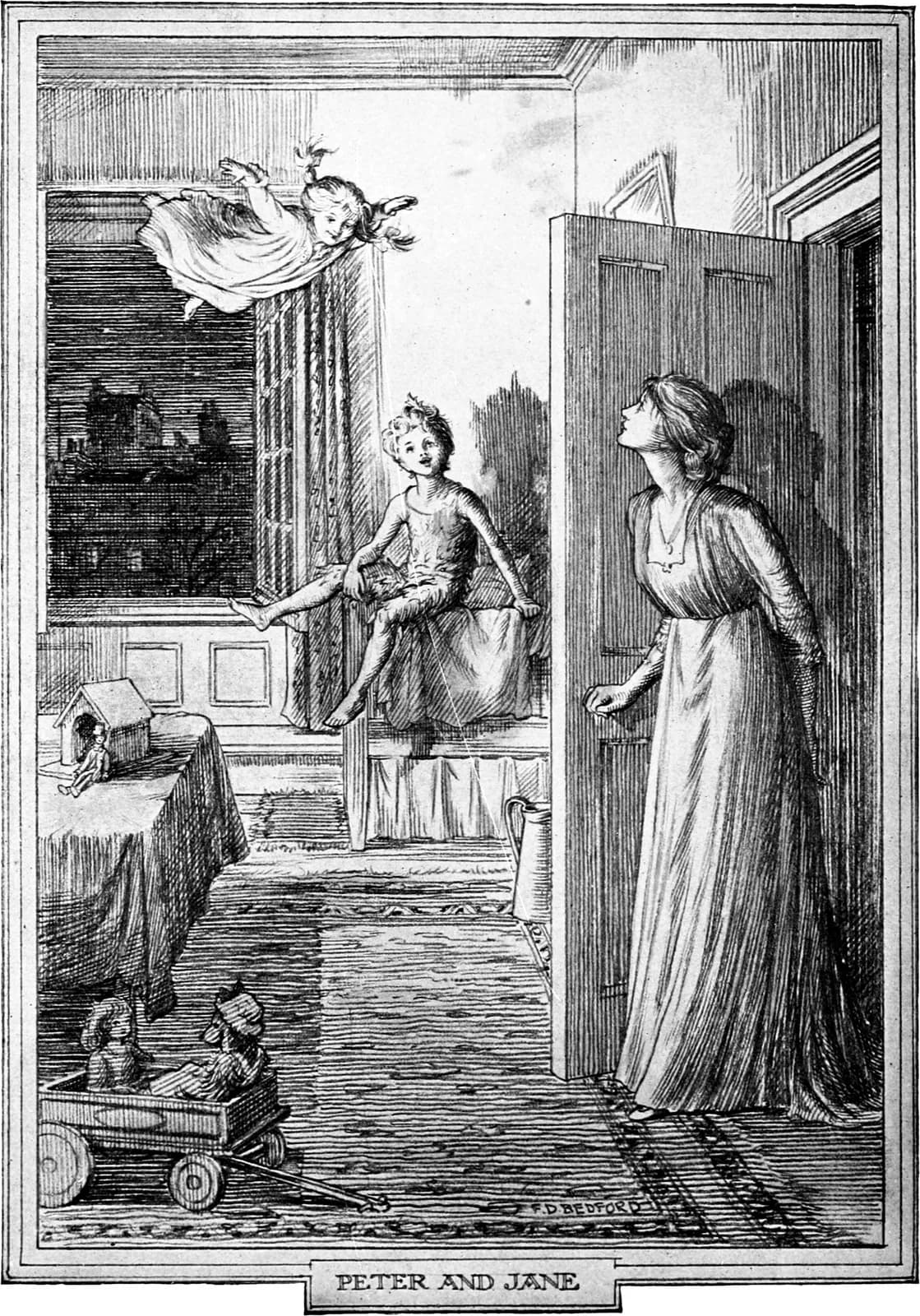
The whole argument turns on one clause, so it is worth starting with the clause rather than with anybody’s theory about it. The ending is also the last doorway in the playable Peter Pan, where it is called The Annual Spring Cleaning. Everything quoted here is Barrie’s own 1911 prose, free and out of copyright at Project Gutenberg, with line numbers so you can check each one.
The sentence everyone argues about
Barrie drops it into a paragraph about how many boys are on the island at any given moment, in the tone of someone explaining staff turnover. Read it slowly, because the construction is doing something careful:
“The boys on the island vary, of course, in numbers, according as they get killed and so on; and when they seem to be growing up, which is against the rules, Peter thins them out.”
There are two separate facts in that sentence and Barrie never joins them. Boys get killed, in the way that boys in an adventure story about pirates and wolves get killed. Separately, growing up breaks a rule, and Peter deals with the boys who break it. The reader supplies the bridge between those two clauses, and the reader has been supplying it for a hundred and fifteen years without the author’s help.
The viral version against the text
The version that travels furthest online is much more specific than the book. In its strongest form Peter is a kidnapper running a cull, and the boys who age out are fed to something. It is a genuinely compelling reading, it explains the creepier half of the novel, and the text supports roughly the first third of it.
- Supported. Growing up is against the rules, Peter enforces the rules personally, and boys do die on this island without the narrator finding it remarkable enough to slow down for.
- Not supported.No method, no scene, no body and no witness. Barrie stages Hook’s death, Tink’s poisoning and an arrow through Wendy in full view, so the absence of a thinning-out scene is a choice rather than an oversight.
- Actively complicated. The last chapter accounts for the surviving Lost Boys by name, and every one of them is alive, middle-aged and employed, which is difficult to square with a standing policy of killing boys who grow.
The Final Flight is the doorway where the rule actually bites. You can go back through the window, stay on the island, or try to talk Peter out of the rule entirely, and the scene lets the conversation go somewhere he will not like. Role-play Peter Pan →
What happens to the other Lost Boys
Barrie disposes of them in seven lines, and the seven lines are the funniest and bleakest passage in the book. He begins by announcing that all the boys were grown up and done for by this time, so it is scarcely worth saying anything more about them, and then says quite a lot more about them anyway (l.6011).
The twins and Nibs and Curly can be seen any day going to an office, each carrying a little bag and an umbrella. Michael drives an engine. Slightly married a lady of title and became a lord. Tootles is the judge in the wig coming out at the iron door. John is the bearded man who does not know any story to tell his children, which is the cruellest sentence Barrie ever wrote about growing up and takes four seconds to read.
Set that against the thinning-out clause and you get the real shape of the ending. The boys who left Neverland were absorbed rather than killed, and Barrie measures the loss in umbrellas and bags instead of blood. Whatever thinning out meant, it did not happen to these five, and the book does not tell you whether it ever happened to anybody.
Wendy’s own ending
Wendy’s fate is the one part of this the novel states flatly. She grows up. Barrie is almost brusque about it, and the brusqueness is deliberate, because the sentimental reading of this book wants her to be a casualty and the author declines to provide one.
“Wendy was a married woman, and Peter was no more to her than a little dust in the box in which she had kept her toys. Wendy was grown up. You need not be sorry for her. She was one of the kind that likes to grow up.”
Her husband is never named and never speaks. When Peter finally turns up again she has to tell him what has happened to her, and the line she uses is the plainest in the chapter: “I am a married woman, Peter” (l.6216). He does not accept it, which is the point of him, and she does not soften it, which is the point of her.
Then the machine starts again. Her daughter Jane goes with him, and after Jane comes Margaret, and Barrie closes the book by extending the arrangement forward indefinitely: when Margaret grows up she will have a daughter, who is to be Peter’s mother in turn, “and thus it will go on, so long as children are gay and innocent and heartless” (l.6289).
Why Barrie leaves it open
That last phrase is the key the novel hands you two chapters early. Children can fly, Barrie says, because they are gay and innocent and heartless, and they stop flying when they stop being heartless (l.6072). Heartlessness in this book is not cruelty. It is the ordinary inability of a small child to grasp that other people continue to exist and suffer when they are out of the room.
Read that way, the thinning-out sentence stops needing a body. Peter forgets people. He forgets Tinker Bell between chapters, he forgets Wendy across years, and a boy Peter has forgotten is gone from Neverland as completely as a boy Peter has killed, with nobody required to do anything about it. Barrie leaves the sentence unfinished because the frightening version and the innocent version produce exactly the same result.
Which is why the ending reads as a horror story to some readers and a gentle one to others, from the same words on the same page. If you want the real family history that sits underneath all of this, the brothers Barrie actually knew and what became of them, that is a separate and considerably sadder essay, and those boys are real people rather than characters, documented in the Andrew Birkin J. M. Barrie archive.
Sources
- Peter Pan (Peter and Wendy), J. M. Barrie — Project Gutenberg #16 — Project Gutenberg
- Peter Pan — the 1904 play and the 1911 novel — Wikipedia
- The J. M. Barrie archive, curated by Andrew Birkin — jmbarrie.co.uk
- F. D. Bedford, plate facing p. 264 of Peter and Wendy (1911) — Wikimedia Commons
Frequently asked questions
- Did Wendy marry a Lost Boy?
- No, and Barrie never names the man she did marry. All the wedding gets is one line, “Wendy was married in white with a pink sash” (l.6019), plus a narrator’s aside that it is strange Peter did not alight in the church and forbid the banns. The husband has no dialogue, no description and no name anywhere in the novel.
- Why didn’t Peter and Wendy end up together?
- Because Peter stops arriving, and Barrie slips the reason in as a joke. Wendy was “untrue to him when she got a prize for general knowledge” (l.6003), and after that the years came and went without him. By the time they meet again he has become, in Barrie’s phrase, a little dust in the box where she kept her toys.
- Did Peter Pan marry Wendy’s granddaughter?
- No. He collects her for spring cleaning and she tells him stories, which is the whole of their relationship in the book. The granddaughter is called Margaret in Barrie; the “Moira” some retellings give her is a later screen invention, and no version of the novel marries Peter to anybody at any point in the last chapter.
- Did Peter Pan kill the Lost Boys?
- The text does not say so. It says the number of boys varies “according as they get killed and so on”, and that Peter thins them out when they start growing up, without ever joining those two facts together. Barrie mentions in the same breath that there were six of them at that point in the story, counting the twins as two, and leaves the arithmetic alone.
- What does “thins them out” mean in Peter Pan?
- It is deliberately unfinished. The verb covers everything from sending a boy home to something much worse, and Barrie never picks. The novel does play the same idea for comedy elsewhere: every boy has to fit the hollow tree he climbs down, so “Peter measures you for your tree as carefully as for a suit of clothes”, the difference being that you have to be made to fit the tree (l.2655).
Enjoyed this one?