The Peter Pan Line Everyone Quotes Backwards — What Barrie Actually Wrote
Quote cards all over the internet have the verb the wrong way round, and the scene Barrie actually wrote is stranger and colder than the version people share.


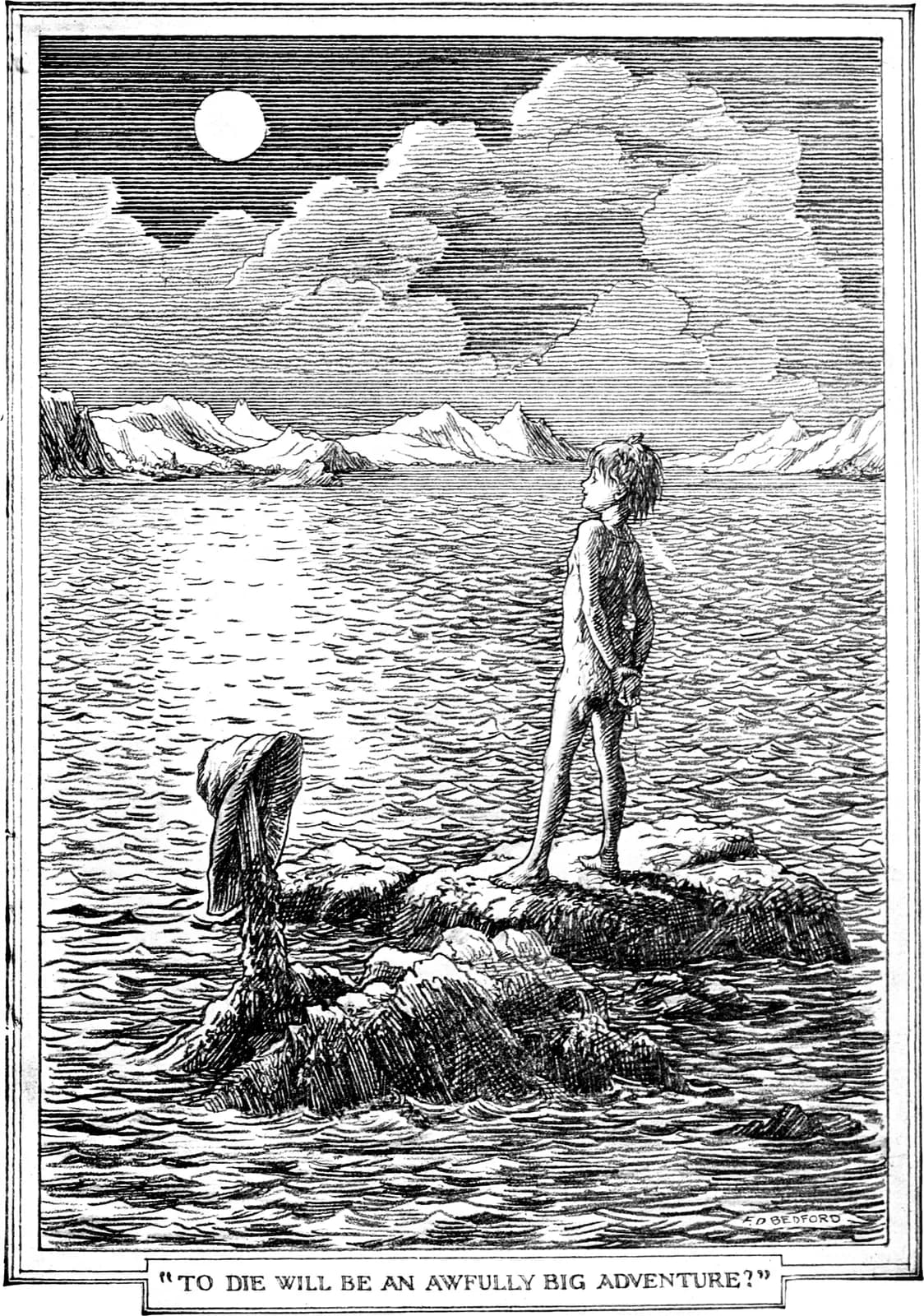
That rock is a real place in the story, and in the playable Peter Pan it is a doorway you can walk into called The Darkening Lagoon. Every quotation below comes from Barrie’s own 1911 prose, which is out of copyright and free at Project Gutenberg, and every one carries its line number in that file so you can check it against the text rather than against a quote card.
What Barrie actually wrote
The line arrives at the end of a chase that has gone badly. Hook has cut Peter in the water, and the two children left on the rock work out between them what that means. Wendy asks whether they are both going to drown, and Peter answers by pointing at how fast the sea is coming up the stone they are sitting on.
He gets her off the rock and stays on it. Barrie spends a paragraph on the light going and the mermaids calling to the moon, then records that Peter shuddered once, the way the sea does, and only once. What follows is not spoken to anybody, because by then there is nobody left to speak to, and Barrie hands it to the reader as something heard rather than said, inside a child who has decided to be brave about the next ten minutes.
“Next moment he was standing erect on the rock again, with that smile on his face and a drum beating within him. It was saying, ‘To die will be an awfully big adventure.’”
The phrase appears exactly once in the whole novel, which is unusual for a line this famous, and Barrie never lets any character repeat it back. It is a thought, on a rock, in the dark, and the reason it lands is that the book has spent eight chapters establishing that Peter does not fully understand what dying is before it puts him in a position to find out.
Where the “to live” version came from
Search for the line and you will meet a second version almost immediately, with the verb reversed: to live will be an awfully big adventure. It circulates on quote cards, in graduation speeches and on merchandise, and it has been quoted often enough to generate its own search demand, which is a strange achievement for a sentence nobody wrote.
You can see why it spread. The flipped version is usable at a wedding and the original is not, and a line about dying being an adventure is an awkward thing to print on a nursery wall. The substitution keeps the cadence and Barrie’s best word, “awfully”, and throws away the only part of the sentence that cost the author anything. The scholarly archive at jmbarrie.co.uk, built over forty years by Andrew Birkin from his own research into Barrie, keeps the material that explains why the real version reads the way it does.
The Darkening Lagoon drops you onto the rock with the tide already moving and one kite between two people. You can send Wendy up, argue about it, or refuse to decide until the water makes the decision for you. Role-play Peter Pan →
The opening line people rearrange
The same thing happens to the book’s first sentence, more quietly. Barrie opens with five words and a comma, and the comma is doing more work than any single word around it:
“All children, except one, grow up.”
It is usually reproduced as “all children grow up except one”, which says the same thing and sounds like nothing. Barrie puts the exception in the middle so that the sentence has to stop for it, and the pause is where the whole book lives. Moving the clause to the end turns a small shock into a piece of trivia about a boy you have already heard of.
The kiss that was a thimble
The third commonly mangled moment is not a quotation at all but an exchange. Wendy offers Peter a kiss; he holds out his hand, because he has no idea what she means; she gives him a thimble instead rather than embarrass him. He then offers her one back, and what he actually drops into her palm is an acorn button off his own clothes (l.955-965).
- Neither of them is pretending. Peter genuinely believes a thimble is a kiss, and goes on using the word that way for the rest of the novel, which makes several later scenes read very differently once you have noticed it.
- Wendy wears the button.She puts it on the chain round her neck, and Barrie tells you immediately that this was lucky, because “it was afterwards to save her life” (l.965). The payoff comes a few chapters later and is worth arriving at cold.
- The scene predates every film.It is in the 1911 prose, in Barrie’s own wording, and our characters guide takes the payoff half of it, since that is where Tinker Bell earns her reputation.
Why this line in particular flips
Misquotation is usually lazy, but this one is editorial. Somebody along the chain decided that the sentence would be better if it were about living, and enough people agreed to make the improved version the one that surfaces first. The original is a child alone on a rock talking himself into the water, and that is a harder thing to put under a sunset photograph.
Barrie’s own version survives anyway, because the book keeps it attached to the circumstances that produce it. Read it on the page, with the kite gone and the tide up, and the sentence stops being advice about how to approach your one wild life and becomes what it was built as: a small boy, badly frightened, finding the only frame that lets him stand still.
Sources
- Peter Pan (Peter and Wendy), J. M. Barrie — Project Gutenberg #16 — Project Gutenberg
- The J. M. Barrie archive, curated by Andrew Birkin — jmbarrie.co.uk
- Peter Pan — the 1904 play and the 1911 novel — Wikipedia
- F. D. Bedford, plate facing p. 142 of Peter and Wendy (1911) — Wikimedia Commons
Frequently asked questions
- What was Peter Pan’s famous line?
- “To die will be an awfully big adventure.” The phrase appears exactly once in the 1911 novel, and it is the closing sentence of Chapter VIII, “The Mermaids’ Lagoon”. Barrie gives it to Peter as a thought rather than a speech, so nobody on the page ever hears him say it — Wendy has already been carried off the rock by then.
- What does the quote “To live will be an awfully big adventure” mean?
- It does not mean anything in Barrie, because he never wrote it. The inverted version reads as an epitaph-friendly toast to seizing the day, which is why it travels well on greetings cards and graduation speeches. Barrie’s own sentence runs the other way. It arrives once in the whole novel, at the end of Chapter VIII, The Mermaids’ Lagoon, and it belongs to a wounded child who has decided that drowning is something he can be brave about.
- Who said “to die will be an awfully big adventure”?
- Peter Pan, in Barrie’s novel, thinking rather than speaking. The scene arrives after Hook wounds him in the lagoon and he tells Wendy he can neither fly nor swim. He ties her to the tail of a kite Michael built — it will not carry two, because Michael and Curly had already tested that — and pushes her off the rock before the tide finishes rising.
- What is the opening line of Peter Pan?
- “All children, except one, grow up.” Barrie spends the next paragraph explaining how Wendy found out: she was two, she brought her mother a flower in the garden, and Mrs. Darling put a hand to her heart and said she wished Wendy could stay that way for ever. That is the whole of the book’s theory of childhood, delivered before anyone flies anywhere.
- Who wrote the opening line “All children except one grow up”?
- J. M. Barrie, in Peter and Wendy, published in 1911. Peter himself is older than that sentence: he first appears in Barrie’s 1902 novel The Little White Bird and then in the 1904 stage play, and the 1911 book is Barrie writing the play out as prose. The opening line belongs to that last version and to no earlier one.
- Is “I do believe in fairies, I do, I do” really in the book?
- No. The novel’s version is Peter shouting “If you believe, clap your hands; don’t let Tink die” (l.4663), and Barrie then records the response in three flat lines: many clapped, some didn’t, a few beasts hissed. The chanted film line that everyone can quote is a later adaptation’s invention and does not appear in Barrie’s prose at all.
Enjoyed this one?