Cao Cao: Hero, Villain, or the Only Realist in the Room?
The ablest man in the book, introduced with a murder and a sentence, and argued over ever since by readers who suspect the novel rigged the trial.


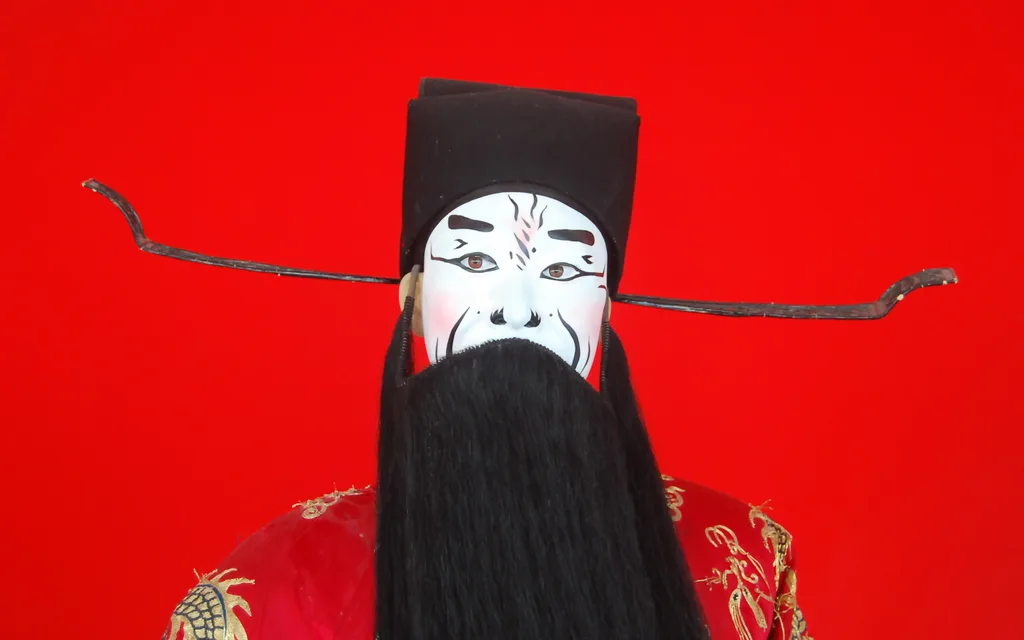
He is the most capable man in the book and the book cannot stand him. Cao Cao out-thinks everyone he meets, holds the north together while the rest of China is falling apart, writes poetry between campaigns, and is presented from his fourth chapter onward as a man you should be afraid of. Readers have been arguing about whether that is fair for centuries, and the argument has been getting louder, not quieter.
- He never took the throne. He died Chancellor and King of Wei in 220; his son declared the dynasty later that year.
- He fixed the food supply. The military-farm system he adopted resettled refugees on abandoned land and shortened his own supply lines.
- He won the war's decisive northern battleat Guandu in 200 AD, by burning his enemy's grain rather than by beating his army in the field.
- The line everyone quotes against himis from the novel, in one place, and the encyclopaedia's account of the incident does not contain it.
Below: the line, the record, and why the reappraisal keeps gathering strength. If you would rather run his campaign than read about it, the playable Romance of the Three Kingdoms will put you outside Wuchao at night with a torch and a decision.
🎭 The novel casts him as the villain on purpose
It does not start there, which is the part most summaries skip. In chapter one, before he has done anything at all, two men are asked to size up the young Cao Cao. He Yong of Nanyang says the Han is finished and this is the man who will settle the empire.
Then Cao Cao goes to Xu Shao of Runan, who had a reputation for reading people, and asks outright what sort of man he is. Xu Shao does not answer. Asked a second time, he gives the sentence the whole argument has been running on ever since: an able minister in an age of order, a treacherous hero in an age of chaos. Cao Cao, the novel says, was delighted. Anyone who has ever said that calling this man good or evil misses him is agreeing with the first chapter. The book's own opening verdict is deliberately double, and it makes the answer depend on the age rather than on him.
Then it does the work early and it does it with a scene rather than a judgement. In chapter four Cao Cao is a fugitive who has just tried to assassinate the tyrant Dong Zhuo and failed. He takes shelter with an old family friend, hears knives being sharpened in the kitchen, assumes the household is about to hand him in, and kills everyone in it. Then he discovers they were killing a pig for him.
He rides out. On the road he meets the friend himself, coming back with wine, and cuts him down too. His companion Chen Gong, who has given up an official post to follow him, says that killing by mistake is one thing and killing knowingly is a great wrong.
Better that I wrong the world than that the world wrong me.
Brewitt-Taylor's 1925 English begins it I would rather betray the world, and Chen Gong says nothing at all. That silence is the whole characterisation. Everything the novel wants you to think about this man for the next hundred and sixteen chapters is loaded in one sentence, spoken over a body, to a man who has just given up his career for him.
The scene is superb craft and it is also a frame. Cao Cao is introduced as an attempted tyrannicide, which is heroic, and then immediately converted into something colder, and the conversion happens before he has done any of the things he is actually famous for.
💬 Where the famous line actually comes from
It comes from the novel, and it occurs exactly once in a hundred and twenty chapters, in the scene just described, over Lü Boshe's body. That is worth stating plainly, because the sentence circulates as though it were something a historical statesman is on record as having said, and it is quoted in arguments about his character as if it settled them.
The historical trace is much thinner. Standard reference accounts of Cao Cao's flight from Luoyang in 189 do record an encounter with the family of Lü Boshe, an old acquaintance, and they carry no version of the speech. What survives in the popular memory is the novelist's line, attached to a real incident, and it has been doing the work of evidence for six hundred years.
None of which makes it a bad line. It is one of the best in the book, and it is characterisation of a very high order: it does not claim he enjoys harm, only that he has decided, once, out loud, which way he will resolve the question when it comes up again. The point is simply that it is a novelist's sentence and should be argued with as one.
🌾 What he actually did, with the framing removed
Take the novel away and the record is a career in logistics and administration more than in villainy. Northern China in the 190s was a collapsed state: the capital burned, the imperial court a hostage, farmland abandoned, armies feeding themselves by taking food from people who had none. What Cao Cao is credited with is fixing the food problem.
| In the novel | In the record |
|---|---|
| A usurper in all but name, whose ambition for the throne is the engine of the middle of the book. | Never took the throne.He died in March 220 as Imperial Chancellor and King of Wei; his son Cao Pi accepted the last Han emperor's abdication later that year and gave his father the title of emperor posthumously. |
| Wins by cunning and treachery, and loses spectacularly at Red Cliffs because the book needs him to. | Broke the largest army in China at Guandu in 200 AD by destroying its supplies at Wuchao. Mopping up the rest of the north took him years more. |
| A schemer with no interior life beyond appetite and suspicion. | Celebrated as a poet in his own right, and the novel itself stages him composing on the eve of his greatest defeat. |
The military-farm system is the piece that deserves more attention than it gets. Adopted on the advice of two officials named Zao Zhi and Han Hao, it settled displaced refugees onto abandoned arable land and turned them into a food supply that also fed the army, which shortened the campaign lines that had been killing every warlord in the region. It is unglamorous work, and it is the reason there was a state of Wei at all.
The title of this piece calls him the only realist in the room, and this is where that argument sits. Everyone around him is operating on a theory: that the Han mandate can be restored, that a bloodline confers the right to rule, that the correct family in the correct seat will make the empire work again. Cao Cao behaves throughout as though the dynasty is already over and the question is who feeds the survivors. He spent the last twelve years of his life as Imperial Chancellor, governing in the name of an emperor nobody pretended had power, and stopped one step short of the title for all twelve of them.
The novel itself hands him the evidence in chapter six, when Dong Zhuo burns the imperial palaces at Luoyang and marches the court west to Chang'an. The capital of a four-hundred-year dynasty is set on fire by the man supposedly protecting it, and the coalition assembled to stop him spends the following chapters quarrelling over precedence and an imperial seal. A reader who comes away from those chapters thinking the idealists have not earned their idealism is reading the book correctly.
Even the poetry survives inside the hostile version. In chapter forty-eight, on the river the night before everything goes wrong for him, the novel has him take a spear and sing a poem about wine and the shortness of a life, comparing the days already gone to morning dew. The book that is about to destroy him gives him that first.
📈 Why the reappraisal keeps growing
Worth saying plainly, since it comes up in almost every online argument about who was “really” right: the tilt against Cao Cao did not start with the Qing editors. Luo Guanzhong himself, writing in the late Yuan to early Ming period, was already working from dramas and folk stories that cast Liu Bei and his circle as the heroes of the piece — a centuries-old storytelling tradition, not a single editorial thumb on the scale. The novel is pro-Shu by design, from its first draft, in a climate that treated Liu Bei's Han bloodline as the empire's rightful line. Mao Zonggang did not invent the bias; he sharpened one that was already the novel's premise.
Partly because the text everyone reads is not neutral, and we can date one further tilt. The version of the novel in every modern edition is the one Mao Lun and his son Mao Zonggang produced in 1679, and their editing quietly realigned who the reader is meant to be with.
Mao Lun praised Liu Bei without reservation and condemned Cao Cao without reservation, where earlier texts of the same novel had been readier to let him be complicated. Readers who feel that the book is arguing with them about this man are correct; the same editorial thumb shaped the rest of the story too. Partly because the modern reader arrives with different instincts. A twenty-first-century audience that has spent decades on antiheroes finds a competent pragmatist surrounded by men talking about righteousness a much easier figure to like than a sixteenth-century audience did. The screen versions have followed: he is the antagonist in essentially every adaptation, and the more recent ones let him be the interesting one, which the adaptation survey traces.
And partly because the counter-case is genuinely strong and always was. The man who fed the north, held the court, won the decisive battle of the era on a supply raid and then never took the crown at all is not obviously the villain of anything. He is simply the person the winning literary tradition needed to lose.
The sharpest version of the modern reading does not defend him. It points out that none of the three men at the centre of this war would pass as a good man by any standard we would use now: Liu Bei is a claimant building a kingdom on a bloodline, Sun Quan spends the book selling out whichever ally is currently less useful, and Cao Cao is the only one who never pretends the exercise is about anything except power. That is what sits behind the wry thing readers keep saying about him, which is that he is really the protagonist. He behaves like one. He has objectives, he adapts, he loses and continues, and he is the only figure in the book who tells you what he is doing while he is doing it.
Which is where the realist reading lands, and it is not a defence either. Being the only man in the room who has understood the situation is not the same as being right about what to do with it, and the novel is careful to show you what it costs the people around him. What it will not do is let anyone else in the story claim clean hands, and six hundred years of readers have noticed.
Chapter numbers were checked against the Chinese text at Project Gutenberg, and the English phrasing against Brewitt-Taylor's 1925 translation. The two men he spends the book fighting get their own pieces: the strategist and the god of war he could not keep.
Sources
- 三國志演義 (Chinese text, 120 chapters) — Project Gutenberg
- San kuo; or, Romance of the three kingdoms (volume 1 of 2), tr. C. H. Brewitt-Taylor, 1925 — Project Gutenberg
- Cao Cao — Wikipedia
- Mao Zonggang — Wikipedia
Frequently asked questions
- Was Cao Cao a villain or a hero?
- Both, depending on which document you read. He was made King of Wei in 216 and held that title alongside the chancellorship for the last four years of his life, which is as close to the throne as a man could get without taking it. Whether that reads as restraint or as patience is exactly what the argument is about.
- Did Cao Cao really say "I would rather betray the world than let the world betray me"?
- It is the novel's line, not a documented quotation. It sits in chapter four, whose title covers two things at once: the deposing of the Han emperor, and Mengde presenting the dagger. The sentence arrives inside a chapter built to establish him, and standard accounts of the historical incident behind it carry no such speech.
- Did Cao Cao ever declare himself emperor?
- No. He died in March 220 without taking the throne, and it was his son Cao Pi who accepted the last Han emperor's abdication later that year. Cao Pi then made his father an emperor retroactively, with the posthumous title Emperor Wu, which is the only sense in which Cao Cao ever held the rank.
- What do Chinese think of Cao Cao?
- The reappraisal is real and its cause is traceable. The standard text of the novel is the revision by Mao Lun and his son Mao Zonggang, who lived from 1632 to 1709; their edition praised Liu Bei and condemned Cao Cao far more firmly than earlier versions had. Readers who feel argued at are reacting to a specific seventeenth-century editorial hand.
- Why is Cao Cao the villain if he never took the throne?
- Because the novel treats the intention as the crime. It is unambiguous about who actually did it: chapter eighty is titled for Cao Pi deposing the emperor and usurping the Han, and Cao Cao is dead by then. The book spends four hundred pages accusing the father of an ambition the son carried out.
- Did Cao Cao defeat Lu Bu?
- Yes, decisively, in chapter nineteen. Lu Bu was besieged at Xiapi and did not lose a fight so much as run out of people willing to hold a wall for him: his own officers tied him up while he slept and handed him over. Cao Cao had him strangled and then beheaded, and it is the one execution in the book nobody argues about.
Enjoyed this one?