Every Three Kingdoms Adaptation, Ranked for Faithfulness: 1994, 2010, Red Cliff and the Games
Eighty-four episodes, ninety-five episodes, two films, and two game franchises that have been teaching people these names since 1997.


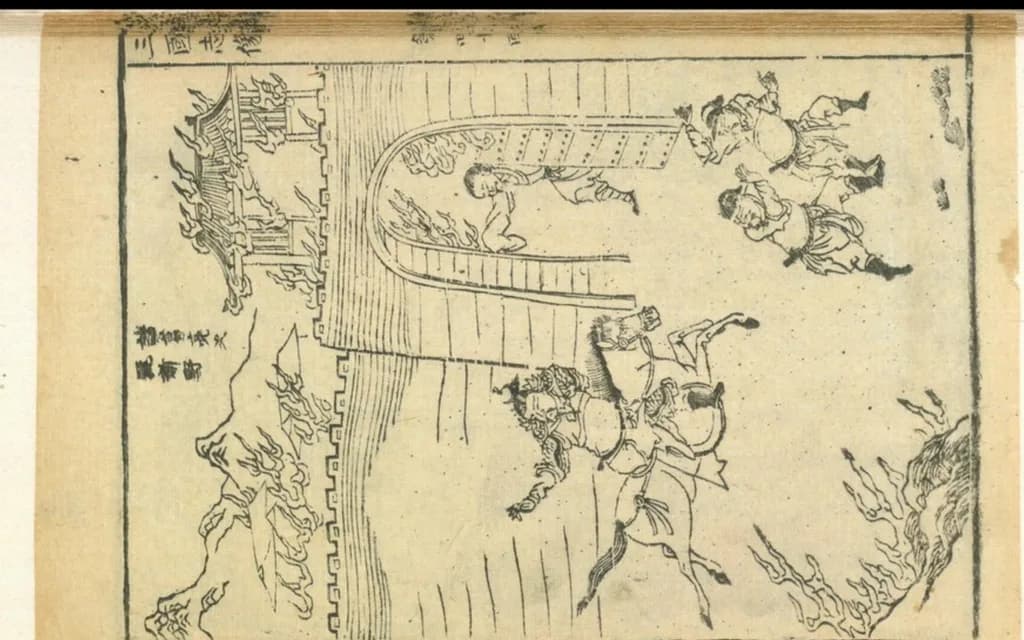
Seventeen centuries after the war it describes ended, this story still has not stopped being remade. There is a state-television epic that ran for eighty-four episodes, a glossier remake that ran for ninety-five, a John Woo blockbuster about one battle, a strategy game that lets you play the novel or play the history, and a brawler franchise that has been introducing teenagers to these names since 1997. This is what each of them keeps and what each of them throws away.
- Start with the 1994 series if you want the novel. Eighty-four episodes, and it is still the version people mean by the definitive one.
- The 2010 remake is the readable one, and the least faithful. It deviates from the novel and from the record alike, on purpose.
- Red Cliff is one battle, beautifully, and its director says out loud that it is half history at best.
- The strategy game ships both versions, with a mode named after the novel and a mode named after the history.
Ranked below from most faithful to least, with what each is actually good at. If you would rather be in the story than watch it, the playable Romance of the Three Kingdoms runs from the orchard in chapter one to the surrender in chapter one hundred and twenty.
📺 Romance of the Three Kingdoms (1994, CCTV)
This is the faithful one, and the scale is the reason. Chinese state television spent 170 million yuan of 1994 money and is credited with moving more than four hundred thousand people through the production to get eighty-four episodes made, splitting the work across six directors and six screenwriters under a head director, Wang Fulin.
Nothing else has ever been given that much room to adapt this book, and it shows in the pacing: scenes that a film would compress into a montage get a full episode. The casting is the part that stuck. Bao Guo'an's Cao Cao, Tang Guoqiang's Zhuge Liang and Lu Shuming's Guan Yu became, for a generation of viewers, simply what these people look like. Lu Shuming died on 1 November 2022 at the age of sixty-six, and the tributes that followed were not the usual kind; a lot of them came from people who had never seen him in anything else and could not picture the character any other way.
The case against it is fair and small. It is a 1994 television production, so the battles are crowds rather than armies and the pace is unhurried by any modern standard. If you can accept that, it remains the only screen version that treats the novel as a novel rather than as a source of scenes.
🎬 Three Kingdoms (2010)
Ninety-five episodes, directed by Gao Xixi, more than 160 million yuan, and five years of pre-production before a frame was shot. That budget is nominally close to the 1994 series and, sixteen years later, buys considerably less, which shows on screen as fewer extras and more close-ups. It is a handsome, fast, modern television drama, and it is the version to hand somebody who found the 1994 one slow.
It is also, by its own account, not trying to be faithful. It deviates significantly from the novel and from the historical record alike, restructuring relationships and inventing motivation freely. It dominated the ratings and made its money back, and the critical reception was mixed: the standard complaint was that it prioritised commercial entertainment over research and reached for the habits of romantic and palace-intrigue serials, losing the gravity of the source.
The character the two versions are most often set against each other over is Liu Bei. Viewers who have watched both tend to describe Yu Hewei's 2010 version as harder and more calculating, against the gentler and more passive figure the 1994 series built, and which of those you prefer is a decent proxy for which series you will prefer overall.
What it also has is Chen Jianbin's Cao Cao and Ni Dahong's Sima Yi, two performances that treat the antagonists as the most interesting people on screen. If you have read the novel and come out of it thinking the book was unfair to Cao Cao, this is the adaptation that agrees with you, and the case for that reading is here.
🔥 Red Cliff (2008 and 2009, dir. John Woo)
One battle, eighty million dollars, and no pretence of covering the book. Woo split it in two for Asian cinemas, a 146-minute first part in July 2008 and a 142-minute second part in January 2009, then cut the whole thing down to a single 148-minute film for the international release. It took $250.1 million worldwide, and the first part broke the mainland Chinese box office record that Titanic had held.
| Keeps | Changes |
|---|---|
| The alliance and the fire ships. The southern coalition, the false surrender, the burning fleet. | Roughly half of everything else. Woo has said plainly that the film is only fifty per cent based on history. |
| Zhou Yu as a lead, played by Tony Leung Chiu-wai, given the stature the novel keeps taking away from him. | The register. Woo has described the film as reaching for emotional impact and a modern perspective ahead of accuracy, which is a fair account of what it does to everyone in it. |
| Cao Cao as the antagonist, played by Zhang Fengyi, with the fleet and the arrogance intact. | The politics, compressed hard so that the campaign can be a single coherent action film. |
As an adaptation it is a fragment. As a film it is the best-reviewed thing on this page, at eighty-nine per cent on the Tomatometer with a seventy-eight per cent audience score, and it is the version to watch if you want to know what a naval engagement in 208 might have felt like from the deck.
🎮 Total War: Three Kingdoms and Dynasty Warriors
The strategy game is the most intellectually honest adaptation on this page, because it refuses to choose. Total War: Three Kingdoms, released by Creative Assembly and Sega on 23 May 2019, ships two campaign modes. Romance mode is built on the novel and gives generals nearly superhuman strength, the way the book does.
Records mode is built on Chen Shou's history, strips those powers out, and stops letting you send a single hero at an army. It is a difficult literary distinction turned into a menu toggle, and it works. It also sold: a million copies in its first week and 3.21 million by March 2025, with Steam user reviews sitting at eighty-four per cent positive across more than seventeen thousand of them. For a great many English-speaking readers, that toggle is the first time anyone has told them the novel and the history are two different objects.
Dynasty Warriors is the older door and the stranger one. The series began in 1997, and the first game was a one-on-one fighting game; the format everybody actually remembers, one officer against an entire battlefield, arrived with Dynasty Warriors 2 in 2000. It has sold more than twenty-four million copies, ran its most recent mainline entry in January 2025, and has spent nearly thirty years teaching people the names of Zhang Liao and Xiahou Dun before those people had any idea there was a book.
As adaptations these are unfaithful in an interesting direction. They keep the roster and the battles and throw away the argument, which means players arrive at the novel already knowing the cast and entirely unprepared for how much of it is politics. Anyone in that position will find the translation guide the useful next step.
🐉 Is it really China's Game of Thrones?
The comparison holds on scale and fails on structure. Both are long, both are political, both kill people you had assumed were safe, and both are about legitimacy: who has the right to rule, and what happens to everyone else while that is being settled. Anybody recommending this book to a fantasy reader is making a defensible pitch.
Where it breaks down is that one of these is invented and the other is not. The Three Kingdoms war happened, the dates are documented, and the novel is working against a record it cannot simply overrule. That produces a shape no fantasy series would choose: campaigns that achieve nothing over a decade, major characters who die offstage of illness, and an ending fixed in advance by events rather than by an author.
The other thing worth saying is that a direct line of influence has never been established. The comparison is one readers make, not a documented lineage, and it is worth keeping those two things separate. What is true is that a fourteenth-century Chinese novel got there several centuries before any of the fantasy it now gets compared to, and that none of the adaptations above is trying to be Game of Thrones, which is why the comparison keeps disappointing the people who arrive expecting one.
Every one of these versions ends the same unsatisfying way the book does, with a dynasty called Jin holding all three states and nobody the audience followed alive to see it; the full answer to who actually won is here. Chapter numbers in this series were checked against the Chinese text at Project Gutenberg.
Sources
- Romance of the Three Kingdoms (1994 TV series) — Wikipedia
- Three Kingdoms (2010 TV series) — Wikipedia
- Red Cliff (film) — Wikipedia
- Red Cliff — Rotten Tomatoes
- Total War: Three Kingdoms — Wikipedia
- Dynasty Warriors — Wikipedia
- List of media adaptations of Romance of the Three Kingdoms — Wikipedia
Frequently asked questions
- What is the best adaptation of Romance of the Three Kingdoms?
- The 1994 CCTV series, and it has more competition than most people realise. Screen versions of this story go back to the beginning of Chinese cinema: Dingjun Mountain, directed by Ren Jingfeng in 1905, took a single Three Kingdoms episode and is usually called the first Chinese film ever made.
- Is the 1994 CCTV series still worth watching today?
- Yes, for the performances more than the production values. Sun Yanjun's Liu Bei is the one modern viewers underrate: the character is easy to play as a weeping saint, and the 1994 version gives him enough political calculation to explain how a man selling straw sandals in chapter one ends up an emperor.
- Is Romance of the Three Kingdoms similar to Game of Thrones?
- In scale and body count, yes; in structure, no, because the ending is fixed by history. Chinese television has since gone further than any fantasy series would dare: The Advisors Alliance, a two-part series from 2017, retells the entire war from the point of view of Sima Yi, the man whose grandson eventually takes everything.
- Is there a good Three Kingdoms film besides Red Cliff?
- Two are worth knowing, and both take a single character rather than the war. Three Kingdoms: Resurrection of the Dragon, directed by Daniel Lee in 2008, follows Zhao Yun; The Lost Bladesman, by Alan Mak and Felix Chong in 2011, dramatises Guan Yu's ride through the five passes. Neither attempts the whole novel.
- Which Three Kingdoms game should I start with?
- Total War: Three Kingdoms if you want the war, Dynasty Warriors if you want the cast. There is an older option most English-speaking players never meet: Koei's turn-based Romance of the Three Kingdoms strategy series began in 1985, twelve years before Dynasty Warriors, and Dynasty Warriors was originally its spin-off.
Enjoyed this one?