Guan Yu and Lu Bu: the God of War and the Warrior Nobody Trusted Twice
Two of the finest fighters in the book, remembered in opposite directions. One is worshipped with incense; the other is a cautionary tale with a horse.


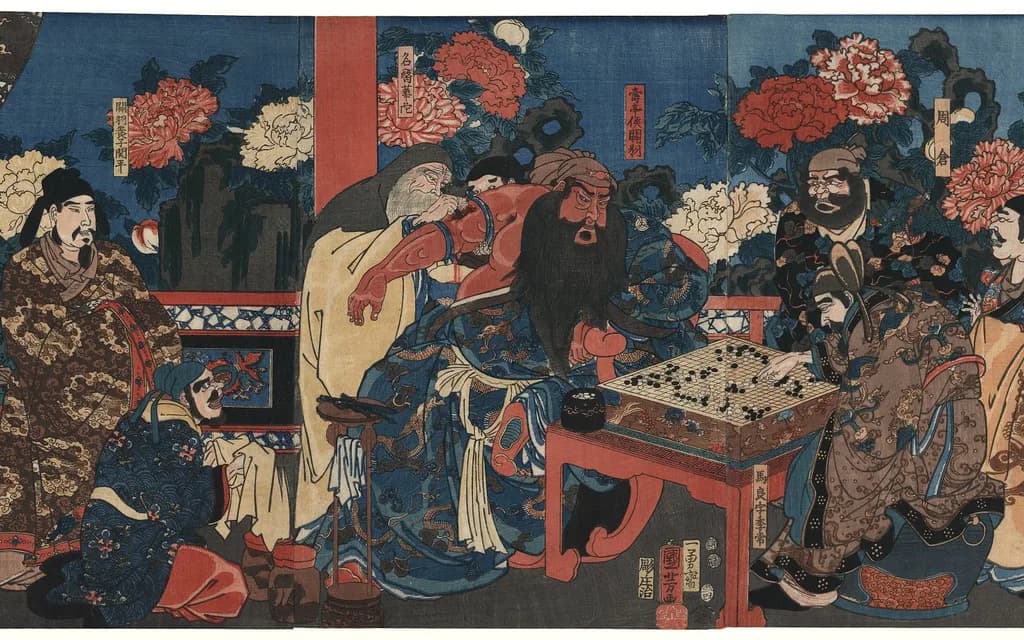
Two men in this novel are famous for the same thing and remembered in opposite directions. Guan Yu is the finest fighter on his side and the most reliable man in the book, and he ends up worshipped in temples with incense burning in front of him eighteen centuries later. Lu Bu is the finest fighter in the entire book, full stop, and he ends up as the answer to a different question: what happens to a man everyone wants and nobody can keep.
- Guan Yu became a god, and the paperwork survives. Emperors kept adding titles for a thousand years, until his ran to twenty-four characters.
- Lu Bu killed two adoptive fathers in sixteen chapters, and the second one had bought him from the first.
- They meet once, at Hulao Pass, and it takes three of the heroes at the same time to hold him.
- Neither man dies well. One is executed on a tower; the other loses his head and gets it posted to his enemy.
Below: how a general becomes a deity, what the novel itself says happened, and why nobody who recruited Lu Bu survived trusting him. If you would rather meet them both at once, the playable Romance of the Three Kingdoms has the one scene where they are on the same field.
🕯️ Why Guan Yu is worshipped as an actual god
Because loyalty, in this tradition, is the virtue with the most political value, and Guan Yu is its cleanest illustration. He is captured by Cao Cao, treated magnificently, offered everything, and leaves anyway the moment he learns where his sworn brother is, cutting his way through six officers at five passes to get there. Chapter twenty-seven is the whole argument for him in one journey.
The elevation is unusually well documented, because it happened by imperial decree over roughly a thousand years. He was being treated as a deity as early as the Sui dynasty. Under the Song, Emperor Huizong gave him a dukedom and then a princedom, and in 1187 Emperor Xiaozong extended the title further. In 1644 the Qing Shunzhi Emperor named him the Loyal and Righteous God of War and Holy Great Emperor, and by the middle of the nineteenth century the official title had grown to twenty-four characters. The Qing also promoted his worship among the Mongol tribes, where he became one of the most revered religious figures, ranked behind only their own lamas.
The result is a soldier holding the same rank in the culture as Confucius: one is the Saint of Letters, the other the Saint of War. Temples to him stand across mainland China, Hong Kong, Macau and Taiwan, and in Vietnam, South Korea and Japan. The Qing promotion is the part worth pausing on: a dynasty of Manchu rulers governing a mostly Han empire chose, as the figure to push hardest, a Han general whose entire meaning is that he keeps his word to the lord he has sworn to.
👻 What the novel itself says happened after he died
The historical end is grim and quick. Guan Yu was cut off in the winter of 219, fell back to Maicheng, was captured, and was executed by Sun Quan's forces at Linju in the first weeks of 220. Sun Quan then sent his head north to Cao Cao, hoping Liu Bei's revenge would land on Wei instead of Wu.
Cao Cao saw the trap, gave the head a nobleman's funeral and buried it with full honours. The novel keeps all of that and then adds the scene that matters for the worship. In chapter seventy-seven, Guan Yu's spirit rises over Mount Yuquan calling out for his head to be given back. An old monk in a hermitage there, Pujing, who had met him years before, strikes his door and asks where he thinks he is. Then he asks the question that ends the haunting: if you demand your head back, to whom should Yan Liang and Wen Chou and the six officers you killed at the five passes address the same demand.
Guan Yu understands, bows, and stops. Afterwards, the novel says, he appeared again and again on that mountain to protect the local people, who built him a temple on the summit and sacrificed there through the four seasons. That is the legend's own account of how a general became a god, told inside the story: not by winning, and not by dying well, but by being asked whether his grievance was special and having the grace to admit it was not.
⚔️ Lu Bu, and the pattern nobody survives
Lu Bu is introduced in chapter three as the adopted son of a provincial governor named Ding Yuan, and he is out of that arrangement within the same chapter. An envoy arrives with gold, pearls and a famous horse from Dong Zhuo, the warlord holding the capital, and points out that Lu Bu is serving the wrong man.
Lu Bu kills Ding Yuan and brings his head to Dong Zhuo, who adopts him in turn. Six chapters later he kills Dong Zhuo as well, this time over a woman, in a plot engineered by a minister who worked out that the fastest way to remove the tyrant was to make his bodyguard jealous. Lu Bu is by then the most feared fighter in China and has personally ended the careers of both men who claimed him as a son.
The bill arrives in chapter nineteen. Besieged at Xiapi, betrayed by his own officers while he sleeps, he is brought bound before Cao Cao and makes what is, on the numbers, a reasonable offer: put me in front of the cavalry and you will hold the empire in a year. Cao Cao is visibly tempted and turns to Liu Bei for an opinion. Liu Bei says one sentence. Have you forgotten what happened to Ding Yuan and Dong Zhuo.
| Guan Yu | Lu Bu |
|---|---|
| One lord, for life. Captured by Cao Cao, loaded with honours, and gone the moment he hears where Liu Bei is. | Four in sixteen chapters. Ding Yuan, Dong Zhuo, then a run of temporary allies, each abandoned when a better offer arrived. |
| Kills six officers at five passes to keep a promise, in chapter twenty-seven. | Kills two adoptive fathers to improve his position, in chapters three and nine. |
| Executed at Linju in 220, and worshipped as a god within four centuries. | Strangled and beheaded at Xiapion Cao Cao's order, with nobody in the room arguing for him. |
The last thing he says is aimed at Liu Bei and it is not wrong: that this is the most faithless man of all, and does he not remember the day at the camp gate when Lu Bu shot an arrow through a halberd blade at a hundred paces to stop a war and save his life. Both things are true at once. He did save Liu Bei, and he could not be trusted, and the second fact ate the first.
🏇 So was Lu Bu stronger than Guan Yu?
The book declines to answer, and the way it declines is the answer. The two of them share exactly one battlefield, at Hulao Pass in chapter five, and the novel does not stage them one-on-one. Zhang Fei goes in first and cannot finish it. Guan Yu joins him and the two of them together cannot finish it.
Liu Bei rides in third, and only then does Lu Bu break off and retreat behind the pass. Three of the most celebrated fighters in Chinese literature, simultaneously, to force one man to disengage. That is the novel telling you the ranking without ever having to run the fight, and it is why the question keeps getting asked: everybody can feel that the book dodged it on purpose.
What the book is much clearer about is that the ranking does not decide anything. In the same chapter five, Guan Yu goes out and kills the enemy champion Hua Xiong before the wine poured for him has had time to cool, and that is not the scene anyone worships him for. The scene they worship him for is a long ride in the wrong direction to keep a promise nobody would have held him to.
Chapter numbers were checked against the Chinese text at Project Gutenberg. The man who held Guan Yu for a season and let him go gets his own reappraisal here, and if you want to know which of these scenes the historians actually record, that is the fact-versus-fiction piece.
Sources
- 三國志演義 (Chinese text, 120 chapters) — Project Gutenberg
- Guan Yu — Wikipedia
- Lü Bu — Wikipedia
Frequently asked questions
- Why is Guan Yu worshipped as a god?
- Because loyalty was the virtue the imperial state most needed, and he is its clearest example. The novel builds the case in chapter seventy-seven, whose title pairs two hauntings: his spirit manifesting at Mount Yuquan, and Cao Cao being troubled by that same spirit at Luoyang. The dead man unsettles his enemy and protects the villagers, which is a god's job description.
- Is Guan Yu still worshipped in China today?
- Yes, and the titles accumulated for a thousand years before they stopped. In 1187 the Song Emperor Xiaozong styled him Prince Zhuangmou Yiyong Wu'an Yingji, a five-part honorific; the Qing later expanded the official title to twenty-four characters. Temples to him are still active across China and in the Chinese communities of Vietnam, South Korea and Japan.
- Was Lu Bu really the strongest warrior in the Three Kingdoms?
- By the novel's own arithmetic, yes, and it makes the point with property rather than a duel. Lu Bu's horse, Red Hare, passes after his death to Guan Yu, presented by Cao Cao in chapter twenty-five. Guan Yu bows twice for a horse after refusing to bow for gold, because the animal can cover a thousand li in a day.
- Why did Lu Bu keep betraying the people who trusted him?
- Because he was consistently worth buying and consistently for sale. The man who turned him against his first adoptive father was an envoy named Li Su, who arrived with gold, pearls and a horse and an argument about serving the wrong master. It worked in one conversation, and the novel never lets you forget how quickly.
- Was Lu Bu stronger than Guan Yu?
- The book refuses to run the fight. Their only shared scene is chapter five at Hulao Pass, whose title says plainly that it takes three heroes to fight Lu Bu, and even then he disengages rather than loses. Every ranking argument since has been an attempt to settle something the novelist deliberately left open.
Enjoyed this one?