Is Romance of the Three Kingdoms Worth Reading? Yes, and Which Translation to Start With
A hundred and twenty chapters, close to a century of civil war, and two English translations that read like different books. The honest case for it, and the one that gets you through.


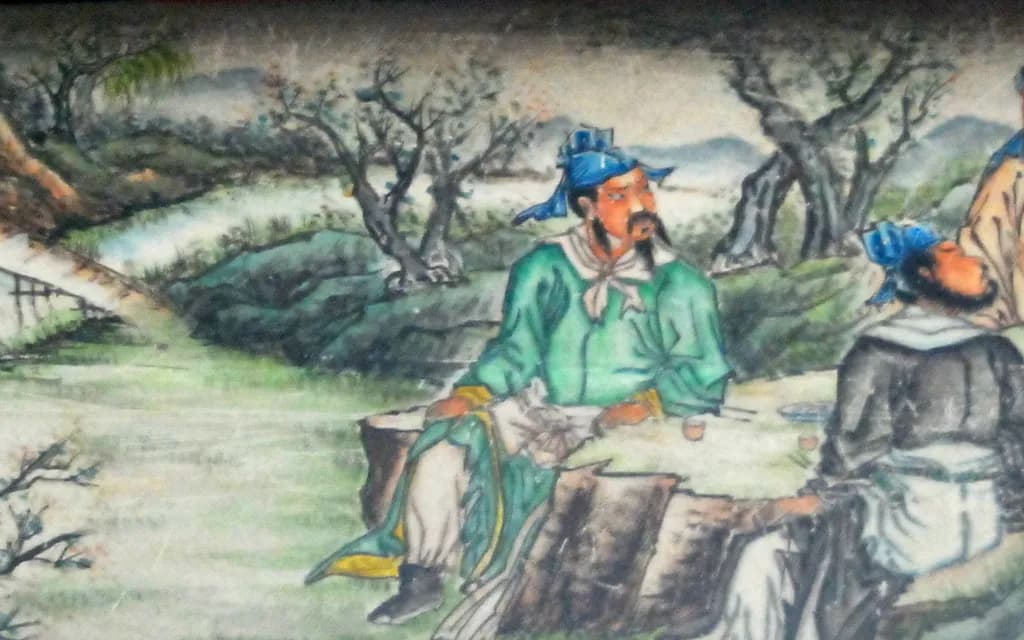
Almost nobody arrives at this book cold. You have beaten a campaign as Cao Cao, or spent a teenage summer mashing a button as Lü Bu, or watched a fan-made recap and come away with forty names and no idea which of them are real. Then you go looking for the source and find a hundred and twenty chapters, a civil war that runs for the best part of a century, and an English translation situation that nobody explains clearly. Here is the short version of what you are actually signing up for.
- It is a hundred and twenty chapters covering close to a century, and it opens on three strangers swearing brotherhood in an orchard.
- It is episodic by design. A siege, a stratagem, a betrayal, a funeral, and on to the next province. You can read it twenty pages at a time.
- The names are the wall, not the prose. Everyone has a given name and a courtesy name, and the translations disagree about which to use.
- One translation is free, one is the scholarly standard, and picking between them decides how far you get.
Everything below is about that choice and what each version costs you. If you would rather walk into the story than read about it, the playable Romance of the Three Kingdoms opens exactly where the novel does, in a peach orchard in Zhuo County with three men who have known each other for about a day.
🍑 Is it worth reading, or is the reputation doing the work?
It is worth reading, and the reason is that the first chapter does not make you wait. Three men meet, decide within a page that they like each other, and kneel in an orchard to swear brotherhood before a black ox and a white horse. The oath they recite is the sentence the whole book then spends a hundred and twenty chapters honouring and breaking.
We ask not the same day of birth but we seek to die together.
That is the engine. Three men promise to die on the same day, and the rest of the novel is a century-long argument about whether loyalty of that kind can survive contact with politics. Everything else, the sieges and the fire ships and the ambushes in the fog, hangs off it. Readers who report bouncing off the book almost never say the story bored them; they say they lost track of who was who.
Readers who finish it tend to describe the same thing, and it is not the battles. The book is built as a loop. Its first line of prose says that what has long been divided must unite and what has long been united must divide, and its last chapter quotes that line straight back at you after everything you have watched people die for has been swept up by a dynasty nobody was rooting for. Corruption to collapse, collapse to order, order to prosperity, prosperity to corruption. Reading it as a cycle rather than as a contest is what turns a very long war story into something worth the time.
The other thing worth knowing before you start is how unembarrassed it is. It opens on a lyric poem, before a single line of prose. It stops for verse whenever a river or a defeat deserves one. Grown men weep constantly and the narrator never treats it as weakness, to the point that one of its best-known chapters is titled for a commander shedding tears while he orders an execution he cannot avoid. If that sounds like a lot, it is, and it is most of the reason people who love this book love it.
The structure helps more than its length suggests. This is not one continuous plot but a chain of set pieces, each with its own trap and its own resolution: a champion cut down at a mountain pass in chapter five, a night raid on a grain depot in chapter thirty, a fleet of straw-laden boats in a fog bank in chapter forty-six, a man playing a zither on an undefended city wall in chapter ninety-five. Put the book down for a fortnight and you can pick it up at the next set piece without rereading anything.
The one honest warning is the cast. Several hundred people speak, and traditional Chinese naming gives most of the important ones two names apiece, a given name and an adult courtesy name, both of which the narrator uses interchangeably. Cao Cao is also Mengde. Zhuge Liang is also Kongming. Liu Bei is also Xuande, which older translations spell Yüan-tê. Nothing about the prose is difficult; the bookkeeping is.
📚 Which English translation should you pick?
Take Brewitt-Taylor if you want to start tonight for nothing, and Roberts if you want the version scholars cite and modern readers find easier on the eye. Both are complete. The practical difference is a century of English prose style and one romanization system.
| Version | What you are getting |
|---|---|
| C. H. Brewitt-Taylor (1925) | Complete, published in two volumes by Kelly & Walsh in Shanghai, and in the public domain in the United States. Free at Project Gutenberg. Edwardian phrasing and Wade-Giles spellings throughout: Ts'ao Ts'ao, Kuan Yü, Liu Pei, Chang Fei. |
| Moss Roberts, unabridged (1991) | The modern scholarly standard, from the University of California Press with Foreign Languages Press in Beijing. Roberts is professor emeritus of Chinese at New York University. Modern pinyin, full apparatus, and the version most academic citations point at. |
| Moss Roberts, abridged (1976) | Published by Pantheon as Three Kingdoms: China's Epic Drama, fifteen years before his complete one. Same translator, same voice, a fraction of the length. The option most first-time readers do not know exists. |
The spelling difference is the one that catches people out, because it is invisible until it is not. A reader who knows the cast from a game knows Cao Cao, Lü Bu and Zhao Yun. Open Brewitt-Taylor and those men are Ts'ao Ts'ao, Lü Pu and Chao Yün. Nothing is wrong; the 1925 text uses the romanization of its own decade, and you adjust inside a chapter. It is still worth knowing before you decide that you have the wrong book.
There is one thing every English edition shares, and it is stranger than the translation question. The line that opens the novel in every modern version, the one about an empire long divided having to unite and a long-united one having to divide, was not written by its author. Mao Lun and his son Mao Zonggang added it when they re-edited the novel in 1679, and no earlier edition carries it. Their text then drove every rival off the market and was, for close to three centuries, the only Romance of the Three Kingdoms most Chinese readers had ever seen. Brewitt-Taylor renders the same opening as Empires wax and wane; states cleave asunder and coalesce, which is the older phrasing of a line that is itself an editorial addition.
⏳ How long is it, and does an abridgement cost you anything?
A hundred and twenty chapters, and in English that lands as two substantial volumes. Brewitt-Taylor's 1925 edition was physically published that way, volume one running from chapter one to chapter sixty and volume two carrying the rest, which is a fair indication of the shape of the thing.
An abridgement costs you less here than it would in almost any other long novel, for the same reason the book is easy to read in short sittings. Cut an episode and you remove an adventure, not a thread the next chapter depends on. What you lose is the accumulation: the sense that these men have been fighting each other for decades, that the young officers of the middle chapters were children in the early ones, and that the last quarter is being fought by the sons and grandsons of the men who swore the oath.
The last quarter is also where most readers who quit have already quit, and it is the part the abridgements cut hardest, which is a shame. The founding generation dies off, the war continues without them, and the book keeps going anyway. That stretch is the strangest and most modern thing in it, and it is why the ending lands the way it does.
For scale in a different currency: the 1994 television version needed eighty-four forty-five-minute episodes to get through this story, and still did not film all of it. If you are trying to work out whether the novel is long, that is a better yardstick than a page count, and the adaptations are ranked here.
🎮 Does arriving from a strategy game put you behind?
It puts you ahead, and the advantage is exactly the thing that makes the novel hard for everyone else. The wall in this book is the cast list. A reader who has spent a hundred hours recruiting generals already knows that Zhang Liao and Zhang He are different people, that Wei is the north and Wu is the south, and that the man with the red face is not the man with the halberd.
That is most of the onboarding, done. The games did leave you with two things worth unlearning. The first is that they compress a century into a map you can see all at once, so the novel's enormous stretches of waiting, of provinces changing hands over a decade while nothing decisive happens, come as a surprise. The second is that a game gives every faction an equal chance, and the novel does not. It has a side it wants you on, and it starts pushing in chapter one.
Which raises the question everyone asks next, and this piece is not the place for it: how much of this actually happened. The war is real, the men are real, and a good deal of the best material is invented. We take that apart in the piece on how much of the novel is true, which also answers the question the search engines say readers ask most about this book.
The Chinese text is free at Project Gutenberg, and so is Brewitt-Taylor's 1925 English translation. Both are where every chapter number in this series was checked. If you want to know which of the famous scenes are real before you commit, the Empty Fort is taken apart here, and the case for and against the book's villain is made in the piece on Cao Cao.
Sources
- 三國志演義 (Chinese text, 120 chapters) — Project Gutenberg
- San kuo; or, Romance of the three kingdoms (volume 1 of 2), tr. C. H. Brewitt-Taylor, 1925 — Project Gutenberg
- Romance of the Three Kingdoms — Wikipedia
- Mao Zonggang — Wikipedia
- Moss Roberts — Wikipedia
Frequently asked questions
- Is Romance of the Three Kingdoms worth reading?
- Yes, and it is the most approachable of its group. It is one of the Four Great Classical Novels of Chinese literature, alongside Journey to the West, Water Margin and Dream of the Red Chamber, and it is the one with the clearest forward motion: a war with dates, sides and consequences rather than a pilgrimage or a household.
- Romance of the Three Kingdoms: which English translation is best?
- Moss Roberts for a modern unabridged read, C. H. Brewitt-Taylor if you want it free. The free option is newer than it sounds: Brewitt-Taylor's 1925 first volume only reached Project Gutenberg on 7 December 2025, so a complete public-domain English text has been easy to get hold of for less than a year.
- How long is Romance of the Three Kingdoms, and should I read an abridged version?
- A hundred and twenty chapters, published in English as two substantial volumes. An abridgement is a reasonable way in, because the middle is episodic. If you want to check a chapter against the original, the Chinese text is catalogued under its full title, Sanguozhi Yanyi, rather than the English name.
- Is Romance of the Three Kingdoms hard to read for a first-timer?
- The sentences are easy and the first page is dense. Chapter one opens on a collapsing dynasty and a peasant uprising, the Yellow Turban rebellion, and introduces three men and about a dozen court officials before anything is explained. Get through that and the book settles into self-contained episodes almost immediately.
- Do I need to know Chinese history before I start?
- No. The novel supplies its own context, and the underlying history is short enough to summarise: three states between 220 and 280 AD, documented by a court historian named Chen Shou within a decade of the war ending. Everything else the book teaches you as it goes.
- Why is Romance of the Three Kingdoms so popular?
- Because it has never stopped being adapted, in every medium China has had. Dingjun Mountain (1905), usually called the first Chinese film ever made, was a filmed recording of a Peking opera drawn from this story, which puts the novel into cinema in the same decade cinema reached China. Television, comics and games have kept the cycle running since.
Enjoyed this one?