Did Arthur Conan Doyle Hate Sherlock Holmes? Why He Killed Him, and Why He Brought Him Back
Doyle sent his detective over a waterfall in 1893 and spent the next decade being asked to undo it. The letter to his mother, the cancellation figure nobody can source, and the two real criminal cases he worked himself.


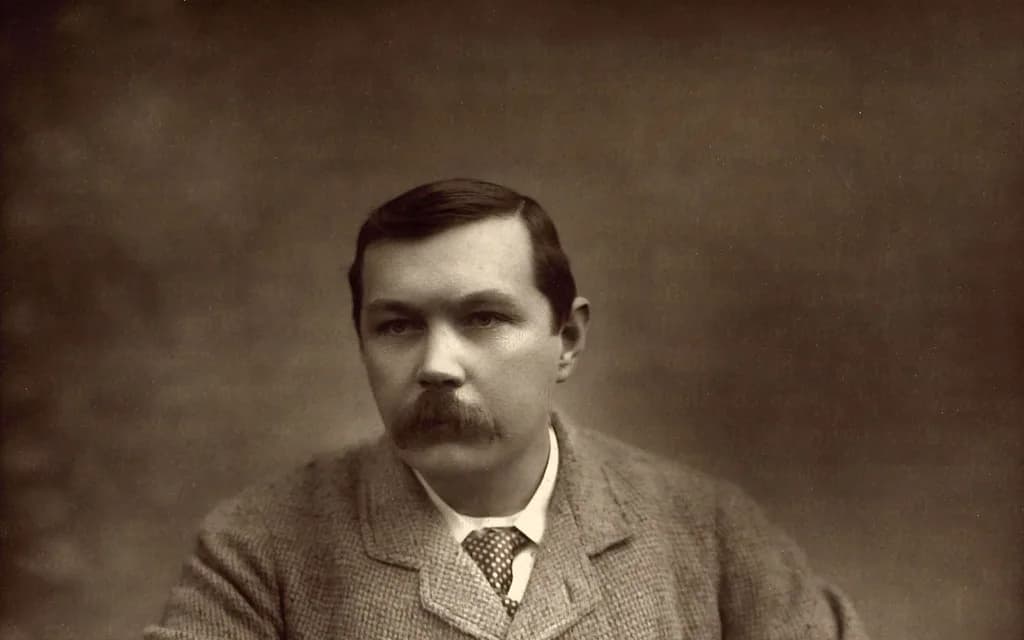
In 1893 Arthur Conan Doyle wrote to his mother that he was in the middle of the last Sherlock Holmes story, after which the gentleman would vanish and not come back. The sentence that ends that letter is the one everybody quotes, and it is six words long: “I am weary of his name.” He then sent his detective over a waterfall, and spent the next decade being asked to undo it.
- He killed Holmes on purpose, in a story written for the purpose, and invented Professor Moriarty to do it.
- The reason was career, not money. Holmes was making him rich and blocking the reputation he actually wanted.
- The famous 20,000 cancellations are repeated everywhere and documented nowhere.
- He came back for good in 1903, ten years later, and went on writing Holmes for a quarter of a century.
None of this happens inside The Adventures of Sherlock Holmes, the 1892 collection of twelve stories that made Doyle famous and that the playable version on this site is built from. It is what happened next, to the man who wrote them.
✍️ The short answer: he was tired of him by the second collection
The twelve stories in this collection ran monthly in The Strandthrough 1891 and 1892 and were an immediate, enormous success. Doyle’s response to that success was to try to price himself out of writing more of them, and when the magazine kept paying, to stop by other means. The letter to his mother, written in 1893, survives in more than one transcription and the middle of it varies between them. In one the gentleman “vanishes, never to return”. In another he “vanishes never never to reappear”, doubled word and all. The last sentence is identical in both.
“I am weary of his name.”
Six words, to his own mother, about the character paying for the house he was writing them in.
🌊 The story written to end him
“The Final Problem” appeared in The Strandin December 1893. It introduces Professor Moriarty, gives him a criminal organisation and an intellect to match Holmes’s, and uses him to push Holmes off a ledge above the Reichenbach Falls in Switzerland. Moriarty exists for that one purpose. He is invented in the story that kills Holmes, which is why he does not appear anywhere in the twelve Adventures at all, a fact worth knowing before you start the book and set out in full here.
What happened next has become one of publishing’s favourite anecdotes, and it deserves handling with tongs. The story usually told is that more than 20,000 readers cancelled their subscriptions to The Strand, that the magazine nearly folded, and that its staff thereafter referred to the death as “the dreadful event”. The figure is repeated confidently by Stanford University Libraries’ own Holmes exhibit and by newspapers including The Irish Times, and not one of them cites a circulation record. Even Wikipedia hedges it as reported. Something certainly happened, because the outcry is well attested in Doyle’s own correspondence and in the magazine’s behaviour afterwards. The number is folklore that has been quoted long enough to sound like data.
📚 Why a rich author wanted rid of his own bestseller
Doyle wanted to be taken seriously as a historical novelist, and the more Holmes sold the more firmly he was fixed in the public mind as the man who wrote the Holmes stories. In December 2023 The Guardian reported the historian Lucy Worsley’s argument, written up by her in the Radio Times alongside a BBC documentary, that Doyle came to resent Holmes precisely because the character denied him recognition for the work he cared about, even while making him rich.
The resentment is easier to believe once you look at what he did with the money. He kept writing the historical novels and histories he would rather have been remembered for, and he spent years of his life on two criminal cases that were nothing to do with him. Holmes was the job that funded all of it, and the job would not stay in its place.
⚖️ The detective work Doyle did himself
Twice he took on a wrongful conviction in person, and both times it cost him years. George Edalji, a Birmingham solicitor, was convicted in 1903 of maiming livestock. Doyle met him, noticed immediately that Edalji was severely short-sighted and astigmatic, and argued in print that a man who could barely see his own hand could not have crossed fields at night to do what he was accused of. Edalji was pardoned in May 1907 and was back practising as a solicitor by November, though he received no compensation because an official inquiry concluded he had written some of the anonymous letters in the case himself.
The claim that Doyle’s campaign created England’s Court of Criminal Appeal in 1907 is the version that circulates, and it is too neat. Legal scholarship treats Edalji as one of three cases always invoked as the impetus for that court, alongside the Adolf Beck and Florence Maybrick cases. It was a contributing scandal rather than the cause.
Oscar Slater took very much longer. Slater was convicted of a Glasgow murder in 1909. Doyle published The Case of Oscar Slater in 1912, arguing the conviction was unsafe, and was still pressing the case in print in the 1920s. Slater walked out of prison in November 1927. His conviction was quashed the following July, on the narrow ground that the trial judge had misdirected the jury about his character rather than on the facts of the murder, and he was awarded six thousand pounds.
🔁 How Holmes came back
In two stages, and the first one is a trick. Doyle serialised The Hound of the Baskervilles in The Strand from August 1901 to April 1902 and set it before the Reichenbach Falls, so Holmes could be alive in it without being alive now. It is a posthumously discovered case rather than a resurrection, and readers noticed.
The real return is “The Adventure of the Empty House”, published in October 1903, in which Holmes turns out to have survived the fall and to have stayed away while the world believed him dead. Doyle went on writing him until 1927, thirty-four years after deciding to stop.
The best evidence that the hatred was never simple arrives at the very end. In 1927 The Strandasked Doyle to name his own twelve best Holmes stories, and he did it, in order, with reasons. The story he placed fourth on that list is “The Final Problem”, the one he wrote to be rid of the man. The four from this collection that made his list, and where to start because of them, are here, the trick he spent thirty-four years being unable to put down is set out in one line of the first story, and the twelve stories themselves are free at Project Gutenberg.
Sources
- Arthur Conan Doyle secretly resented his Sherlock Holmes creation, says historian — The Guardian
- Sherlock Holmes: The Great Hiatus — Stanford University Libraries
- The hounding of Arthur Conan Doyle — The Irish Times
- Conan Doyle's own mystery cases: Oscar Slater — Conan Doyle Info
Frequently asked questions
- Did Arthur Conan Doyle hate Sherlock Holmes?
- Resented is the better word. The Guardian reported in December 2023 that the historian Lucy Worsley argues Doyle came to resent the character for denying him recognition as a serious novelist. Holmes says something close to it himself: in The Copper Beeches he complains that Watson has degraded what should have been a course of lectures into a series of tales.
- Which story killed off Sherlock Holmes?
- The Final Problem, published in The Strand in December 1893, in which Holmes and Professor Moriarty go over the Reichenbach Falls together. It was collected in The Memoirs of Sherlock Holmes, the volume that follows The Adventures. The story and the book carry different years in most references, because the magazine issue is 1893 and the collection is usually dated 1894.
- How many people cancelled their Strand subscriptions when Holmes died?
- Nobody can say. The figure repeated everywhere is more than twenty thousand, and no source that prints it cites a circulation record. It is also a story about a different book: The Adventures of Sherlock Holmes appeared in 1892 and The Final Problem did not run until December 1893, so none of the twelve stories here is the one that emptied the postbag.
- Did Conan Doyle ever solve a real crime?
- He worked two, both convictions rather than mysteries. George Edalji was pardoned in May 1907 and refused compensation; Oscar Slater left prison in November 1927 and had his conviction quashed the following July on a misdirection to the jury. Both have the shape of The Boscombe Valley Mystery, where the police have already arrested the wrong man before Holmes arrives.
- How long was Sherlock Holmes dead?
- Nine years and ten months of publishing time. The Final Problem ran in December 1893 and The Adventure of the Empty House, the real resurrection, in October 1903. In between Doyle serialised The Hound of the Baskervilles from August 1901 to April 1902 and set it before the death, which fed the demand without reversing anything.
Enjoyed this one?