Which Sherlock Holmes Story Should You Read First? Doyle's Own Ranking of the Twelve Adventures
Twelve stories, no required order, and a reading-order genre that answers a question nobody asked. Doyle published a ranking of his own in 1927, and four of his top twelve are in this one book.


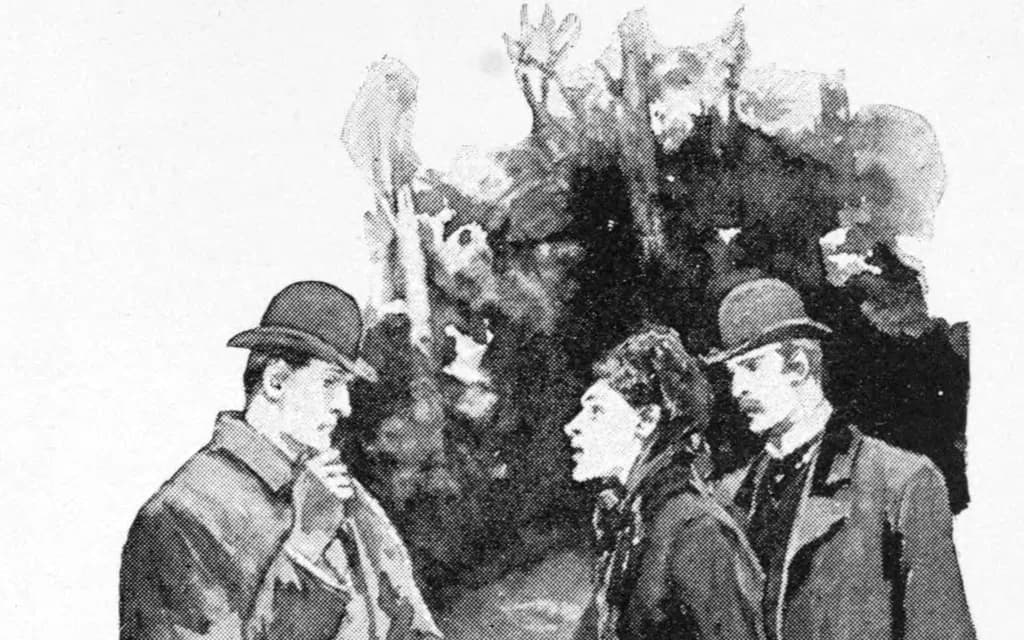
There are twelve stories in The Adventures of Sherlock Holmes, none of them depends on any of the others, and the reading-order guides that dominate this question are mostly answering a different one. You do not need a sequence. You need to know which one is good enough to make you read the other eleven, and on that question the most useful opinion available belongs to Arthur Conan Doyle, who published his in 1927.
- Doyle ranked his own stories. In 1927 The Strand asked, and he named his twelve best, in order.
- His number one is in this book. The Adventure of the Speckled Band took first place.
- Four of his twelve are here. Numbers one, two, five and seven all come from this one collection.
- Order does not matter. Each story is a complete case with its own client, and nothing carries over.
Whether to begin with this collection at all is a different question, and the short answer to it lives here. Nothing below names a culprit or gives away a solution. If you would rather walk into one of the twelve than read about it, the playable Adventures of Sherlock Holmes opens all twelve as doorways plus the consulting room itself.
🥇 The short answer: use Doyle’s own list
In 1927, more than thirty years after he had first tried to be rid of the character, Doyle drew up a ranked list of the twelve Holmes short stories he thought were the best of the ones he had written, and The Strand printed it with his reasoning. The introduction he gave it is characteristically flat.
“I have drawn up a list of the twelve short stories contained in the four published volumes which I consider to be the best.”
Four of the twelve he chose are in this collection, and they are spread across his ranking rather than clustered at the bottom of it: The Adventure of the Speckled Band at number one, The Red-Headed League at two, A Scandal in Bohemia at five and The Five Orange Pips at seven. That is a third of his personal best-of coming from his first collection, which is a reasonable argument for starting where most readers start anyway.
Worth being precise about one thing. The line you will see quoted, that Doyle called The Speckled Band his best story, traces back to this same 1927 list rather than to a separate occasion on which he said so. He ranked it first, once, in print, with reasons. That is enough.
🐆 Why his first choice still works
The Speckled Band opens at a quarter past seven in the morning with a woman who has come up by train before dawn. Watson notices that her hair is shot with premature grey though her face is a face of thirty, and that she is trembling. Her sister died two years ago, days before her own wedding, and her last words were about a band, a speckled band. Nobody has been able to explain them.
The house she has come from has a stepfather with a violent history, a wing under repair, and, wandering loose on the grounds, a cheetah and a baboon. It is a locked-room mystery with an actual locked room, and it is built so tightly that a modern reader can see every piece Doyle puts on the table and still not assemble them. That construction is what he was ranking. He was not sentimental about these stories and he put this one first.
There is also a small moment in it that most readers do not expect, thirty seconds into the interview, before any deduction happens at all.
“You must not fear,” said he soothingly, bending forward and patting her forearm. “We shall soon set matters right, I have no doubt.”
🟥 If you only read one more
Read The Red-Headed League, Doyle’s number two and the second story in the book. A pawnbroker with fiery red hair comes to Baker Street to complain about a job he has just lost, and the job is the joke: he was being paid four pounds a week to sit in an office copying out an encyclopaedia, on the sole qualification that his hair was the right colour. He is not distressed. He is annoyed, and he wants to know what the point of it was.
It is the funniest of the twelve and the one that best shows what the collection actually is: not a series of murders but a series of situations too strange to leave alone. Holmes’s own line about why he takes work like this belongs to another essay on this hub, which quotes it properly.
After those two, order genuinely stops mattering. A Scandal in Bohemia, Doyle’s number five, opens the book and is the one case in it that Holmes loses, which is its own subject. The Five Orange Pips, his number seven, is the bleakest thing in the collection. The remaining eight are a pawnbroker’s cellar, a missing bridegroom, an opium den, a goose, a thumb, a coronet, a governess and a country lane, in whatever sequence you like.
🩺 The man the method came from
One piece of biography is worth having before you start, because it changes how the deductions read. Doyle did not invent the technique. He watched it being done, as a medical student in Edinburgh, by his teacher Dr Joseph Bell, a surgeon who lived from 1837 to 1911 and who was in the habit of telling patients their occupation and recent movements before they had said anything at all. Doyle worked as his outpatient clerk from 1877, which meant standing beside him while he did it, all day.
Doyle acknowledged the debt directly. In a letter to Bell he wrote: “It is most certainly to you that I owe Sherlock Holmes.” Read the stories with that in mind and the deductions stop being magic tricks. They are a clinical routine, transplanted from a hospital outpatients’ department to a sitting room in Baker Street, which is why they hold up.
All twelve stories are free at Project Gutenberg and the whole collection runs to an evening or two. If you want to know who you will meet in them, without meeting them, the cast is set out here, and the reason Doyle came to dread writing more of them is a story in itself.
Sources
- The Adventures of Sherlock Holmes — Project Gutenberg
- The 12 Best Sherlock Holmes Stories, According to Arthur Conan Doyle — Literary Hub
- List of Sherlock Holmes stories — Wikipedia
- The Scot who inspired the creation of Sherlock Holmes — Scottish Field
Frequently asked questions
- Which Sherlock Holmes story did Arthur Conan Doyle think was his best?
- The Adventure of the Speckled Band. He put it first when The Strand asked him in 1927 to rank the twelve best Holmes short stories he had written. Third and fourth on that list were The Adventure of the Dancing Men and The Final Problem, the story he had written thirty-four years earlier specifically to kill the detective off.
- Do you have to read the Sherlock Holmes stories in order?
- No. Each of the twelve in this collection is a complete case with its own client and its own ending. Two novels came first, A Study in Scarlet and The Sign of the Four, and the stories occasionally nod back to them: in A Case of Identity, Watson mentions both by name while listing the tangles Holmes has unravelled. Nothing in the book requires you to have read them.
- Who was Sherlock Holmes based on?
- Dr Joseph Bell, who taught Doyle at Edinburgh and took him on as an outpatient clerk in 1877. The evidence is in the book. The first thing Holmes does in the first story is read Watson off his clothes: seven and a half pounds heavier, back in practice, getting himself very wet, employing a clumsy and careless servant girl.
- How long does it take to read The Adventures of Sherlock Holmes?
- About five or six hours for the whole book, and roughly half an hour for a single story. A Scandal in Bohemia, the opening one, runs to a little over eight and a half thousand words in the Project Gutenberg text. That is the practical case for starting anywhere: one story is an evening's reading on its own, and no story leaves you owing another.
- What stories are in The Adventures of Sherlock Holmes?
- Twelve, in this published order: A Scandal in Bohemia, The Red-Headed League, A Case of Identity, The Boscombe Valley Mystery, The Five Orange Pips, The Man with the Twisted Lip, and then six titled as adventures: the Blue Carbuncle, the Speckled Band, the Engineer's Thumb, the Noble Bachelor, the Beryl Coronet and the Copper Beeches.
Enjoyed this one?