Who's Who in Frankenstein: Clerval, Justine, Walton, Elizabeth and the Creature
Frankenstein has a reputation for being a two-hander and that is not how it is built. It is a stack of documents around a Genevan household of five people, four of whom are dead by the last chapter. The survivor is a brother almost nobody can name.


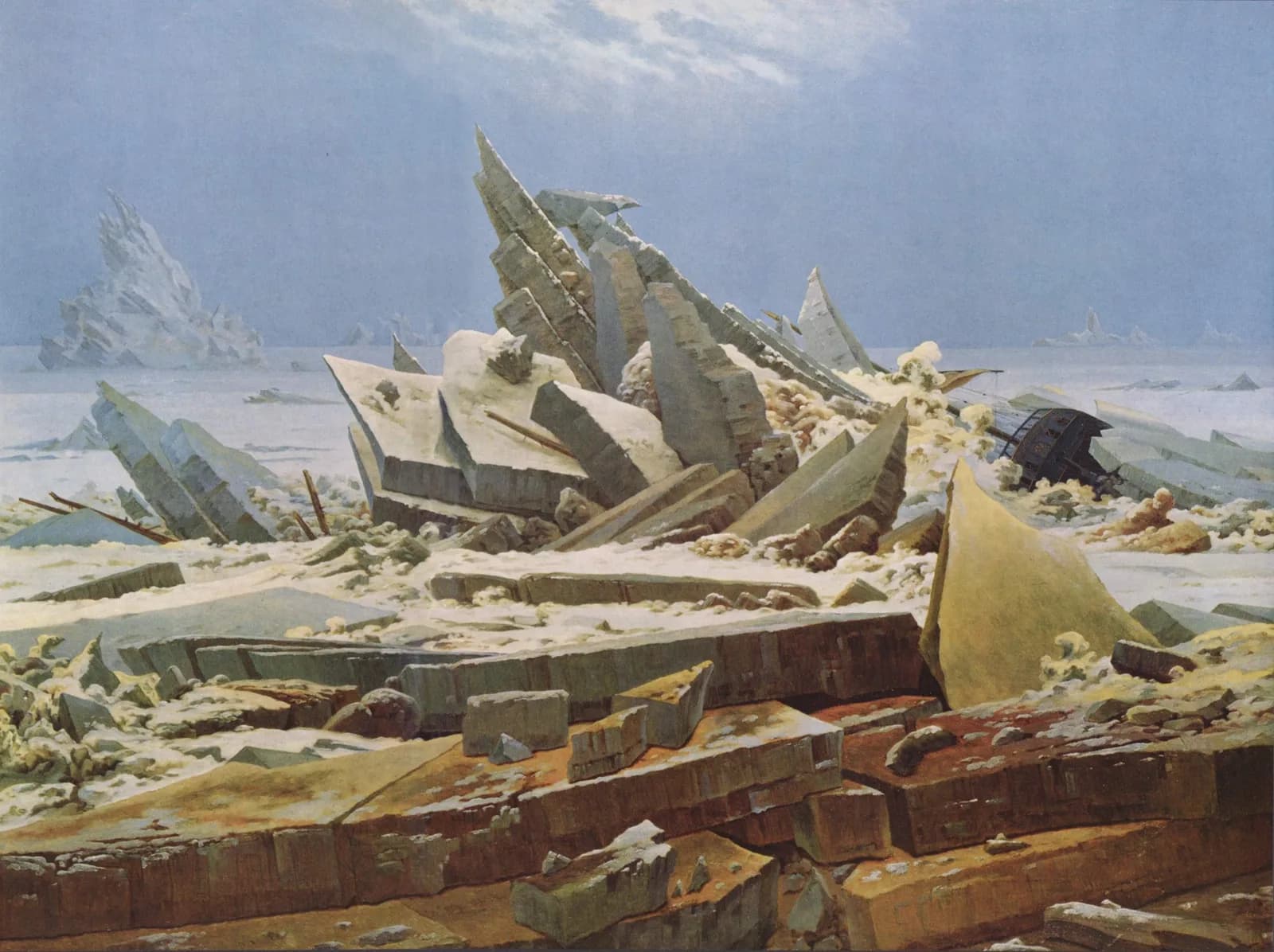
Frankenstein has a reputation for being a two-hander, a scientist and the thing he makes, and that is not how the book is built. It is a stack of documents: a sea captain’s letters home, containing a dying stranger’s confession, containing the confession of the creature who ruined him. Around all three sits a Genevan household of five people, four of whom are dead by the last chapter. The survivor is a brother almost nobody can name.
- Robert Walton writes the letters the whole novel arrives inside.
- Henry Clerval is the friend, and the second person the creature strangles.
- Justine Moritz is hanged for a murder everyone in the room knows she did not commit.
- The creature is the only character in the book with no name at all.
Everything below is stated in the 1831 chapter numbering. Which Frankenstein you are holding, and the one paragraph that tells you, is a companion post’s subject.
🧭 Robert Walton, the letters the whole book sits inside
Walton is an English explorer sailing north to find a passage over the pole, and every word of Frankenstein reaches you inside a letter he is writing to his sister, Mrs. Saville, whom he calls Margaret. He is self-taught, having spent his first fourteen years running wild on a common with nothing to read but his Uncle Thomas’s books of voyages, and the thing he wants is stated in the second letter before the plot has started at all.
“I bitterly feel the want of a friend. I have no one near me, gentle yet courageous, possessed of a cultivated as well as of a capacious mind, whose tastes are like my own.”
He then pulls a half-dead man off the ice who turns out to be exactly that, and listens to him for the rest of the book. Walton is easy to forget because he holds no plot of his own, and he is the reason the novel has an ending at all: the creature comes aboard at the finish and speaks to Walton, not to Victor, who is past hearing. What Walton is for, thematically, is the subject of another essay on this hub.
🏠 The Frankensteins, and the brother who outlives them all
Victor Frankensteinis a student, and the book is careful about it. He goes to Ingolstadt at seventeen, is mocked by the professor of natural philosophy M. Krempe for reading alchemists, is won over to chemistry by M. Waldman, works alone for nearly two years, and leaves before any of it turns into a qualification. The phrases “Doctor Frankenstein” and “Dr. Frankenstein” do not occur in the novel once.
Alphonse Frankenstein, his father, is a Genevan syndic, patient to a fault, and writes long letters that arrive too late to help. Caroline Beaufort, his mother, dies in chapter 3 of scarlet fever caught while nursing Elizabeth through it. The novel notes without comment that Elizabeth recovers.
William Frankensteinis the youngest, strangled in chapter 7 on a walk near Geneva. The miniature of his mother that he wore is missing from his body, and it is later found in Justine’s pocket. Victor, who works out what has happened the instant he sees a shape moving on the mountain, says nothing to anyone.
“I considered the being whom I had cast among mankind… nearly in the light of my own vampire, my own spirit let loose from the grave, and forced to destroy all that was dear to me.”
Ernest Frankenstein is the middle brother, sixteen when Elizabeth writes about him in chapter 6, and his name appears thirteen times in the whole 1831 text. He wants to go into the army, is talked out of it, and is the one who tells Victor that Justine has been accused. Then he is barely mentioned again until the end of chapter 24, when Victor comes home from the wedding night to find that his father and Ernest are still alive, and his father dies within days. Every named Frankenstein except Ernest is dead by the last page. He is the only one who was never told what any of it was about.
🎻 Henry Clerval, the friend Victor does not deserve
Clerval is a Genevan merchant’s son who wanted to be a poet, comes to Ingolstadt to study languages, and arrives on the morning after the creation to find Victor raving. He nurses him for months without asking what happened. He is, by some distance, the warmest person in the book, and Victor keeps him in the dark from the first page to the last.
He is killed in chapter 21 in Ireland, while Victor is off destroying the creature’s half-built mate on Orkney. A fishing party finds a body on the sand, a handsome young man of about five and twenty, not drowned and not yet cold, with no injury but the black mark of fingers on his neck. It is the same mark as William’s. Victor is arrested for the murder, is held for months, and is treated with unusual decency by the magistrate, Mr. Kirwin, who is the only official in the novel who behaves well.
⚖️ Justine Moritz, and the confession she did not mean
Justine is a servant in the Frankenstein house, taken in as a girl and treated as family, and she is tried in chapter 8 for William’s murder on the evidence of the miniature found in her pocket. Elizabeth speaks for her in court. Victor, who could end it in one sentence, does not. The part most readers forget is that Justine pleads guilty, and why.
“I did confess, but I confessed a lie. I confessed, that I might obtain absolution; but now that falsehood lies heavier at my heart than all my other sins.”
Her confessor threatened and menaced her until she agreed she was the monster he said she was. The chapter ends in six words: “And on the morrow Justine died.” She is the novel’s clearest demonstration that the creature is not the only thing in it that destroys an innocent person for the convenience of everyone watching.
💍 Elizabeth Lavenza, whose backstory depends on your edition
Elizabeth is raised in the Frankenstein house from early childhood, intended for Victor by his mother, and married to him in chapter 23. How she got there is the single largest difference between the two published texts. In the 1818 edition she is Victor’s first cousin, the daughter of his father’s dead sister. In the 1831 edition she is an unrelated foundling with hair of the brightest living gold, adopted out of a peasant cottage near Lake Como. The full test is set out here.
In both versions she writes the letters that carry the family news, she is the one who fights for Justine, and she is strangled on her wedding night while Victor is outside searching the corridors for an attacker he expects to come for him instead. He finds her thrown across the bed with the murderous mark of the fiend’s grasp on her neck. Victor spent the whole engagement assuming a threat aimed at himself, which is the last and worst of his misreadings.
👤 The creature, the only character with no name
About eight feet tall, which is the novel’s own hedge, assembled from collected remains, with yellow skin, hair of a lustrous black, teeth of a pearly whiteness and watery eyes set in dun-white sockets. He is abandoned in the hour he opens his eyes, and he educates himself over the following year by hiding in a lean-to against a cottage in Germany and watching the family inside.
Those are the De Laceys: blind old De Lacey, his son Felix, his daughter Agatha, and Safie, the Arabian woman Felix loves. Felix teaches Safie French from Volney’s Ruins of Empires, and the creature learns beside her without any of them knowing he is there. He later finds three books in a portmanteau and reads them: Paradise Lost, a volume of Plutarch’s Lives and the Sorrows of Werter. That is where his vocabulary comes from, and it is why he can out-argue Victor on a glacier.
“Remember that I am thy creature; I ought to be thy Adam, but I am rather the fallen angel, whom thou drivest from joy for no misdeed.”
Across the whole 1831 text he is called creature forty-four times and fiend thirty-five, plus four more epithets besides. Not one of those is a name, and nobody in the novel ever gives him one. Why the world has spent two centuries handing him his maker’s surname instead is a whole post of its own.
The complete text of both editions is free at Project Gutenberg, and the creature has the last word in it, promising Walton he will build his own funeral pile and burn on it.
Sources
- Frankenstein (1831 text) — Project Gutenberg
- Frankenstein (1818 text) — Project Gutenberg
- Frankenstein — Wikipedia
Frequently asked questions
- What is the point of Robert Walton in Frankenstein?
- He is the reason the novel can end. Walton is an Arctic explorer writing home to his sister, and everything you read arrives inside his letters. He also makes the choice Victor never makes. When the crew forces the question he writes one line on 7 September: the die is cast; I have consented to return if we are not destroyed.
- What happens to Henry Clerval in Frankenstein?
- He is strangled in chapter 21 while Victor is on Orkney destroying the creature's half-built mate. A fishing party finds him on the Irish shore, not drowned and not yet cold, with no injury except the black mark of fingers on his neck. Three chapters earlier Victor had described him by quoting Wordsworth's Tintern Abbey.
- Why is Justine executed in Frankenstein?
- For the murder of William, on the evidence of a miniature found in her pocket that had been taken from his body. She pleads guilty, and tells Elizabeth afterwards that she confessed a lie to obtain absolution. She had come into the house at twelve, because her own widowed mother could not endure her.
- Is Ernest Frankenstein a real character or just a name?
- Real, and the only Frankenstein left alive. Elizabeth's chapter 6 letter has him at sixteen, desirous to be a true Swiss and to enter into foreign service, and adds that he looks upon study as an odious fetter and spends his time climbing hills and rowing on the lake. The family will not part with him until Victor comes home.
- How does the creature in Frankenstein find out who made him?
- From Victor's own journal. In chapter 15 the creature tells Victor he found papers in the pocket of the dress he took from the laboratory: the journal of the four months that preceded his creation, every step of the work set down beside accounts of domestic life. It gives him a maker but no name. Creature, fiend, wretch and daemon stay categories.
Enjoyed this one?