Frankenstein 1818 vs 1831: Which Edition to Read, and the One-Line Test That Tells Them Apart
There are two authorised texts of Frankenstein and most readers own the second one while believing they own the first. No paperback is obliged to tell you which it printed. You can settle it yourself in about ten seconds, and the test is a woman.


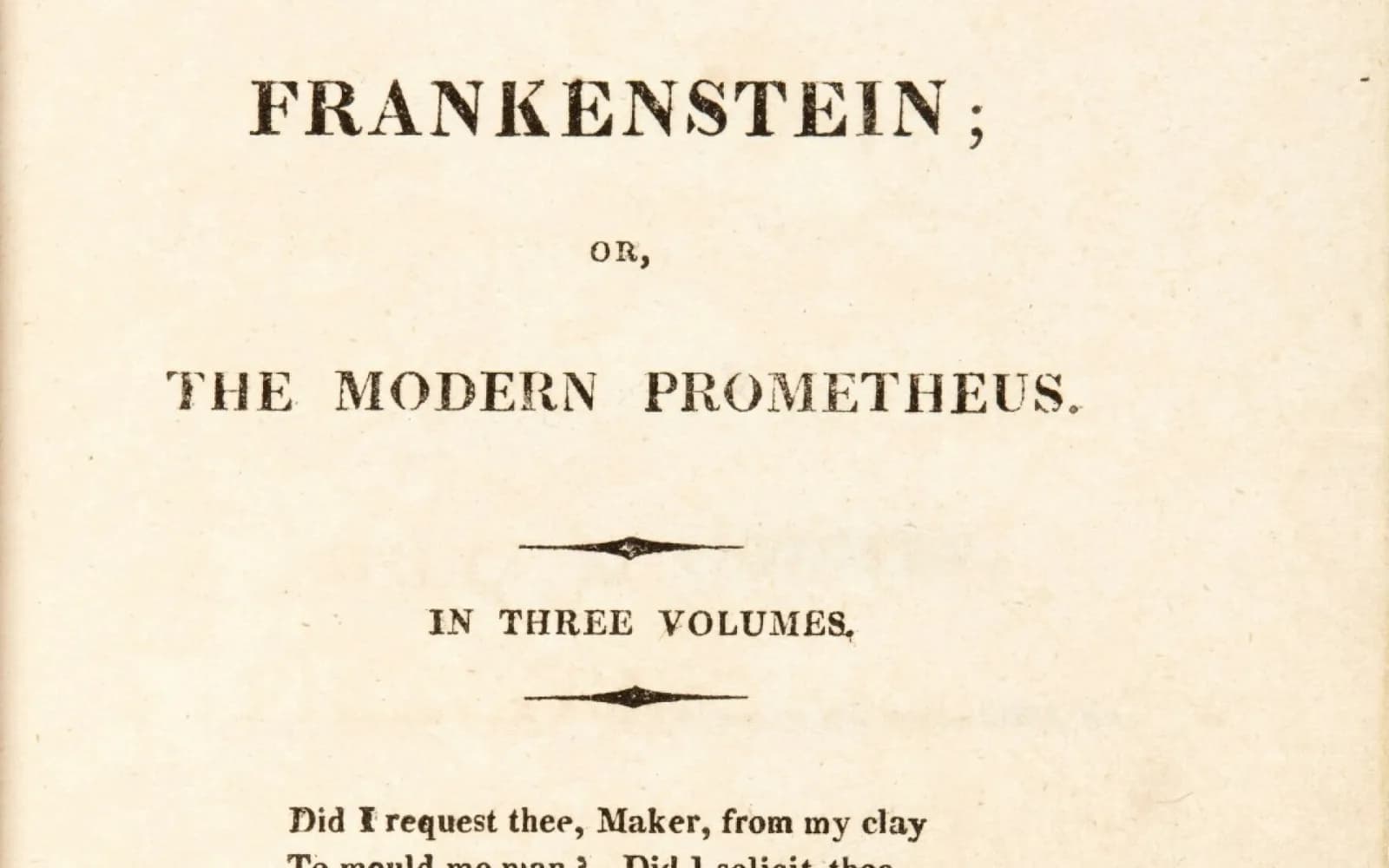
There are two authorised texts of Frankenstein and most readers own the second one while believing they own the first. The cover says 1818, because that is when the novel came out. The pages inside are very often the version Mary Shelley rewrote thirteen years later, and no paperback is obliged to tell you which one it printed. You can settle it yourself in about ten seconds, and the test is one character: Elizabeth.
- 1818.Three volumes, twenty-three chapters, no author’s name anywhere on the title page.
- 1831. One volume, twenty-four chapters, a new introduction by Mary Shelley, and her name on it.
- The test. Open to the first chapter and find Elizabeth Lavenza.
- The answer.Victor’s first cousin means 1818. An adopted foundling with gold hair means 1831.
What the novel argues about how a monster gets made is settled the same way in both texts and is a companion piece’s subject, not re-argued here. If you would rather stand in the storm where Victor decides what to study, the playable Frankenstein opens The Blasted Oak as one of its doorways.
📚 Two Frankensteins, thirteen years apart
The 1818 edition is a triple-decker, the standard shape for a novel of its decade. Four letters from Robert Walton open it, then Volume I runs seven chapters, Volume II runs nine, and Volume III runs seven, which is twenty-three chapters of story. The title page carries the title, the subtitle, a three-line epigraph from Paradise Lost, the publisher Lackington, Hughes, Harding, Mavor and Jones of Finsbury Square, and the year. It does not carry an author.
The 1831 edition folds all of that into one volume with the chapters numbered straight through from one to twenty-four. The extra chapter is not new material. Volume I chapter I of 1818 is split in two, and every chapter after it shifts by one number until the volume breaks disappear. You can check the seam without owning either book: 1831 chapter 9 and 1818 Volume II chapter I open on the same sentence about the dead calmness of inaction that follows a quick succession of events.
The two editions also carry different front matter, and this is where the confusion starts for anyone reading online. The 1818 text opens with a short preface written in the first person by an author who calls the story hers. Mary Shelley later said plainly that she did not write it.
“I certainly did not owe the suggestion of one incident, nor scarcely of one train of feeling, to my husband… From this declaration I must except the preface. As far as I can recollect, it was entirely written by him.”
The 1831 edition keeps that preface and adds her own introduction in front of it, written for Bentley and Colburn’s Standard Novels series and dated London, October 1831. That introduction is the source of nearly every story you have heard about Byron, the rain and the waking dream, which is its own post.
🔍 The Elizabeth test
Elizabeth Lavenza arrives in the Frankenstein household in the first chapter of both books, and she arrives by two completely different routes. In 1818 she is family. Alphonse Frankenstein’s sister married an Italian gentleman, died young, and left one child, whose father asked Alphonse to take her.
“…requesting my father to take charge of the infant Elizabeth, the only child of his deceased sister.”
Elizabeth is therefore Victor’s first cousin, and the 1818 text never hides it. He calls her “my cousin” to his father’s face when the marriage is arranged, and again when he is dreading it. Her eyes in that first description are hazel, as lively as a bird’s. His mother decides on the spot that the two children will marry, and never has cause to regret the plan.
In 1831 none of that is true. Caroline Frankenstein finds Elizabeth in a peasant cottage on a walk near Lake Como, one fair child among four dark-eyed ones, and the peasant woman explains that the girl is not hers.
“Her hair was the brightest living gold… her brow was clear and ample, her blue eyes cloudless… She was not her child, but the daughter of a Milanese nobleman.”
Hazel eyes and a cousin, or blue eyes and a foundling. One paragraph, one answer, and you never have to look at a copyright page again. The change is also the largest single alteration between the two texts, because it removes a first-cousin marriage from the centre of the plot. Victor in 1818 marries a blood relation raised beside him. Victor in 1831 marries a girl his mother brought home.
✏️ What else the 1831 text changed
Mary Shelley’s own account of the revision is modest to the point of being wrong. She closes the 1831 introduction by saying the alterations are principally those of style, that she has changed no portion of the story and introduced no new ideas or circumstances, and that the changes cluster at the beginning of the first volume. The clustering is accurate. The rest of the sentence is not, since a cousin becoming a stranger is a circumstance by any reading.
The second thing to look for is fate. The 1831 text keeps stopping to tell you that Victor was doomed before he began, in language the 1818 text does not use. The clearest instance sits at the end of chapter 2, immediately after the young Victor has been talked out of his alchemists and might still have gone another way.
“It was a strong effort of the spirit of good, but it was ineffectual. Destiny was too potent, and her immutable laws had decreed my utter and terrible destruction.”
Search the full 1818 text at Project Gutenberg #41445 for that sentence, or just for the phrase “Destiny was too potent”, and there are no hits at all. The younger book leaves Victor holding the decision. The older book hands part of it to destiny, and a reader who wants the sharpest version of the moral question is better served by the version that gives him nowhere to hide.
The third question people ask is how much of any of it is Percy Shelley’s. The answer comes from the surviving draft in the Bodleian, transcribed by Charles E. Robinson. Penguin’s edition of that transcription describes some 5,000 words of about 72,000 as his; Wikipedia’s survey of the authorship question puts the figure nearer 3,000, roughly four per cent, and notes that mainstream scholarship reads his contribution as editorial rather than collaborative, with a 2022 stylometric study arguing against any large role. The one thing Mary Shelley herself handed him outright was the preface.
🎭 Which edition the playable Frankenstein uses
Saylia’s Frankenstein game runs on the 1831 text, and its own cast sheet gives it away in three words. Elizabeth Lavenza is described there as slender, golden-haired and ethereal, which is the 1831 foundling rather than the 1818 cousin with hazel eyes. If you want the paperback that matches the game, take any edition whose chapter one has Caroline finding a fair child in a cottage.
The free texts are just as easy to tell apart once you know the numbers. Project Gutenberg’s ebook 84, the one that comes up first everywhere, is the 1831 revision. Ebook 41445 is the 1818 original. A third file, ebook 42324, is the 1831 text with the introduction attached, which ebook 84 leaves out entirely.
📖 Which one to read first
Read 1818. It is the book an eighteen-year-old actually wrote, it is shorter, its prose is plainer, and it refuses to let Victor blame the stars for what he did. Broadview and Oxford both print it with the variants marked, so you can see the 1831 wording without buying twice. Then read the 1831 introduction on its own, because it is a superb piece of writing and it belongs to the older woman who survived the summer she is describing.
Read 1831 first if you want the version everybody else means. It is the text behind most classroom editions, most audiobooks and most adaptations, and coming to a conversation with the same sentences other people have is worth something. Either way the plot is identical, the creature says the same things, and the ending does not move. The two books disagree about how much of it Victor chose.
Both editions are free and complete at Project Gutenberg, and the cast the two texts share, down to Ernest, the brother who outlives every other Frankenstein, is set out here.
Sources
- Frankenstein (1818 text) — Project Gutenberg
- Frankenstein (1831 text) — Project Gutenberg
- Frankenstein (1831 text, with Mary Shelley's introduction) — Project Gutenberg
- Authorship of Frankenstein — Wikipedia
- The Original Frankenstein, edited by Charles E. Robinson — Penguin Random House
Frequently asked questions
- What is the difference between the 1818 and 1831 Frankenstein?
- The 1818 text is three volumes and twenty-three chapters, published anonymously with a preface Percy Shelley wrote. The 1831 text is one volume and twenty-four chapters under Mary Shelley's name, with a new introduction. The 1818 volumes also carry a dedication to William Godwin, her father, from an author who does not give her own name.
- Is Elizabeth Victor's cousin in Frankenstein?
- In the 1818 edition, yes. She is the only child of Alphonse Frankenstein's dead sister, and Victor calls her his cousin to his father's face. In 1831 she is an unrelated foundling, and the revision missed a spot. In her chapter 6 letter Elizabeth is still calling Alphonse my uncle.
- Which edition of Frankenstein is most commonly printed today?
- The 1831 revision. It is the text behind most classroom editions, most audiobooks and most adaptations, and many cheap paperbacks print it without naming it. Project Gutenberg reinforces the habit by date. Ebook 84, the 1831 text, went online on 1 October 1993. The 1818 original, ebook 41445, did not follow until 23 November 2012.
- Did Percy Shelley rewrite Frankenstein?
- He edited it. Charles E. Robinson's transcription of the Bodleian draft is the evidence: Penguin's edition describes some 5,000 words of about 72,000 as his, while Wikipedia's survey puts the figure nearer 3,000. Mainstream scholarship reads that as editorial. The one part he wrote outright is short: the 1818 preface runs to under a thousand words, unsigned, in the first person, as her.
- Which edition does Saylia's Frankenstein game use?
- The 1831 text. Its cast sheet describes Elizabeth Lavenza as slender, golden-haired and ethereal, which is the 1831 foundling rather than the 1818 cousin with hazel eyes. Do not test a paperback on the word cousin alone. Even in 1831, chapter 1 says the two children called each other familiarly by the name of cousin.
Enjoyed this one?