Guillermo del Toro's Frankenstein vs the Book: What Is Real, What Is Invented
Almost everything an average person can picture about Frankenstein came from a film made in 1931, and almost none of it is in the book. Subtract that first, and del Toro's version turns out to restore several things the movies had quietly deleted.


Spoilers below for both the 1818 novel and the 2025 film.
Almost everything an average person can picture about Frankenstein came from a film made in 1931, and almost none of it is in the book. Before you can usefully ask what Guillermo del Toro changed, you have to subtract the century of changes that were already sitting in your head when you walked in. Once you do, his 2025 version turns out to restore several things the movies had quietly deleted, and to invent a few of its own.
- The book never says how. No lightning, no lever, no storm. Two years of work and then a spark.
- The creature is beautiful and then not. Yellow skin, black hair, pearly teeth, eight feet tall.
- He talks. He learns French by eavesdropping and argues Victor to a standstill on a glacier.
- Flat head, bolts, green skin. All 1931, all Universal, all a makeup artist called Jack Pierce.
The other Frankenstein confusion, the one about which character the name belongs to, is a companion post’s subject, and is not re-argued here. If you would rather stand in the laboratory than compare versions of it, the playable Frankenstein opens The Spark of Life as one of its doorways.
🎬 What del Toro kept from Mary Shelley
The most faithful thing in the film is its shape. Shelley’s novel is a set of nested confessions: a sea captain in the ice writes home, the dying man he rescues tells him everything, and inside that the creature gets a long stretch of the book to tell his own side. Peter Bradshaw’s Guardian review from Venice singled out the film’s shift into the Creature’s perspective, and Empire’s Jamie Graham describes the same two-part structure inside an Arctic flashback. Most screen versions throw that away and run the story forwards from the laboratory, which turns the creature into a plot device instead of a witness. How the novel’s own last pages play out in the cabin is the subject of our Frankenstein ending explainer.
Netflix’s own site describes the film as inspired by the 1818 novel rather than the 1831 revision, which are two genuinely different books; the test that tells them apart is set out here. No independent outlet has confirmed the edition, so treat that as the studio’s own description of its source.
⚡ What pop culture had already got wrong
Start with the method, because it is the biggest one. Ask anybody how Frankenstein’s creature comes alive and you will get lightning, a thrown switch and a shout. Here is the entire technical account the novel gives, in chapter 5, at the moment it happens.
“With an anxiety that almost amounted to agony, I collected the instruments of life around me, that I might infuse a spark of being into the lifeless thing that lay at my feet.”
That is all of it. The instruments are never listed and the spark is never explained. The word electricity appears twice in the whole novel and both times in chapter 2, where a young Victor hears a lecture about it years before he starts work. Lightning appears five times and never once in the laboratory. Shelley’s refusal to specify is deliberate, and it is why the book has aged into every technology since without needing a rewrite.
Then the face. The creature Victor assembles is eight feet tall and was built to be beautiful, and the horror in the scene is that the parts were chosen well and the whole is wrong.
“His yellow skin scarcely covered the work of muscles and arteries beneath; his hair was of a lustrous black, and flowing; his teeth of a pearly whiteness; but these luxuriances only formed a more horrid contrast with his watery eyes… his shrivelled complexion and straight black lips.”
No flat skull, no stitches across the forehead, no bolts. Those came from Jack P. Pierce, the makeup artist at Universal, for James Whale’s 1931 film. Wikipedia’s articles on Pierce and on Frankenstein’s monster record that the neck bolts are electrodes, carriers for the current, and that the green greasepaint was chosen because it photographed pale on black-and-white stock. Universal copyrighted the design, which is why every Halloween mask since has had to be subtly wrong. The same film renamed Victor to Henry.
The third deletion is the voice. In the novel the creature hides in a lean-to beside a German cottage for a year, learns French by listening to a young man teach it to his Arabian fiancée, reads Paradise Lost, and then meets Victor on a glacier and out-argues him for an entire chapter. The silent, grunting monster is a screen convention and has no textual basis at all.
🎭 The cast, mapped to the book’s characters
Oscar Isaac plays Victor and Jacob Elordi the Creature, which are the two roles the novel has. After that the correspondence loosens. Mia Goth plays Elizabeth Harlander, where Shelley’s Elizabeth is Elizabeth Lavenza and is raised inside the Frankenstein house. Charles Dance plays Baron Leopold Frankenstein, where the novel’s Alphonse is a Genevan magistrate and no kind of baron. Felix Kammerer plays William, who in the book is a small boy strangled in chapter 7.
Christoph Waltz plays Heinrich Harlander, an arms manufacturer who funds Victor’s work. Empire’s review describes that character as an invention with no counterpart in the novel, and no second outlet confirms it, so take it as Empire’s reading rather than an established fact. David Bradley plays the Blind Man, who is the novel’s old De Lacey, and Lars Mikkelsen plays Captain Anderson, who occupies Robert Walton’s position in the frame. Both Empire and the Daily Tar Heel single out Elizabeth as the most reworked character, and the Tar Heel treats the change as a loss.
🏆 How the film was received
It premiered in competition at Venice on 30 August 2025, reached a limited theatrical run on 17 October and arrived on Netflix on 7 November. As of 8 September 2026 it holds 85 per cent on Rotten Tomatoes across 381 critic reviews, with an average of 7.6 out of 10, and 78 on Metacritic from 58 critics.
The awards season is now closed, which is worth saying because the numbers moved a long way after the first round. At the Golden Globes in January 2026 the film took five nominations and won nothing. At the BAFTAs in February it converted three of eight. At the Academy Awards on 15 March 2026 it had nine nominations and won three: costume design, production design, and makeup and hairstyling. A film about the century of makeup that buried Mary Shelley’s description of her own creature won an Oscar for makeup.
The reception figure carried by the ambition essay on this hub was checked again for this post and still holds. It predates the Oscars, which is what the tally above adds.
📖 Should you read the book first?
Watch first, read second, and you will enjoy both more. The film runs 150 minutes and does not depend on you knowing the source. The novel is short, roughly a long evening, and reading it afterwards is where the real surprise lives, because the thing that will strike you is not what del Toro changed. It is how much of what you thought was his, or Whale’s, or Karloff’s, was a teenager’s in 1816.
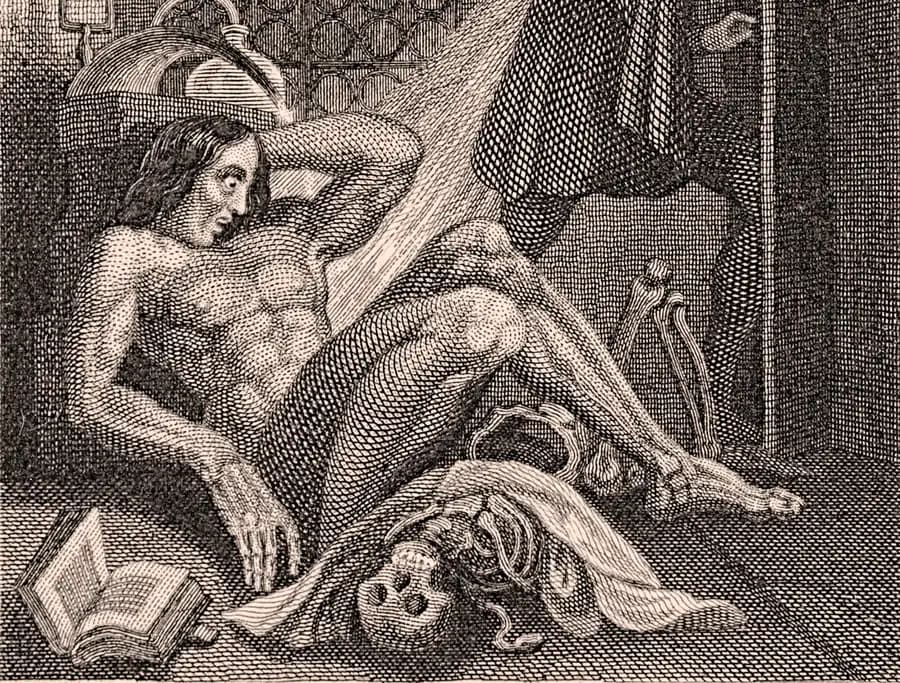
One practical note if you go looking for images. The 1931 Universal film remains under United States copyright until 1 January 2027, which is why this page is illustrated with an 1831 engraving instead. The novel has been free for a very long time and is complete at Project Gutenberg, and the cast the film reshuffles is set out here.
Sources
- Frankenstein (1831 text) — Project Gutenberg
- Everything to know about Guillermo del Toro's Frankenstein — Netflix Tudum
- Frankenstein review — del Toro's monster movie — The Guardian
- Frankenstein (2025) review — Empire
- Frankenstein (2025) — critic and audience scores — Rotten Tomatoes
- Frankenstein wins three Academy Awards — La Biennale di Venezia
- Public Domain Day 2026 — Duke Law Center for the Study of the Public Domain
Frequently asked questions
- How accurate is Guillermo del Toro's Frankenstein to the book?
- It keeps the novel's shape more closely than most screen versions, splitting into Victor's account and then the Creature's inside an Arctic frame, which the Guardian and Empire both describe. That structure is load-bearing in the book. The Creature narrates chapters 11 to 16, about fifteen thousand words, roughly a fifth of the novel, in his own voice.
- Does the book ever explain how the creature comes to life?
- No, and the omission is deliberate. Chapter 5 gives one sentence of method: Victor collects the instruments of life around him to infuse a spark of being into the lifeless thing at his feet. He refuses to say more. In chapter 4 he tells Walton outright, learn from me how dangerous is the acquirement of knowledge.
- Who plays who in del Toro's Frankenstein?
- Oscar Isaac plays Victor and Jacob Elordi the Creature. Mia Goth plays Elizabeth Harlander, where Shelley's Elizabeth is Elizabeth Lavenza. Charles Dance plays Baron Leopold Frankenstein against the novel's Genevan magistrate Alphonse, and Lars Mikkelsen a Captain Anderson in Robert Walton's frame position. Shelley's cast has one more principal than that list: Henry Clerval, killed by the Creature in chapter 21.
- Did del Toro's Frankenstein win any Oscars?
- Three, from nine nominations, at the 98th Academy Awards in March 2026: costume design, production design, and makeup and hairstyling. The design brief in the novel is one line of chapter 4, where Victor resolves to make the being of a gigantic stature, that is to say about eight feet in height, and proportionably large.
- Is del Toro's Frankenstein based on the 1818 or 1831 text?
- Netflix's own site describes it as inspired by the 1818 novel, and no independent outlet has confirmed the edition, so treat that as the studio's description. The two texts differ most visibly in Elizabeth. In 1818 she is Victor's first cousin, the orphaned daughter of his father's sister, fetched from Italy. In 1831 she is an unrelated foundling.
Enjoyed this one?