Frankenstein Ending Explained: Does the Creature Die?
The last chapter is Victor's death, the creature's speech over his body and a raft that drifts out of sight. What the text states, and what it only lets you assume.


Spoilers for the whole of Frankenstein, including the last page of Walton’s final letter.
The last chapter belongs to the sea captain who pulled him off the ice, writing home in a run of dated letters, and that choice decides what the reader is allowed to know. The closing scene is its own doorway in the playable Frankenstein, where you stand in the cabin with the body and the visitor and decide what to say to him while he stands at the window.
🧊 Does the creature die at the end of Frankenstein?
The book never shows it. The creature announces his own death several times, in detail, and then leaves the only witness behind. What follows his exit is one sentence from Walton, and it is the last sentence of the novel.
“He was soon borne away by the waves and lost in darkness and distance.”
Everything after that line is the reader’s assumption. Shelley gives the creature a plan, a motive and a speech full of certainty, but she ends the book on a man watching a shape disappear across the water at night, and she never sends anyone back to look for the ashes.
🛳️ Victor dies on Walton’s ship
By the final chapter Victor has lost almost everyone. Elizabeth was killed on their wedding night, and his father died in his arms a few days after hearing the news. He has followed the creature north across the ice until Walton’s crew found him, and he spends his last strength telling the whole story to a stranger.
His final speech does not soften. He still says the creature ought to die, he asks Walton to take up the hunt, and then he backs away from the request and leaves the decision to the captain. His last advice is aimed at Walton’s own ambition: seek happiness in tranquillity and avoid ambition, even the apparently innocent kind that wants a name in science. Half an hour later his eyes close for ever, and Walton tells his sister that he cannot find words for the loss.
🕯️ The creature’s speech over the body
At midnight Walton hears a hoarse voice from the cabin where the remains lie. He finds a gigantic figure bent over the coffin, its face hidden by long ragged hair and one vast hand stretched out, a hand Walton describes as like a mummy’s in colour and texture. The creature sees him and springs toward the window. Walton shuts his eyes, recollects his duty and calls on him to stay.
What follows is the longest speech the creature makes outside his own narrative, and it opens with an accounting. “That is also my victim!” he says of the dead man, and he goes through his crimes as a list he wants someone living to hear. He tells Walton that his work is nearly complete and that one more death is required to finish it, which is his own.
❄️ The raft, the funeral pile and the missing death
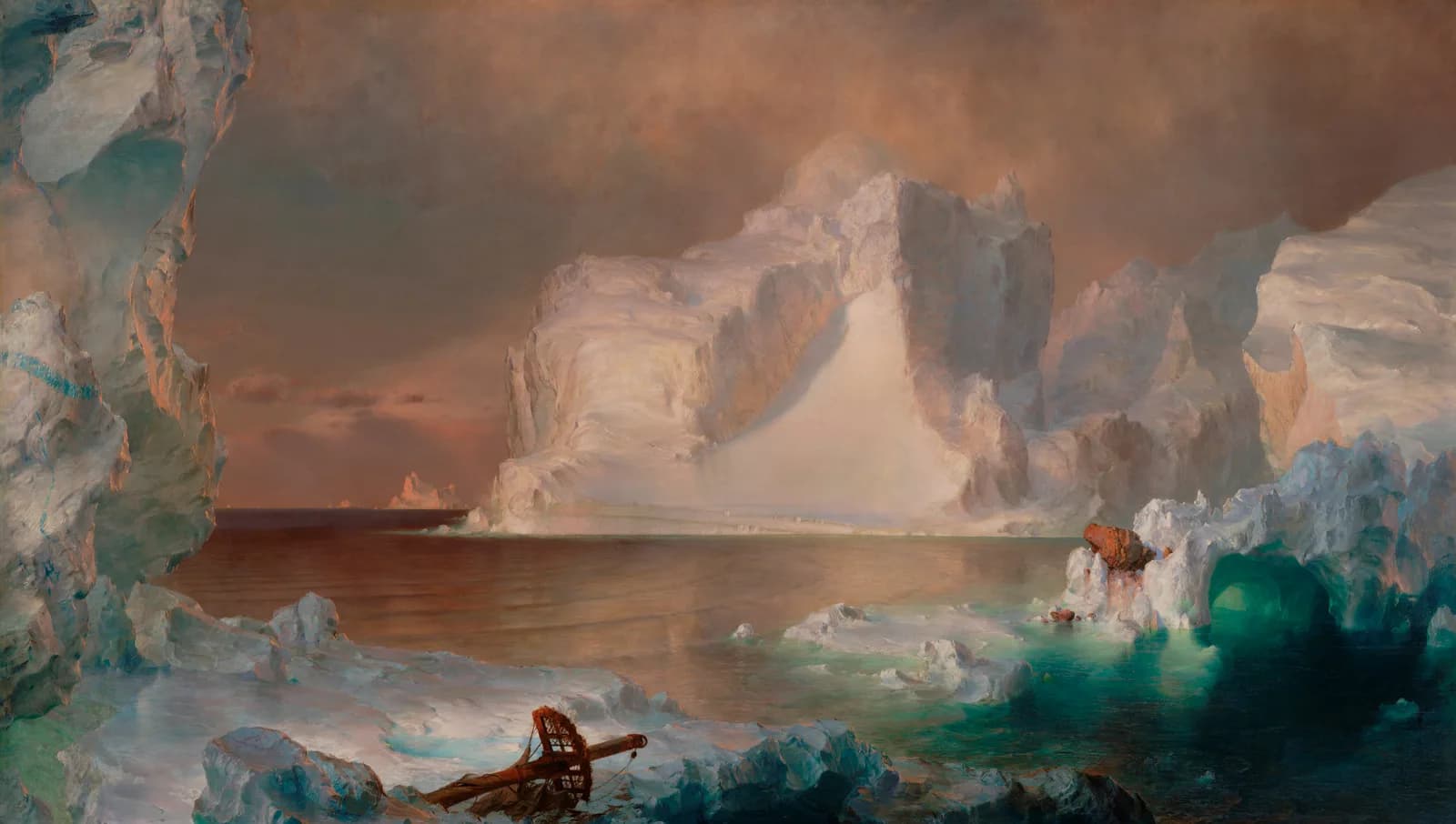
The plan he gives is specific. He will leave the ship on the ice raft that brought him, travel to the most northern point of the globe, build his own funeral pile and burn on it. He comes back to the pile once more before he goes, promising to ascend it triumphantly and to have his ashes swept into the sea by the wind.
His reason is the last thing he says about Victor’s science: the ashes are meant to leave nothing behind for “any curious and unhallowed wretch” who would try to build another creature like him. Then he jumps from the cabin window onto the raft and the waves carry him off. A reader who wants proof is given only the word of the one speaker in the book whose threats to Victor all came true, which is reason to believe him and no proof at all. If you came here from Guillermo del Toro’s 2025 film for Netflix, the reference entry for that film has its credits, and the book-versus-film comparison walks through where its ending and Shelley’s part company.
🧭 Walton turns back, and why the frame matters
The other ending running through the same letters is Walton’s. He set out to reach the pole and make his name, and in the last pages he gives in to his crew and agrees to sail home if the ice releases them. He calls it a defeat by cowardice and indecision, but he is the one character in the book who hears Victor’s whole story and then chooses to stop.
That is why the novel needs him at the end. A man who has just watched where unchecked ambition leads is the narrator who reports the creature leaving, and he reports it without comment, as a fact he saw and a death he did not. The Project Gutenberg text of the 1831 edition is the version quoted here, and it is the one the game plays.
- Victor’s death is the one Walton witnesses. Elizabeth and his father died chapters earlier, and Walton sits with Victor in the cabin until his eyes close.
- One death is only announced. The creature names his funeral pile twice and is last seen on a raft heading into the dark.
- The witness turns south. Walton keeps his crew alive and abandons the voyage, the choice Victor never made.
Sources
- Frankenstein; or, the Modern Prometheus (Project Gutenberg eBook #84, 1831 text) — Project Gutenberg
- Frankenstein (2025 film) — Wikipedia
- Frankenstein — Wikipedia
- Frankenstein's monster — Wikipedia
Frequently asked questions
- Does Frankenstein's monster eventually die?
- The novel never confirms it. He promises to burn himself, and he gives a reason that says a lot about him: his remains must "afford no light to any curious and unhallowed wretch who would create such another". He wants no second Victor learning from his body, and the book ends before anyone can check that he kept his word.
- What actually happens at the end of Frankenstein?
- The ice breaks, the ship turns home, and Victor dies before it gets there. Walton's letter dated September 12th opens with "It is past; I am returning to England" and then explains that the ice began to move on September 9th. Victor's death and the creature's midnight visit are both told inside that one long final letter.
- Did the monster ever forgive Victor?
- The book turns the question around: the creature is the one asking to be forgiven. Over the coffin he says "What does it avail that I now ask thee to pardon me?" and then admits the answer himself, because the man is cold and cannot reply. Whether Victor would have forgiven him is left with the dead.
- Why does Walton turn back at the end of Frankenstein?
- Walton has already written that he dreads a mutiny, and then a deputation of sailors demands his promise to turn south if the ice frees the ship. The dying Victor rouses himself to shame them, asking "Are you, then, so easily turned from your design?" and reminding them they called it a glorious expedition. The speech moves them for a moment, but Walton still gives his word to sail home.
- Who narrates the end of Frankenstein?
- Robert Walton does, in letters to his sister. Every letter in the novel is addressed to Mrs. Saville in England, whom he calls Margaret, so the creature's last appearance reaches the reader as a report written for her. Victor's own narration stops when he dies, and the creature speaks only through Walton's record of that night.
Enjoyed this one?