When being brilliant isn't enough: what Frankenstein costs Victor (2026)
One man, one lifetime, five people in the ground — and he's supposed to be the genius of the story. Frankenstein isn't a warning against ambition. It's a warning against ambition that forgets the people. Why del Toro's 2025 film sent everyone back to the book.


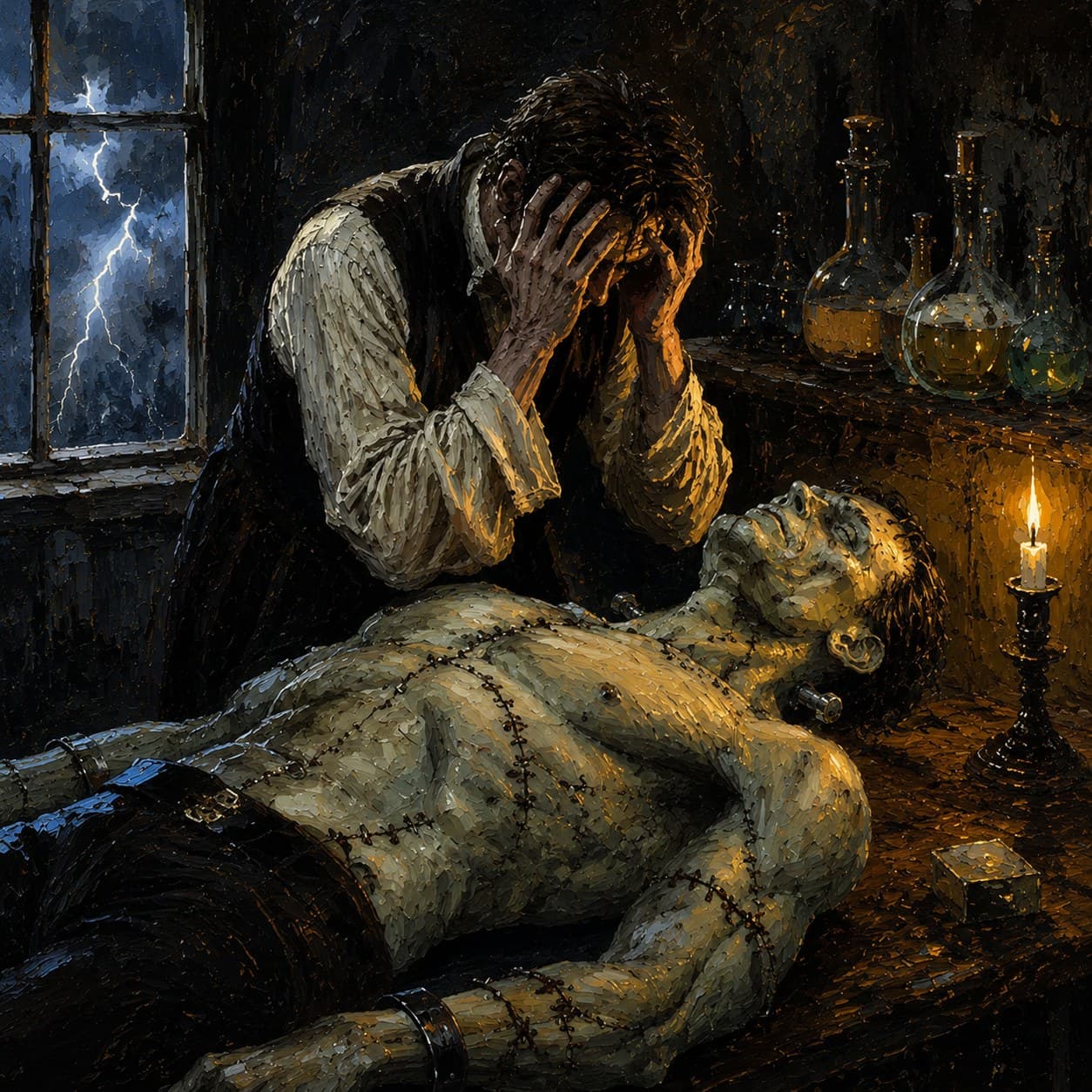
Here's the number that reframes the whole novel: one man, one lifetime, five people in the ground— and he's supposed to be the genius of the story. We remember Victor Frankenstein as the man who built the monster. We forget he's the man who ends completely alone, dying in the Arctic ice while still chasing the thing he made. Frankenstein is not a warning against ambition. It's a warning against ambition that forgets the people— and in 2026, after Guillermo del Toro's film and two years of AI discourse, that's exactly why it reads like a story about the present.
- Five deaths, all people closest to Victor. The cost of his ambition is counted in the people he loved, not in lab equipment.
- The book's real question isn't what he built.It's what kind of person he became while building it.
- “Brilliance without love” is the whole indictment in three words: all the genius in the world, no one to share it with.
- The book is having a 2026 moment.The del Toro film and the “Frankenstein-of-X” idiom turned a 200-year-old novel into contemporary reality.
🔢 Count the losses
The cost of Victor's ambition is counted in people, not lab equipment — and the names land harder than the number. On the Saylia podcast, Leo reads them out:
The fiancée. The father. The best friend. The little brother. Plus the maid, hanged for a murder she didn't do. Five people. All gone.
Elizabeth, his bride, killed on their wedding night. His father, dead of grief. Henry Clerval, his warmest friend, murdered on a Scottish beach. William, his six-year-old brother, the first to die and the start of the whole chain. And Justine, hanged for William's murder while Victor stayed silent. Victor wins — he does the impossible thing nobody else could — and loses every relationship he had to get there. That's the whole book in one breath.
| What we remember about Victor | What his ambition actually cost |
|---|---|
| The genius who created life | A man who ends with no one left to share it with |
| A triumph of science | Five funerals among the people closest to him |
| The question is what he built | The question is who he became while building it |
| A gothic monster tale | A story about ambition that forgets the people |
Brilliance without love. That's the whole indictment in three words. He's got the genius. He's got nobody.
🎬 Why Frankenstein is everywhere again in 2026
The book is having a genuine cultural moment. Guillermo del Toro's 2025 Frankenstein landed around 85% on Rotten Tomatoes with five Golden Globe nominations, and sent a new audience back to the novel. Meanwhile the word itself became a verb: somebody Frankensteins a slide deck together before a meeting; you Frankenstein a dating profile out of three exes' advice.
It stopped being a story about him and became one about us.
The best line about why the book reads this way comes from novelist Jeanette Winterson, in her introduction to the Penguin Modern Classics edition (surfaced via a top Goodreads review):
We are the first generations to read it not as gothic horror but as contemporary reality.
🪞 The version of this you've actually seen
The loud version is the founder shipping some world-changing AI. But the book's move is usually closer to home. On the podcast, Leo draws the scene most of us recognize:
Posts the big win photo from the all-hands Friday, the thread thanking the team. Sleeping in the office two months. The divorce papers have sat on the kitchen counter since March. Nobody at work knows. Everybody at home stopped asking.
From the outside, that's the win — the photo, the applause. From the inside, it's just Victor: brilliance without love, the same trade two hundred years apart. The book has been holding up that mirror the whole time; del Toro just made a new generation look into it.
🧭 The bottom line, four episodes in
After tracing how a monster gets made, how loneliness drives the whole story, and why abandonment is the real sin, the series lands on the synthesis Leo states plainly:
It's not a warning against ambition. It's a warning against ambition that forgets the people. Two hundred years on, that's still the conversation.
And there's the quieter line the series planted back in Episode 1 — mind the spark: the fire you start has a way of consuming everyone near it. The thing you build will demand everything you've got, so make sure there's still someone in the room when you finish. Or, as Leo and Sharon leave the series: love what you make. The novel reads in an afternoon.Moby-Dick runs the same ambition-without-people argument at sea, with a captain who never once turns back.
Sources
- Frankenstein (2025 film) — Wikipedia
- Frankenstein (2025) — Tomatometer — Rotten Tomatoes
- Frankenstein — reader reviews — Goodreads
Frequently asked questions
- How many people die in Frankenstein because of Victor?
- Five people closest to Victor die in the chain he sets off: his little brother William, the maid Justine (hanged for William's murder), his best friend Henry Clerval, his bride Elizabeth (killed on their wedding night), and his father, who dies of grief. Victor achieves the impossible and loses every relationship he had to get there.
- Is Frankenstein a warning about ambition or about science?
- About ambition, not science. The novel isn't a warning against discovery itself — it's a warning against ambition that forgets the people. Victor wins the science and ends utterly alone, which is why the book reads less like a moral about technology and more like a story about what unchecked drive costs the people around you.
- Why is Frankenstein popular again in 2026?
- Guillermo del Toro's 2025 Frankenstein film (85% on Rotten Tomatoes, five Golden Globe nominations, and nine Academy Award nominations from which it won three in March 2026) sent a new generation back to the novel, and the AI debate keeps invoking it. The word is now a verb — people “Frankenstein” a slide deck together. As Jeanette Winterson wrote, “we are the first generations to read it not as gothic horror but as contemporary reality.”
- Is Frankenstein worth reading today?
- Yes — and it's short. The novel reads in an afternoon and lands very differently than the Halloween-monster image suggests: it's a heartbreak story about isolation, responsibility, and the human cost of ambition. Readers returning to it after the 2025 film consistently report it feels like a story about the present, not a 200-year-old gothic.
- Why does Elizabeth die in Frankenstein?
- Elizabeth, Victor's bride, is killed by the creature on their wedding night — the creature had warned Victor, “I will be with you on your wedding-night.” Fixated on his own safety, Victor leaves her alone and fails to protect her. Her death is the starkest proof of the book's theme: Victor's ambition costs the people closest to him their lives.
Enjoyed this one?