Was Frankenstein's monster born evil — or made that way? (2026)
Mary Shelley's creature begins articulate, gentle, and hopeful. “Monster” is a status the world hands him, one rejection at a time. Here's what the novel actually argues about how monsters get made.


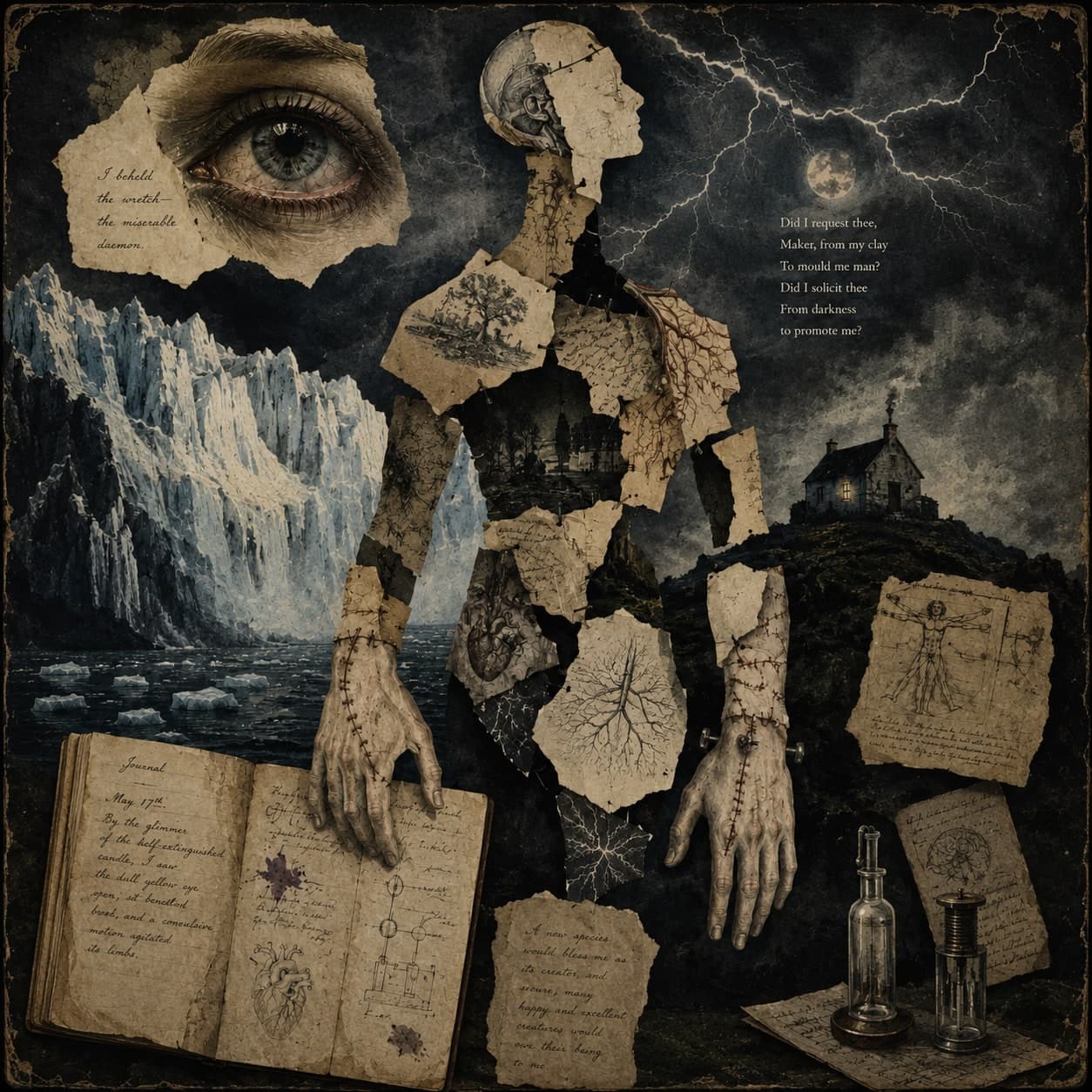
Guillermo del Toro's 2025 Frankenstein sent a fresh wave of viewers back to Mary Shelley's 1818 novel — and most of them arrive expecting the green-skinned, bolt-necked monster of Halloween. What they find instead is a being who teaches himself to read, weeps over a borrowed copy of Paradise Lost, and secretly chops firewood for a family who would scream if they saw his face. The question the book actually asks isn't how do you build a monster? It's how does a gentle creature get turned into one?
- The creature is born good. He starts out curious, articulate, and desperate to be liked.
- “Monster” is a verdict, not a birth defect. Every human he meets rejects him on sight, before he can speak a word.
- Victor never lays a hand on anyone — he abandons everyone. The book keeps inverting who the real monster is.
- The mechanism is universal. You teach someone to be scary by treating them as scary, long enough — at school, at work, anywhere.
🎭 The monster everyone remembers vs. the creature Shelley wrote
Two centuries of film adaptations flattened Shelley's creature into a grunting, inarticulate brute. The novel's creature is the opposite: he narrates whole chapters in elegant first person, reasons through philosophy, and makes a moral case for himself that has persuaded readers for 200 years. The gap between the pop-culture monster and the text is so wide that the cultural conversation has literally renamed him.
| The myth most people arrive with | What Shelley actually wrote |
|---|---|
| Born a monster; evil by nature | Born gentle; turned monstrous by rejection |
| Mute, grunting brute | Self-taught reader who quotes Milton |
| Wants to destroy | Wants one person to look at him without flinching |
| Victor is the tragic hero | Victor is, for many readers, the real monster |
That last row isn't a hot take — it's the consensus reading. Reason magazine ran a piece titled “Victor Frankenstein Is the Real Monster”, and the Princeton Alumni Weekly noted the cultural drift directly: “For years Victor Frankenstein's creation was known as the Monster, then critics seemed to identify him as a victim and called him the Creature.” The rename is the argument.
🪡 How a monster actually gets made, scene by scene
The creature's first months of life read nothing like a horror movie. On the Saylia podcast, co-host Sharon walks them: he hides in a shed behind a poor family's cottage, learns to talk by listening through a crack in the wall, and finds three books dropped in the woods. One of them is Paradise Lost.
Paradise Lost, of all things. And he weeps over it. You know why? Because he sees himself in Satan. Despised, cast out, alone.
He doesn't lash out. He helps. Every night while the family sleeps he chops their firewood and stacks it by the door; they decide a benevolent spirit is doing it. Then he works up the courage to introduce himself — choosing the blind father, the one person who can't recoil at his appearance. They talk for an hour. The father calls him a kind young man. Then the sighted children come home, the son grabs a stick, and the family is gone by morning. He never even gets to say his name.
Then how does the gentlest character in the story end up as the monster of it?
That's the whole arc compressed: every rejection happens before he gets to speak. The verdict lands on his face, never on his character. When he finally confronts his creator, he delivers the line readers have been tattooing and screenshotting for two centuries (verified verbatim against the 1818 Project Gutenberg text):
I was benevolent and good; misery made me a fiend. Make me happy, and I shall again be virtuous.
The grammar matters. He leads with benevolent and good. The fiend comes second, and it comes with a condition — make me happy, and I shall again be virtuous. Even at his most dangerous, he's still reaching.
Made into one. Which is basically how you teach someone to be scary. Treat them like they're scary, long enough.
💬 What readers are saying about it in 2026
The “made, not born” reading is the single most-saturated theme in Frankenstein discourse right now. On Goodreads, where the novel holds a 3.92 average across nearly two million ratings, one of the most-upvoted reviews puts it bluntly: “The real monster of this novel is Victor Frankenstein, and not his monstrous creation. The creature is a monster on the outside but Victor is on the inside, which is a form much worse.”
The same conversation runs across BookTok, where dozens of “book vs. movie” videos circle one idea — the novel is the emotionally truthful, sympathetic version. The creature isn't scary. He's the saddest character in the book.
🪞 Why this still matters — the part that isn't about a monster at all
The reason the book outlived its own genre is that the mechanism scales out of it. You don't need a lab or a corpse to make a monster — you just need a group of people who decide, quietly and without malice, that someone doesn't belong. Sharon's co-host Leo lands it with a scene most of us have watched happen: a new hire on day one, nervous, nobody making eye contact, nobody asking where they're from. A year later they're gone, and the exit interview blames “cultural fit.” Nobody connects it back to that first silent standup.
He didn't show up a monster. He learned to be one. And so do the rest of us. When we keep doing this to each other.
That's the takeaway worth carrying out of an 1818 novel into a 2026 week: monstrousness is usually manufactured, one rejection at a time, by people who never meant to make one. Mind the spark.Dr Jekyll and Mr Hyde makes the opposite argument, one man builds his own monster on purpose in a locked room.The Picture of Dorian Gray makes a third one, where the man who supplies the idea never has to touch it himself.The War of the Worlds widens the same question to a whole species, and answers it on its first page.
Sources
- Victor Frankenstein Is the Real Monster — Reason
- Essay: The monster and its humanity — Princeton Alumni Weekly
- Frankenstein (1831 text) — Project Gutenberg
- Frankenstein — reader reviews — Goodreads
- Frankenstein (2025 film) — Wikipedia
Frequently asked questions
- Is Frankenstein's monster born evil?
- No. In Mary Shelley's 1818 novel the creature is born gentle and curious. He teaches himself to read, secretly helps a poor family, and only turns to violence after a cascade of rejections that begins with his creator abandoning him. He says it plainly: “I was benevolent and good; misery made me a fiend.” He is made into a monster, not born one.
- Who is the real monster in Frankenstein?
- Most modern readers and critics argue Victor Frankenstein is the real monster. He abandons his creation the moment it lives, refuses responsibility, and lets an innocent woman hang rather than confess what he knows. The creature commits the killings, but the novel locates the moral failure in the man who made and rejected him — a reading echoed everywhere from Reason magazine to the Princeton Alumni Weekly.
- What does “made, not born” mean in Frankenstein?
- It's the idea that monstrousness is produced by how others treat you, not by what you are at birth. The creature is judged on appearance before he can speak, beaten away from every human contact, and learns to be feared because he is treated as fearful. The same mechanism shapes real outsiders — the excluded new hire, the kid labeled early and never let out of the label.
- What is the most famous quote from Frankenstein's monster?
- “I was benevolent and good; misery made me a fiend. Make me happy, and I shall again be virtuous.” The creature says it to Victor's face. It's the line readers most often tattoo and screenshot, because it states the whole nature-vs-nurture argument in one breath.
- Why does the creature in Frankenstein turn violent?
- His violence is reactive, not innate. He secretly helps a poor family for months, then is beaten away the moment they see his face; his own creator fled at the sight of him and never came back. Only after every attempt at kindness and connection is answered with fear and cruelty does he turn to revenge — which is exactly why the novel frames him as made, not born.
Enjoyed this one?