Mary Shelley Wrote Frankenstein at Eighteen: What Actually Happened at Villa Diodati
Five people spent a cold, wet June beside Lake Geneva in 1816, and only the teenager finished her ghost story. The real timeline is stranger than the version that circulates, and Mary Shelley's own account of it needs handling with care.


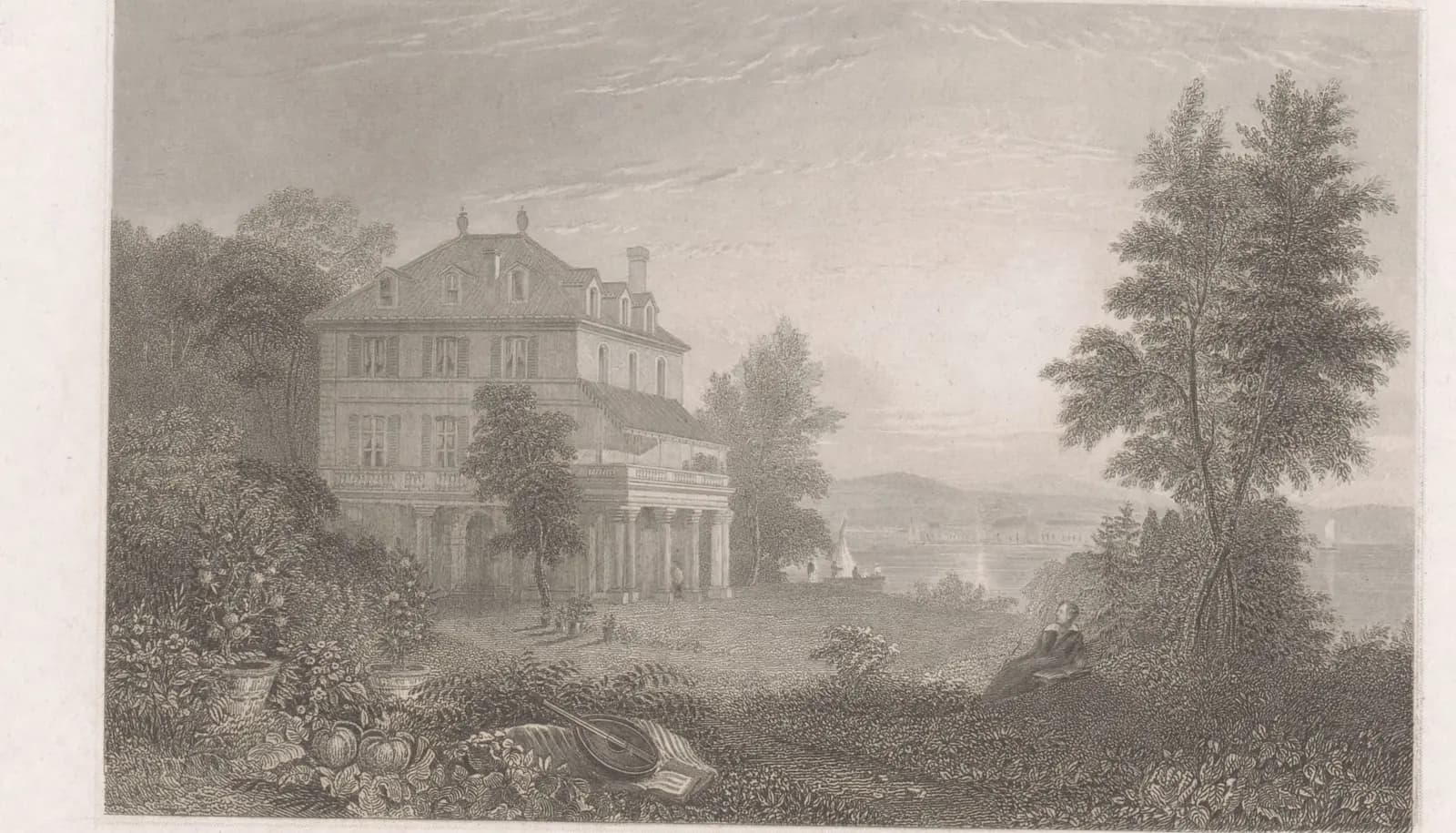
Five people spent a cold, wet June beside Lake Geneva in 1816. Two of them were the most famous poets in England. One was a doctor with literary ambitions. One was a teenager who had run away with a married man two years earlier. When they agreed to write ghost stories to pass the rain, only the teenager finished hers, and hers is the one still in print.
- She was eighteen. Born 30 August 1797, so eighteen at the villa and twenty when the book came out.
- The weather was a volcano. Tambora had erupted in Indonesia the year before and cooled the whole planet.
- Byron set the dare. By her own count four people took it up.
- She was the only one who finished. The 1818 preface says so, though Percy Shelley wrote it.
Which of the two published Frankensteins you should read, and how to tell them apart in one paragraph, is a companion post’s subject. This one is about the year and a half before there was anything to publish. If you would rather stand on the deck than read about the summer, the playable Frankenstein opens The Frozen Horizon, the night something crosses the ice toward the ship.
🌧️ The summer with no sun
In April 1815 Mount Tambora erupted in what is now Indonesia and threw enough sulphate into the stratosphere to dim the sunlight reaching the northern hemisphere. Global average temperatures fell by something in the range of four to seven tenths of a degree, which sounds small and was not. Snow fell out of season across Switzerland, France, Germany and Poland, harvests failed across the British Isles, and 1816 acquired the name it still has, the Year Without a Summer.
Mary Shelley’s description of it needs no scientific vocabulary at all.
“But it proved a wet, ungenial summer, and incessant rain often confined us for days to the house.”
Percy Shelley, writing the 1818 preface in his wife’s voice, puts the same weather more briskly: the season was cold and rainy, and in the evenings they crowded round a blazing wood fire. Neither of them knew about the volcano. Nobody in Europe did.
🕯️ The dare, and who actually took it
Byron had rented the Villa Diodati and brought his young physician John Polidori with him. The Shelleys and Claire Clairmont had taken a smaller house below it, close enough to walk up most evenings. Some volumes of German ghost stories in French translation came into the party’s hands, they read them aloud, and Byron made a proposal that has been quoted ever since.
“‘We will each write a ghost story,’ said Lord Byron; and his proposition was acceded to. There were four of us.”
Four, in her count, not five. Claire Clairmont was in the room for the readings and is not in the tally of writers. Byron began a tale and printed the fragment of it at the end of his poem Mazeppa. Percy Shelley started something founded on his own early life and let it go. Polidori, in Mary Shelley’s account, had a terrible idea about a skull-headed lady who was punished for peeping through a keyhole, and could not think what to do with her afterwards.
Polidori is usually credited with the summer’s other survivor, and the credit needs one correction. The Vampyre, the story that gave English fiction its first suave aristocratic bloodsucker, grew out of Byron’s abandoned fragment rather than the skull-headed lady. It was published in April 1819 in the New Monthly Magazine, without Polidori’s consent and under Byron’s name, and Polidori spent the following month writing letters to explain that the groundwork was certainly Byron’s and the development was his. It came out seventy-eight years before the novel that took the idea mainstream.
🕊️ What she was carrying into the story
Her mother, Mary Wollstonecraft, died of puerperal fever on 10 September 1797, eleven days after giving birth to her. That is the first fact of Mary Shelley’s life and she grew up reading her mother’s books to know her.
In February 1815, at seventeen, she gave birth two months early to a daughter who lived about a fortnight. Sources disagree on the exact day the baby died. They do not disagree about what she wrote in her journal on 19 March, which Ruth Franklin quoted in the New Republic and which is the most-shared sentence Mary Shelley ever wrote outside the novel itself.
“Dream that my little baby came to life again; that it had only been cold, and that we rubbed it before the fire, and it lived. Awake and find no baby.”
A version of this circulates online in which Frankenstein was written while she grieved a dead child, and the sequence is worth getting right, because the true one is stranger. That entry is from March 1815, fifteen months before Byron proposed anything. By the time of the villa she had a second child, William, born the previous January and alive. Her third, Clara, was born in September 1817 and was alive when the novel was published four months later. Clara died in September 1818 and William in June 1819, both after the book was out in the world. The loss that precedes Frankenstein is the 1815 one, and the two children who are usually folded into the story outlived the writing of it.
What she brought to the villa, then, was a dead mother, a dead first baby, a living second one, and eighteen years spent first in her father’s house and then in this circle, among people for whom the reanimation of the dead was a thing serious men discussed at dinner.
💡 The night the story arrived
Nothing came for days. Her own account of it is the least romantic description of writer’s block in English, and anybody who has ever promised a piece of work will recognise the morning ritual.
“Have you thought of a story? I was asked each morning, and each morning I was forced to reply with a mortifying negative.”
What broke it was a conversation she listened to rather than joined. Byron and Percy Shelley sat up talking about the nature of the principle of life and whether it might ever be discovered and communicated; about Dr Darwin, who was said to have kept a piece of vermicelli in a glass case until it moved of its own accord; and about galvanism, which she writes had given token of such things. She went to bed and could not sleep, and what she saw with shut eyes was a scene rather than a plot: the pale student of unhallowed arts kneeling beside the thing he had put together.
She says she began the next day with the words “It was on a dreary night of November”, and this is one claim in the introduction you can check yourself. Both published texts open their creation chapter on exactly that sentence, the 1818 edition at Volume I chapter IV and the 1831 edition at chapter 5. The sentence survived fifteen years and a whole revision untouched.
Treat the rest of the introduction more carefully. It was written in 1831 for a reprint series, fifteen years after the summer it describes, by an author with a reputation to shape and a dead husband to memorialise. Scholars read it as a retrospective rather than a transcript, and check it against Polidori’s diary, which was kept at the time and published in 1911. The tale is true in outline. The lighting is hers.
🚀 Was it the first science-fiction novel?
Brian Aldiss made the case in Billion Year Spree, and it is the strongest version of the claim: Frankenstein is the first novel in which the marvellous thing is produced by a named branch of study rather than by magic or the devil, and in which the consequences are worked out as consequences. That is a real argument and it has real opponents. Johannes Kepler’s Somnium of 1634 and Francis Godwin’s The Man in the Moone of 1638 are both put forward, and where you land depends entirely on the definition you started with.
The safer statement, and the one worth carrying out of this, is that no earlier candidate has anything like the same afterlife. The 1818 preface says the tale is the only one which has been completed. Two centuries later that is still the score.
Her own farewell to the book is the last line of the introduction, and it is the only place she ever calls it a child. Both texts are free at Project Gutenberg, introduction included.
“And now, once again, I bid my hideous progeny go forth and prosper.”
Sources
- Frankenstein (1831 text, with Mary Shelley's introduction) — Project Gutenberg
- Frankenstein (1818 text, with Percy Shelley's preface) — Project Gutenberg
- Mary Shelley — Wikipedia
- Mary Shelley biography — Biography.com
- Year Without a Summer — Wikipedia
- Mary Shelley's Obsession with the Cemetery — The New Republic
Frequently asked questions
- How old was Mary Shelley when she wrote Frankenstein?
- Eighteen. She was born on 30 August 1797, so she had turned eighteen the previous summer when Byron proposed the ghost-story contest in June 1816, and she was twenty when the novel was published anonymously on 1 January 1818. The account everyone quotes is later still: her introduction is dated London, October 15, 1831.
- What was the Villa Diodati ghost-story contest?
- Byron rented the villa above Lake Geneva in 1816 and brought his physician John Polidori; the Shelleys and Claire Clairmont lodged nearby. The stories they read aloud are described in her introduction. One was the History of the Inconstant Lover, who reaches for the bride he had pledged himself to and finds the pale ghost of the woman he deserted.
- What caused the Year Without a Summer in 1816?
- Mount Tambora erupted in what is now Indonesia in April 1815 and put enough sulphate into the stratosphere to dim northern sunlight; global average temperatures fell by roughly four to seven tenths of a degree. The weather went into the book. Victor climbs to the Montanvert glacier in chapter 10 with the rain pouring in torrents and thick mists hiding the summits.
- Did Mary Shelley write Frankenstein while grieving a child?
- Not the way the story usually circulates. Her first baby was born prematurely in February 1815 and died within about a fortnight, fifteen months before the villa. The grief that did reach the page is a mother's. In chapter 3 Victor's mother catches scarlet fever while nursing Elizabeth through it, and dies before he leaves for Ingolstadt.
- Is Frankenstein really the first science-fiction novel?
- It is contested. Brian Aldiss made the strongest case in Billion Year Spree, that it is the first novel in which the marvellous thing comes from a named branch of study rather than magic. The book makes the claim itself. The 1818 preface says the event it rests on has been supposed by Dr. Darwin and some of the physiological writers of Germany as not of impossible occurrence.
Enjoyed this one?