Is Alice in Wonderland About Drugs? What Lewis Carroll Actually Wrote, and Where the Reading Came From
A caterpillar on a mushroom with a hookah, a girl who keeps changing size, and a rumour with no source. The date the psychedelic reading took hold is easier to pin down than the rumour.


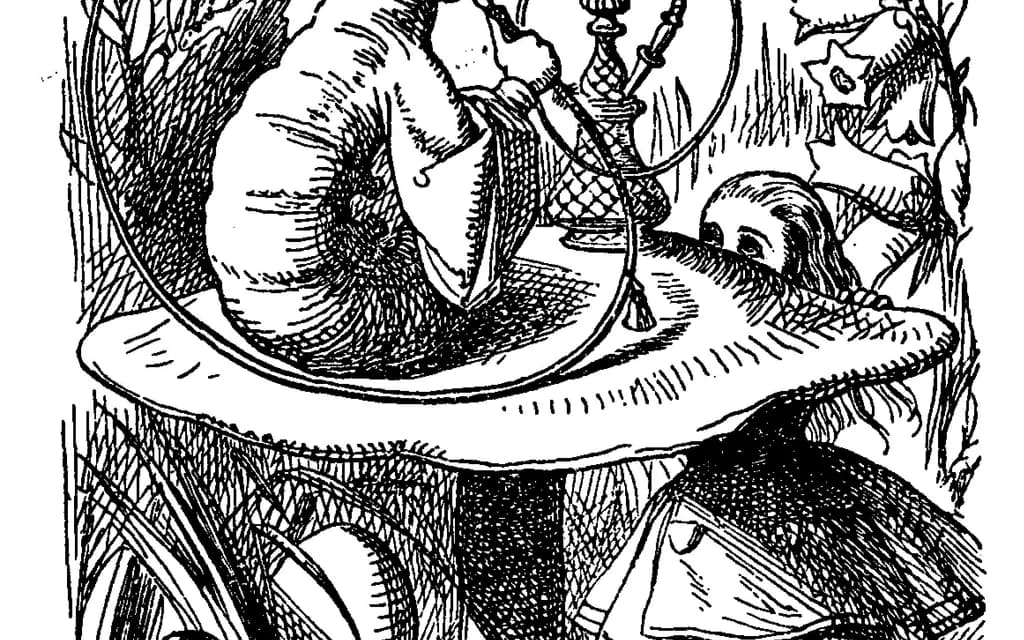
The claim arrives before the book does. A girl eats something and changes size, a caterpillar smokes a hookah on a mushroom, and everyone agrees that a Victorian mathematician must have been on something. It is one of the most durable literary rumours in English, and almost none of it comes from 1865.
- The words are not in the book. Opium, laudanum and drug appear zero times across all twelve chapters.
- The hookah is real. Carroll put it there in chapter four and never said what was in it.
- The record on Carroll is thin and late. His first written note of a migraine aura is dated 1880.
- There is a real condition named after the book. A psychiatrist named it in 1955, and it has nothing to do with drugs.
The scene everyone means is one you can play rather than argue about. The playable Alice's Adventures in Wonderland puts you on the wrong side of the mushroom with a caterpillar asking who you are and refusing to accept the answer.
📄 The short answer: no evidence in the book, and none in the record
Take the book first, since it is the only part of this anyone can check in ten minutes. Search the full public-domain text for opium, laudanum or drug and you get nothing. Alice's size changes are driven by ordinary things: a bottle labelled DRINK ME in chapter one, a cake marked EAT ME a few pages later, a fan, and only then a mushroom. Read in order, the mushroom is the fourth item in a running gag about a child who will eat anything a room offers her, not the source of the whole book's logic.
Then take Carroll. Charles Lutwidge Dodgson lectured in mathematics at Christ Church, Oxford for twenty-six years and was an Anglican deacon, and his surviving diaries are one of the most picked-over private archives in Victorian literature. The first time he records the visual disturbance of a migraine aura is an 1880 entry, fifteen years after Wonderland was published. On the idea that this experience fed the book, the standard account is unusually blunt: there is no evidence that he did. Nobody working from the record has produced a note, a letter or a bill that puts a drug in his hand.
The honest form of this answer matters. It is not that the claim has been disproved, because you cannot prove a negative about a private life. It is that there has never been anything on the other side of the argument except the mushroom.
🍄 The hookah is genuinely there, and it is doing less than you think
At the very end of chapter four Alice climbs up to look at the top of a mushroom and meets a large blue caterpillar sitting with its arms folded and quietly smoking a long hookah. Chapter five is called Advice from a Caterpillar, and the advice, when it eventually comes, is horticultural.
“One side will make you grow taller, and the other side will make you grow shorter.”
A hookah in an 1865 English book is an orientalist prop, the same class of object as a turban or a scimitar in the illustrations of the period, and John Tenniel, who illustrated the first edition, drew it as one. Carroll gives it no smoke rings of meaning and never says what is in the bowl. The Caterpillar is a comic type rather than a symbol: a very small creature being extremely superior to a child, which is the joke Wonderland tells about eight different ways.
What the scene is actually about is stated in its first line. The Caterpillar asks who Alice is, and she cannot answer, because she has changed size so many times that morning that the question has stopped being simple. That is an identity crisis written as a comedy sketch, and it survives being read completely straight.
🧠 There is a real medical condition named after this book
Alice in Wonderland syndrome is a genuine, documented perceptual disorder. Caro Lippman described it in 1952 and the British psychiatrist John Todd named it in 1955, which is why it is sometimes called Todd's syndrome. People who have it perceive objects as much smaller than they are, or much larger, or nearer, or further away, and the shapes of things can distort. Roughly one migraine sufferer in ten reports some form of it, and in children the most common trigger is not migraine at all but Epstein-Barr virus.
The naming is the interesting part. Todd reached for Wonderland because the book gives the best-known description in English of a body that will not hold its size, and the description is good enough to be clinically useful more than eighty years after it was written. That is the opposite of the drug claim: it says Carroll observed something precisely, not that he was chemically deranged while doing it.
It is worth being careful here too. Todd speculated that Carroll drew on his own migraines. Carroll's own first record of an aura postdates both Alice books, so the speculation remains speculation, and the standard account of his life says so.
Worth being clear about what the syndrome is and is not. It is a disorder of perception rather than of belief: people who have it see a doorway as too small or a hand as too large and know perfectly well that it is not, which is precisely Alice's situation for most of the book. She never doubts that a nine-foot neck is absurd. She just cannot stop having one.
🎸 Where the reading actually came from
The Victorian backdrop is real, and it is the part of the story people usually get half right. Opium and its preparations were legal, cheap and largely unregulated in Britain when Carroll was writing. The Pharmacy Act 1868 was the first law to put opium and all preparations of opium or of poppies onto a schedule at all, three years after Wonderland was published, and even that came close to leaving opium out entirely because chemists objected. That is the world the book was written in, and it is why a modern reader can so easily imagine a laudanum bottle behind every Victorian door.
None of which tells you anything about Carroll. It tells you that readers a century later, looking back at the 1860s, could correctly imagine a world where laudanum sat on a shelf, and could then place the Caterpillar in it. That projection has a date. Disney's 1951 cartoon flopped on release and was, in the Disney archive's own words, rediscovered by the psychedelic generation, which put it back into cinemas in 1974 and again in 1981. In between, Grace Slick wrote a song that stitched the book's imagery to the era's pharmacology so tightly that they have not come apart since; the essay on Alice's pop-culture footprint tells that story properly.
So the answer to the question is layered. Nothing in the book is about drugs, plenty of the 1860s was, and the reading that fuses the two is about sixty years old rather than a hundred and sixty. If you want the other things adults find on a second pass through Wonderland, the adult re-read essay covers them, and the characters who do the surreal work are catalogued in the character guide. Every line quoted above was checked against the free text at Project Gutenberg.
Sources
- Alice's Adventures in Wonderland (Project Gutenberg #11) — Project Gutenberg
- Lewis Carroll — Wikipedia
- Alice in Wonderland syndrome — Wikipedia
- Pharmacy Act 1868 — Wikipedia
- Alice in Wonderland (film) — D23, the official Disney fan club
- White Rabbit (song) — Wikipedia
Frequently asked questions
- Is Alice in Wonderland about drugs?
- No. The hookah appears exactly five times in the whole text, all in one scene. The bottle that starts the size changes in chapter I is no more sinister: Carroll lists its taste as cherry-tart, custard, pine-apple, roast turkey, toffee and hot buttered toast, which is a list of Victorian treats rather than anything pharmacological.
- Was Lewis Carroll on drugs when he wrote Alice in Wonderland?
- Nothing in the record says so. The one physiological detail his diaries do supply arrives fifteen years too late: an 1880 entry in which he describes seeing "moving fortifications", the classic visual aura of a migraine, followed by a headache. Standard accounts of his life note that there is no evidence the experience fed the books.
- What is Alice in Wonderland syndrome called?
- Todd's syndrome, after the British psychiatrist who named it in 1955. Its individual symptoms have their own terms: micropsia and macropsia for objects that look too small or too large, pelopsia and teleopsia for too near or too far. The book supplies the extremes the name points at, with Alice ten inches high in chapter I and more than nine feet in chapter II.
- Is Alice in Wonderland syndrome dangerous?
- It is unsettling rather than harmful, and episodes usually pass on their own. Wonderland gets the alarming part right with nothing dangerous in it: the door Alice needs in chapter I is fifteen inches high, and the cost of getting the size wrong is not injury but the pool of her own tears she has to swim across in chapter II.
- Were opium and laudanum legal in Victorian Britain?
- Yes, and largely unregulated while Carroll was writing. The Pharmacy Act 1868 was the first statute to schedule them, and it did so three years after Wonderland was published, listing fifteen named poisons across two parts, with opium and all preparations of opium in the second. Even that nearly did not happen: opium was left out of early drafts after chemists objected.
- Why do people think Alice in Wonderland is about drugs?
- Largely because of one song. Grace Slick wrote "White Rabbit" for Jefferson Airplane's Surrealistic Pillow in 1967, and her stated intent was a rebuke to parents who read their children books full of pills and potions and then wondered where the habit came from. Once the association existed, the book was read backwards through it.
Enjoyed this one?