Is Claudius the Villain in Hamlet — or Is Hamlet?
The question gets asked as though the play were coy about it. It is not. Hamlet names his villain out loud in three separate acts, and the man he names confesses the murder in a soliloquy nobody else hears. What is genuinely open is whether Hamlet is one too.


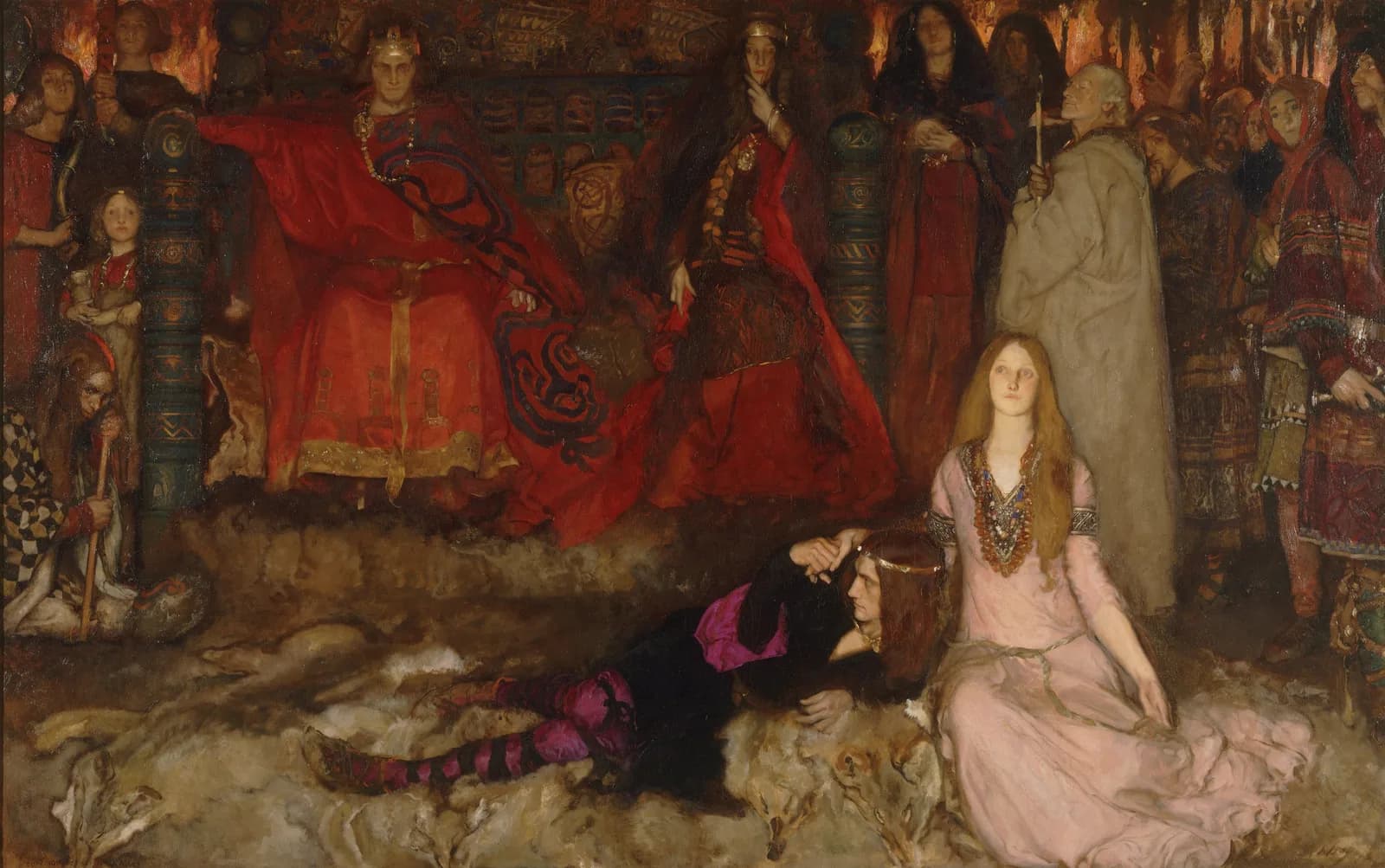
The question gets asked constantly, usually as though the play were being coy about the answer. It answers plainly. Hamlet names his villain out loud three separate times, in three separate acts, and the man he names confesses the crime alone on stage where only the audience can hear him.
What is genuinely open is the second half of the question: whether Hamlet, who kills more people than his uncle does, is a villain too. The prayer scene where both readings collide is a doorway in the playable Hamlet, with the king kneeling and his back turned.
🗣️ Hamlet names him three times, out loud
The word is Hamlet’s own rather than a label a critic applied afterwards, and he reaches for it at three of the play’s hinge moments.
- Act 1 Scene 5.The Ghost has just finished explaining how he was killed, and Hamlet is alone: “O villain, villain, smiling damned villain!” He then writes it down, because he wants a record that a man can smile and be one.
- Act 2 Scene 2.Alone again at the end of the scene, furious with himself for doing nothing: “Bloody, bawdy villain! / Remorseless, treacherous, lecherous, kindless villain!”
- Act 3 Scene 4.To his mother’s face, in the closet scene, describing the man she married: “A murderer and a villain.”
Between the second and third of those, Hamlet stages a play about a poisoning to watch his uncle’s face, and his uncle stops the performance and leaves. That is the moment the hero image on this page shows. The accusation is tested in public in front of the whole court before Hamlet says it to Gertrude in private.
The timing of the three is part of the evidence. The first comes seconds after the Ghost’s account, and on its own it is a grieving son repeating what he has just been told. The second comes after weeks of doing nothing, when Hamlet is angrier with himself than with his uncle. The third comes after the staged play, when he has watched the man’s face and no longer needs a ghost’s word for any of it.
Three namings across three acts also record how the accusation hardens. The first rests entirely on what a ghost said. The second rests on that plus weeks of Hamlet’s own watching. By the third he has staged a public test and read the answer off the king’s face, so the word carries more weight every time he reaches for it.
🙏 Claudius confesses, and cannot repent
The strongest evidence against Claudius comes from Claudius. It is the long speech he makes alone in Act 3 Scene 3, trying to pray and failing, which nobody else in the play ever hears.
“O, my offence is rank, it smells to heaven.”
He then works out, with real precision, why forgiveness is not available to him. He is still holding everything the murder bought: the crown, his own ambition, and the queen. A man cannot be pardoned for a theft while keeping the thing he stole, and Claudius knows the exchange rate. He tries to pray anyway, gets nowhere, and stands up with the driest line in the play.
“My words fly up, my thoughts remain below. / Words without thoughts never to heaven go.”
This is why the “Claudius is just a competent king” reading struggles. He is a competent king; the play gives him diplomacy, nerve and an efficient way with a crisis. He is also a man who states, in private, that he committed the murder for gain and would do the whole thing again rather than give the gains back.
The scene settles something the play otherwise leaves open. Everything Hamlet knows about the murder arrives from a ghost, and two full acts are spent worrying about whether that source can be trusted at all. Act 3 Scene 3 removes the doubt for the audience while leaving Hamlet outside the door, which is exactly why it sits where it sits: we are certain now, and he is still guessing.
There is a cost to giving a murderer that speech, and Shakespeare pays it deliberately. A villain who can describe his own damnation accurately is much harder to dismiss than one who cannot, and the audience spends the rest of the play holding something about Claudius that no other character will ever learn. Sympathy and condemnation arrive in the same forty lines, which is most of why readers argue about him at all.
🩸 The case against Hamlet, taken seriously
The counter-reading deserves better than a dismissal, and the tally behind it is genuine. Hamlet stabs Polonius through a curtain without checking who is behind it, calling out “Dead for a ducat, dead!” as he does it. He is savage to Ophelia in a scene her father and the king are listening to. He sends two former schoolfriends to an execution in England and tells Horatio afterwards that they are not on his conscience.
Intention is what separates them, and the difference holds even at Hamlet’s worst. Claudius plans a murder, executes it in private, then plans a second one and arranges a third as a backup inside the same duel. Hamlet kills the wrong man in a panic and wounds people while trying to reach the right one. The two deaths he does arrange in advance are Rosencrantz’s and Guildenstern’s, and he arranges them after opening the sealed order they were carrying and finding his own execution written into it.
There is also the moment he had and did not take. In Act 3 Scene 3, Hamlet stands behind a kneeling, unguarded Claudius with a drawn sword and decides against it, on the reasoning that a man killed at prayer might go somewhere better than he deserves. It is a genuinely chilling piece of thinking, and it is also the clearest evidence available that efficiency is exactly what this character lacks when a killing is standing in front of him.
The damage he does also lands almost entirely on people who cannot answer back. Ophelia, whose father is running the surveillance she has been placed inside, gets the worst of his tongue in front of hidden listeners. Gertrude gets an hour of moral instruction from a son who has just killed a man in her bedroom. Neither of them knows what he knows, and he never tells either of them enough to judge him fairly.
None of that makes the two men equivalent, and the play is careful about the difference. Claudius damages people in order to keep something he took. Hamlet damages people while trying to establish whether something he was told is true. That distinction excuses nothing, and the text never offers it as an excuse, though it does describe a different kind of harm, and courts have been separating the two for a very long time.
🔁 Why the argument keeps happening
The debate survives because the play refuses to hand anyone a clean moral position, and because Shakespeare gives his murderer the interior life he withholds from most villains. Claudius grieves, calculates, panics and prays. Nothing in the text asks you to enjoy watching him lose, which makes readers suspect they have missed a twist.
There is no twist. There is a murderer who is also a person, and a hero who is also a hazard to everyone standing near him, and a play that declines to simplify either of them. The duel that finishes all of it is laid out scene by scene in the ending essay on this hub. The full text is at Project Gutenberg, with a modern-spelling edition at the Folger Shakespeare Library.
There is a second reason, and it has to do with how the play is taught. A student asked to argue a position needs a position that can be argued, and “Claudius did it” makes a very short essay. The villain question survives partly because it is the most productive wrong question anyone has found: chasing it walks you through the prayer scene, the closet scene and the duel, which is most of the play.
It helps to separate two questions that usually get asked as one. Whether Claudius committed the murder has been settled by the text since Act 3 Scene 3. Whether Hamlet behaves well is a genuinely open argument the play invites and then declines to close. Collapsing them into a single villain question is what makes the whole discussion feel unresolvable when only half of it actually is.
Sources
- Hamlet (Project Gutenberg text) — Project Gutenberg
- Hamlet — Folger Shakespeare Library
Frequently asked questions
- Who is the real villain in Hamlet?
- Claudius, and the play tests it in public before it says so. During the staged poisoning in Act 3 Scene 2 he breaks up his own court entertainment with four words, "Give me some light. Away.", and walks out. A man with nothing to hide sits through the second act of a play.
- Does Claudius actually feel guilty?
- Yes, and he is specific about it. In the prayer soliloquy he identifies his crime by its oldest name, saying it carries "the primal eldest curse" — the mark on Cain for killing a brother. Guilt is never his problem in this play. Being willing to give anything back is.
- Why does Hamlet call Claudius a villain?
- Because the Ghost has just told him the king poisoned his father to take the crown and the queen. Worth noticing: Hamlet never uses the man's name. "Claudius" appears exactly twice in the printed play, in the cast list and one stage direction; every speech heading calls him only KING.
- Is Hamlet himself a villain, or just flawed?
- Flawed, and often cruel with it. In Act 4 Scene 2 he tells Rosencrantz to his face that he is a sponge the king squeezes dry, which is the tone he uses with almost everyone by then. Cruelty and carelessness are not the same as the premeditation Claudius shows.
- Why does Hamlet spare Claudius during the prayer scene?
- On a piece of reasoning most productions cut. Standing over him, Hamlet says "Now might I do it pat, now he is praying" and then talks himself out of it: a man killed mid-prayer goes to heaven, which would be "hire and salary, not revenge". He wants damnation, not a corpse.
Enjoyed this one?