Is Hamlet Really Mad — or Just Pretending? (And What About Ophelia?)
Hamlet has two mad characters and treats them completely differently. One tells his friends in advance that he is about to act strange, then confirms it in private several acts later. The other gets no such scene, no aside, and no warning to the audience at all.


Hamlet has two mad characters and the play treats them completely differently. One of them tells his friends in advance that he is about to act strange, then says so again in private several acts later. The other gets no such scene, no aside, and no warning to the audience at all.
That asymmetry is the whole answer, and it is easy to miss because the two performances look similar from outside. Ophelia’s last appearance is a doorway in the playable Hamlet, where you receive the flowers and decide what to do with them.
🎭 He announces the performance before it starts
The strange behaviour has not begun yet when Hamlet describes it. In Act 1 Scene 5, minutes after the Ghost leaves, he swears Horatio and Marcellus to secrecy and warns them that he may from now on think it useful “To put an antic disposition on.” He is telling two witnesses, in advance, that what they are about to see will be an act.
“To put an antic disposition on.”
This is not the only confession. Two acts later, in the closet scene, he tells his mother in plain language what he wants her not to give away to her husband: that his madness is a method rather than a condition. The line is often quoted as though it came in Act 1 alongside the first one; it does not, and the gap matters, because it means Hamlet is still deliberately performing after killing a man by accident.
“That I essentially am not in madness, / But mad in craft.”
Whether the performance stays entirely under his control is a fair question, and the play leaves room for grief and rage to leak into it. What it never leaves room for is the reading that he is simply ill and unaware of it, because he twice tells other characters otherwise while nobody hostile is listening.
The performance also costs him the thing it was supposed to buy. An antic disposition is cover for investigating a murder, and within two scenes it has turned the entire court into people studying him full-time. He gains the freedom to say dangerous things out loud and pays for it with surveillance he can no longer switch off.
There is one more thing the antic disposition does, and it is the reason the strategy has a point. A man everybody has agreed is mad can insult the king to his face in open court and be laughed at instead of arrested. Hamlet says a great many true and dangerous things in the middle of this play, and every one of them is protected by the reputation he built on purpose.
🌿 What the text says happened to Ophelia
Ophelia arrives twice in Act 4 Scene 5, and neither entrance gets any set-up. The first time she sings, to a queen who has just said flatly that she will not speak with her, and then goes. She comes back later, dressed in straws and flowers, and hands them out with a meaning attached to each. Her brother, watching that second entrance, says the thing the scene is built to make an audience feel: that this is coherence in the wrong shape, “a document in madness, thoughts and remembrance fitted.”
“There’s rosemary, that’s for remembrance; pray love, remember.”
Read that scene as an exhibit rather than a symptom and it sharpens. She is handing out plants with fixed, well-known meanings to specific people in a room that contains the king and the queen, and the choices are exact enough that her brother reads them correctly on the spot. A woman nobody will listen to has found the one channel still open, which is to say the thing with objects instead of sentences.
Her death is never staged. It arrives as a report from Gertrude in Act 4 Scene 7, and the report is carefully, deliberately unresolved. A branch breaks; she goes into the brook; her clothes hold her up for a while and she keeps singing; then the clothes get heavy and she goes under. The crucial phrase is the one describing her state while it happens, and it can be read two entirely different ways.
“As one incapable of her own distress… Pull’d the poor wretch from her melodious lay / To muddy death.”
- Read as accident. She is beyond registering danger, so she does not save herself. The branch broke; nobody chose anything.
- Read as suicide. She is beyond caring what happens to her, and lets the water take her while she is still able to act.
- What the play does about it. It refuses to pick. Act 5 opens with two gravediggers arguing the exact question, and a priest confirming that the burial was contested: her death was doubtful, the rites are cut short, and only an order from above got her into consecrated ground at all.
That is not vagueness on Shakespeare’s part. It is a legal argument staged on purpose. The gravediggers are conducting a coroner’s inquest in comic form. Hamlet, watching from cover before he knows whose funeral it is, notices the “maimed rites” and reads them correctly as a verdict on the manner of the death. Laertes, at the graveside, demands “What ceremony else?” twice and gets a priest’s answer he does not accept. The audience is invited to notice that a court reached a verdict the play itself will not endorse.
Both women in this play are handled the same way, and Ophelia gets the worse end of it. Gertrude’s inner life is argued over by other people for five acts and she is given very little chance to state it herself. Ophelia is given even less, and then has the most important event of her life narrated by Gertrude, in verse, to a room of men who were not there either.
🔍 The reading the text never confirms
A persistent reader theory holds that Ophelia is pregnant, and it is worth naming honestly because it keeps resurfacing and because it is not baseless. It hangs on two moments: Hamlet greeting her as a nymph in the eavesdropping scene, and an earlier exchange with her father in which Hamlet makes a coarse joke about what daughters conceive.
Both are real lines and neither is evidence. The text never says it, no character reacts as though it were true, and the burial dispute in Act 5 turns entirely on the manner of her death rather than on any condition she was in. It belongs in the same drawer as every other reading a play this open invites: interesting, arguable, and not a fact about Ophelia.
It is worth being clear about why readings like this attach to her in particular. Almost everything the audience learns about Ophelia arrives through somebody else: her father explaining her, her brother advising her, Hamlet performing at her, the queen narrating her death to the room. The play leaves a great deal of her offstage, and readers reliably fill what a play leaves out.
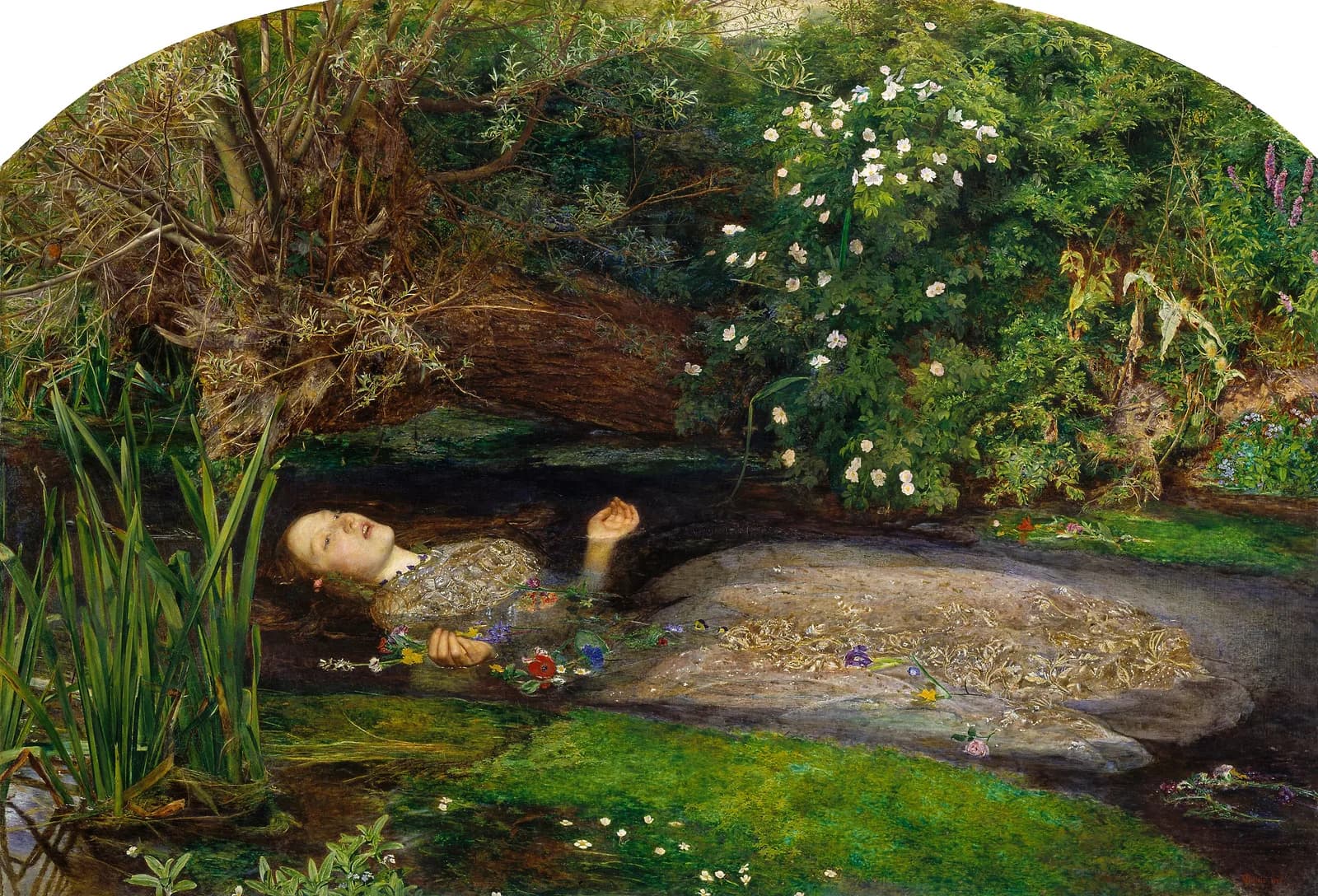
The same gap is why painters keep returning to her. An artist needs a subject who can be looked at rather than listened to, and the play hands them one: a young woman in water, singing, with the question of what she intended left permanently open. The painting at the top of this page is one answer to that question, and there are hundreds of others that disagree with it.
⚖️ Why “one is performing, one is not” reads better
The tidy version of this play has both of them mad and calls it a theme. The text gives you something sharper. One character controls his breakdown well enough to schedule it, warn his friends about it, and confess it to his mother while an eavesdropper stands behind a curtain. The other loses her father to a killing nobody explains to her, loses her brother to exile, and is handled by everyone at court as a problem to be managed.
Set the two side by side and the play’s real subject shows: the difference between being allowed to perform and having no audience that will listen. Hamlet gets soliloquies. Ophelia gets songs, and the court decides what they mean. The full text is at Project Gutenberg, and the Folger Shakespeare Library keeps a modern-spelling edition of the same scenes.
The asymmetry has a practical test attached to it. Ask, for each of them, who gets told the truth. Hamlet tells Horatio, tells Marcellus, tells his mother, and arranges for the audience to be told several times over. Ophelia tells the court in the only register it refuses to take seriously, is handled rather than heard, and then has her death reported by the person least able to describe it plainly.
That test is also why the merged reading flattens the play. If both of them are simply ill, the court’s failure to hear Ophelia is a medical fact and nobody in the room is answerable for it. If one is performing and the other is not, the failure belongs to the people standing around her, and Act 4 is at some pains to show you exactly which people those are.
Sources
- Hamlet (Project Gutenberg text) — Project Gutenberg
- Hamlet — Folger Shakespeare Library
Frequently asked questions
- Is Hamlet actually mad or just pretending?
- Pretending, and the play jokes about how well it worked. In Act 5 Scene 1 a gravedigger who has never met him explains that the prince was shipped to England because he was mad, and adds that he will recover his wits there, or if he does not, it hardly matters in England.
- Does Ophelia commit suicide in Hamlet?
- The text refuses to settle it, and stages the argument instead. The priest at the graveside says that without an order from above she would have been buried in unhallowed ground with "shards, flints, and pebbles" thrown on her. A church court reached a verdict; the play declines to endorse it.
- What does Ophelia say before she dies?
- Her last scene is the flower distribution, and every flower is chosen. Alongside the rosemary she hands out "fennel for you, and columbines", then rue, which she keeps some of for herself. Fennel meant flattery and columbines meant faithlessness, so the bouquet is an accusation in code.
- Is there evidence Ophelia was pregnant?
- None that the play confirms. The reading rests on two lines, and the sharper of them is Hamlet's warning to Polonius in Act 2 Scene 2: let her not walk in the sun, because "conception is a blessing, but not as your daughter may conceive". It is a jibe at her father, not a report.
- Why does Hamlet decide to fake madness in the first place?
- The play states the plan and never explains the reasoning, which is unusual for a character who explains everything. What it shows instead is the plan working: by Act 2 Scene 2 Claudius has sent for Rosencrantz and Guildenstern, two old schoolfriends, specifically to find out what is wrong with him.
Enjoyed this one?