Hamlet's Ending, Explained: Who Dies, and Why
Hamlet's last scene is famous for being a pile of bodies, and most summaries of it get the order wrong. Four people die in that hall in a sequence the text is very precise about, and the crown goes to a man who spent the entire play marching around somewhere else.


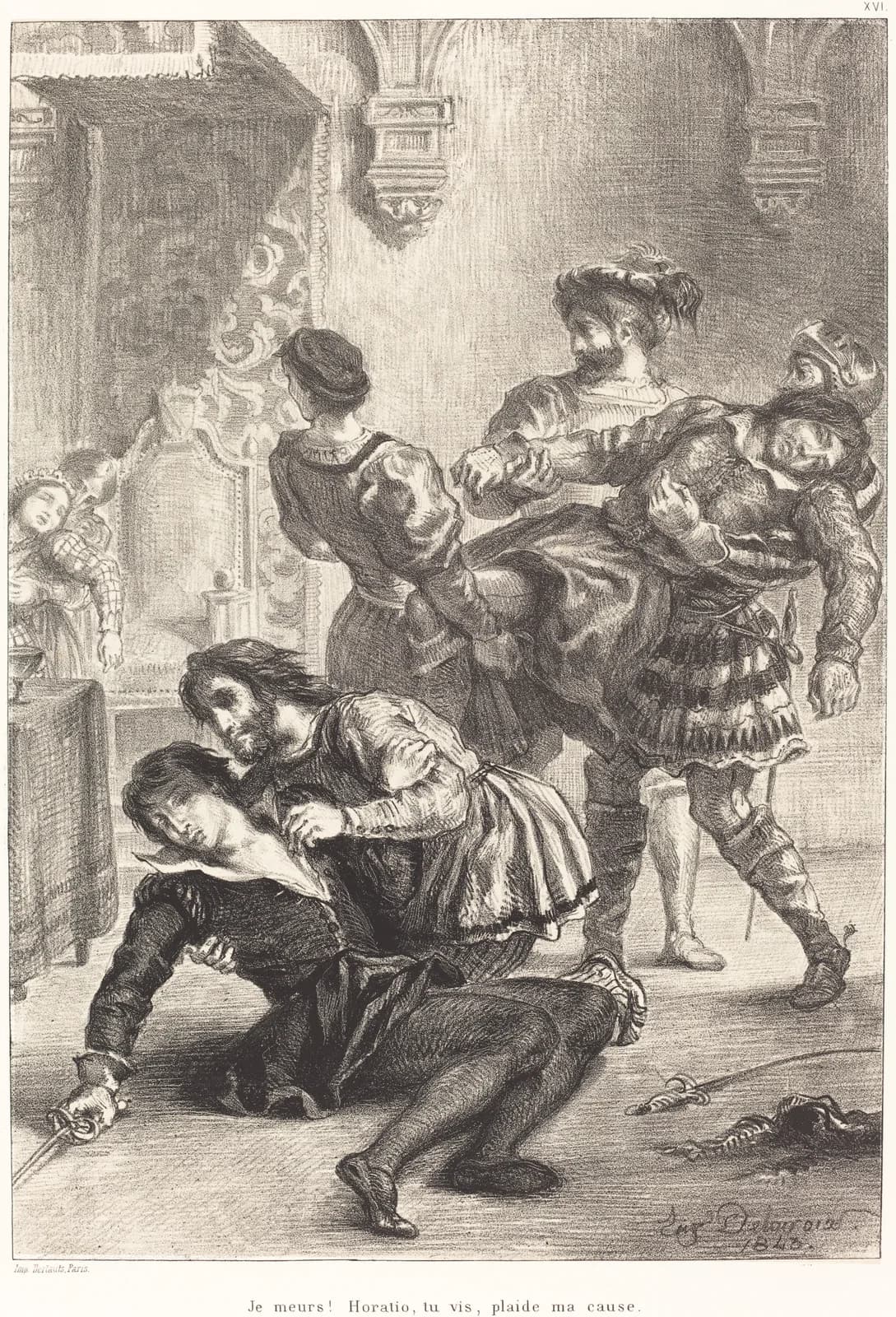
Hamlet’s last scene is famous for being a pile of bodies, and most summaries of it get the order wrong. Four people die in that hall, in a sequence the text is very precise about, and the crown at the end of it goes to a man who has spent the entire play marching around somewhere else.
Everything below is quoted from the free Project Gutenberg text with the act and scene attached. The same duel is a doorway in the playable Hamlet, where the foils are already unbated when you pick one up.
⚔️ The order of the deaths, as the text stages it
The trap has two mechanisms and two authors, and it is built in Act 4 Scene 7, well before the match. Claudius proposes the fencing bout and the unbated blade, which is a foil with the safety tip left off. Laertes goes further on his own account and poisons that blade with something he says he bought from a mountebank. Claudius then adds his own backup: if Hamlet is winning, there will be a cup ready with a pearl dropped in it. The wager, the pearl and the unbated blade are all arranged before a single hit is scored.
“And in the cup an union shall he throw.”
- Gertrude.She drinks to her son from the poisoned cup before anyone can stop her. The stage direction “The Queen falls” comes first, and she names the cause herself: “The drink, the drink! I am poison’d.”
- Claudius.Laertes, dying, gives him up — “The King, the King’s to blame” — and Hamlet runs him through and then forces the rest of the cup on him. “Here, thou incestuous, murderous, damned Dane.”
- Laertes.He is wounded before Gertrude falls but dies after Claudius, and he uses the gap to confess and to forgive: “I am justly kill’d with mine own treachery.”
- Hamlet. He is already cut by the poisoned foil in the scuffle where the two men exchange rapiers, and he outlives every other person in the plot by about sixty lines.
The wound order and the death order are not the same, and that is where most retellings slip. Laertes is hit early and speaks late; Gertrude is untouched by any blade and dies first; Hamlet is struck before he strikes and dies last. Four people die from two doses of the same poison, and only one of those doses was ever meant for the man it eventually killed.
There is one more thing worth noticing about the arrangement. Claudius builds a trap with two independent mechanisms so that a failure of one cannot save Hamlet, and the redundancy is what destroys him. The blade is aimed and does its job. The cup sits on a table where anyone in the hall might pick it up, and the first person who does is his wife, who is drinking to her son.
The whole court is watching while it happens, and that changes what the scene can do. Claudius cannot deny the cup once his wife has named it, cannot deny the blade once Laertes has named it, and cannot walk out of a hall full of nobles who have just heard both. The trap he built in private is taken apart in front of the exact audience he spent five acts managing.
🇳🇴 The crown goes to a prince who was never in the plot
Fortinbras of Norway has been in this play since Act 1, and he has never once been in the same room as its plot. He raises an army, is talked out of invading Denmark, marches instead against Poland for a worthless patch of ground, and passes back through on his way home. He is the only major figure with a dead father and a grievance who never plots anything.
Shakespeare plants him early and keeps him at the edge of the picture. Ambassadors spend part of Act 2 Scene 2 reporting on him: Norway has talked his nephew out of attacking Denmark, taken the army he raised and pointed it at Poland instead, and sent a request for safe passage through Danish ground on the way. For four acts Fortinbras is a foreign-policy item rather than a character, and the play keeps him there on purpose.
The placement is structural. This play contains three sons whose fathers have been killed, and it gives each of them a different method. Hamlet broods and investigates. Laertes storms the palace with a mob behind him. Fortinbras obeys an uncle and points his army somewhere else. Two of those methods end on the floor of the hall in Act 5, and the third ends on the throne of Denmark.
Hamlet, bleeding out, hands him the country. Denmark in this play is not a straightforward inheritance — the throne is settled by election among the nobles, which is why Claudius could take it over a living son — and a dying prince’s stated preference carries weight in that vote.
“But I do prophesy th’election lights / On Fortinbras. He has my dying voice.”
Fortinbras walks in a few minutes later, finds a room of corpses, observes that the sight belongs on a battlefield rather than in a palace, and takes the throne with the practised calm of a man who has arranged a lot of logistics lately. The last order in the play is his, and it is a military one: “Go, bid the soldiers shoot.” A salute for a prince he never actually met, ordered minutes after walking in.
🔇 “The rest is silence”
Hamlet’s own last line is four words long and refuses to summarise anything. He has just asked Horatio to stay alive and tell the story properly, because he knows how it will otherwise be told, and then he stops mid-thought on the thing he cannot report.
“The rest is silence.”
No moral arrives. What arrives instead is administration: an ambassador from England turns up with news nobody needs, reporting that Rosencrantz and Guildenstern have been executed there, and Horatio promises the new king a full account of “carnal, bloody and unnatural acts” that the audience has already watched. Two of the play’s deaths are delivered as a footnote by a courier who has ridden a long way to deliver it.
The one thing Hamlet does settle is Horatio. When Horatio reaches for the poisoned cup to follow him out, calling himself more an antique Roman than a Dane, Hamlet takes it off him and spends most of his remaining breath arguing him into staying alive to tell the story. The last request in the play is for an accurate account rather than for revenge or a monument.
That request is the only one in the play that gets granted. Horatio is the single named character who both knows the whole story and survives to tell it, and he is standing beside the new king within a minute of being asked. Whatever the audience has just watched, the version Denmark will hear afterwards comes from the one person in the building who never lied to anybody.
👑 Why the outsider ending is the ending
Read the last scene as a body count and it looks like chaos. Read it as a transfer of power and it is almost tidy. Every person who spent the play manoeuvring for advantage inside Elsinore is dead, including the one who was right about the murder, and the country goes to the single character who was never manoeuvring at all.
That is a harder ending than a moral, and it is the reason the play keeps being staged. The revenge is achieved, the truth comes out, and neither of those things saves anybody or decides anything about who rules. Claudius engineered the duel that killed all four of them, and a separate essay on this hub makes the case against him properly. The full text, with the whole final scene, is at Project Gutenberg, and the Folger Shakespeare Library keeps a modern-spelling edition beside it.
Notice what being right is worth here. Everything Hamlet suspected turns out to be exactly true, confirmed in public, in front of the whole court, with the murderer’s own guilt forced into the open by a dying man who has no reason left to lie. It saves nobody in the room, and the correction to the record arrives after every person who needed it is already dead.
The play is also unusually honest about what happens next. Nobody left in the hall gets to decide how the story is told. A soldier from another country walks in, reads the room in a couple of lines, and starts giving orders about the bodies. Power in Elsinore does not pass to whoever deserved it or understood it, and it passes to whoever is still standing when the room goes quiet.
Sources
- Hamlet (Project Gutenberg text) — Project Gutenberg
- Hamlet — Folger Shakespeare Library
Frequently asked questions
- Who kills Hamlet, and why?
- Laertes, with a foil whose tip was sharpened and poisoned. His motive is not the duel: Hamlet killed his father Polonius through a curtain and the body was buried in a hurry, which Laertes protests in Act 4 Scene 5 as "his obscure burial". Claudius supplied the poison and the occasion.
- Who becomes king of Denmark at the end of Hamlet?
- Fortinbras of Norway. He does not seize it; he claims it out loud over the bodies, saying he has "some rights of memory in this kingdom" and that fortune now invites him to press them. Denmark's throne is elective in this play, and Hamlet's dying preference is the vote that settles it.
- Is Hamlet responsible for everyone dying?
- For some of it, directly. He tells Horatio in Act 5 Scene 2 that he rewrote the sealed orders he was carrying to England and sealed the forgery with his father's signet ring, which is what got Rosencrantz and Guildenstern executed there. The four deaths in the hall are Claudius's design, not his.
- What are Hamlet's actual last words?
- "The rest is silence." What most people remember as his last line is in fact Horatio's reply over the body: "Now cracks a noble heart. Good night, sweet prince." Hamlet's own final speech is a request, not a summary — he asks Horatio to stay alive and report the story correctly.
- How many people die in Hamlet?
- Nine named characters, four of them in the last scene. The first death happens before the curtain goes up: the Ghost describes being poisoned while asleep in his own orchard. Polonius, Ophelia, Rosencrantz and Guildenstern are gone before the duel is even proposed.
Enjoyed this one?