Hamlet vs. Macbeth: Which Shakespeare Tragedy Should You Read First?
Two tragedies get recommended as the place to start with Shakespeare, and the people recommending them do not agree. Macbeth wins on effort. Hamlet wins on the thing that decides whether you finish a play at all, which is whether you already know what happens.


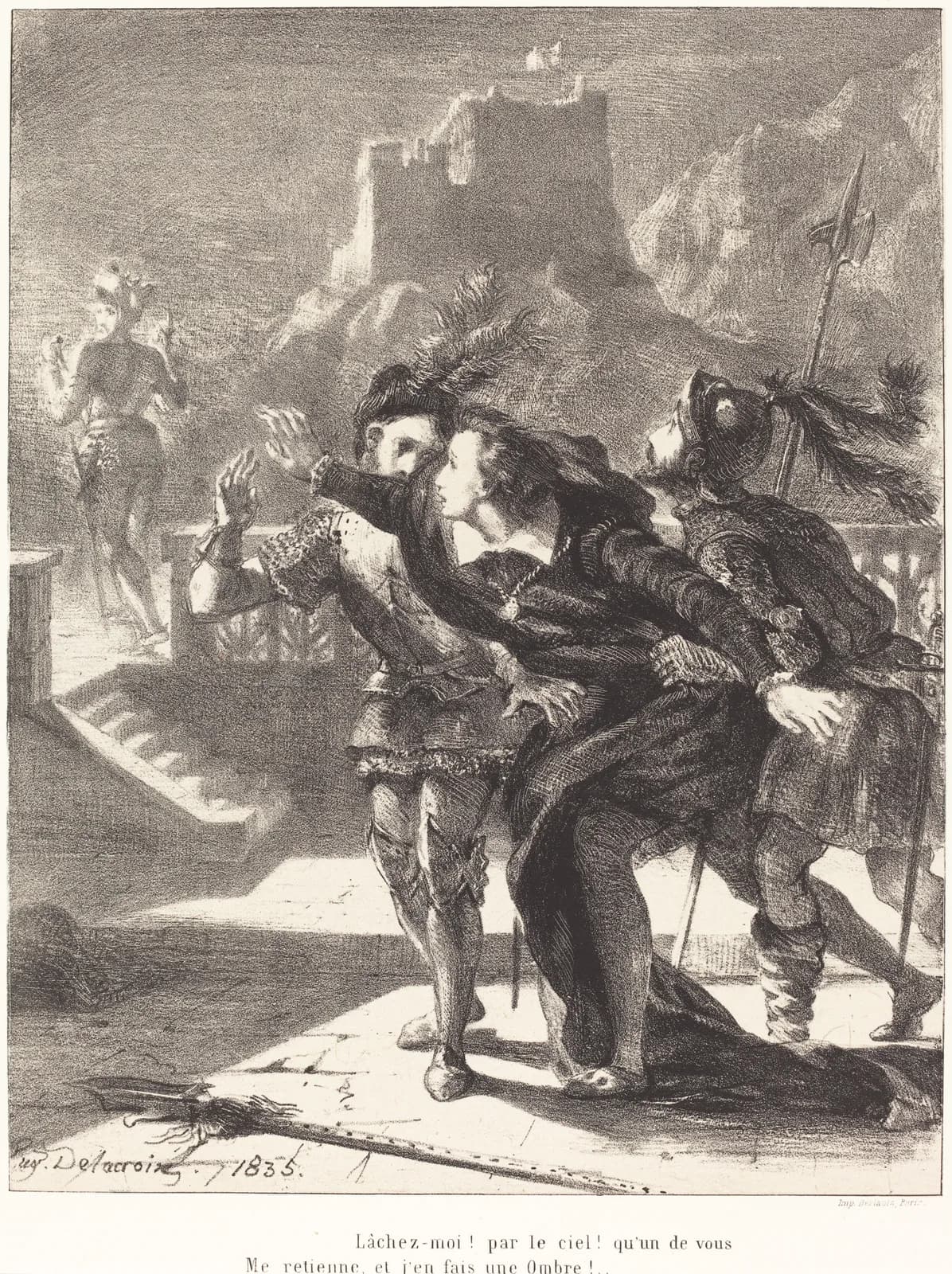
Two tragedies get recommended as the place to start with Shakespeare, and the people recommending them do not agree with each other. One camp says Macbeth, because it is short and it moves. The other says Hamlet, because it is the one you already half know. Both camps are arguing in good faith, and they are quietly answering different questions.
Below is each case with its numbers attached, then a verdict for a reader who has never finished a Shakespeare play. The same opening night is walkable in the playable Hamlet, which starts on the castle wall with the guards rather than on a famous speech.
🗡️ The case for Macbeth, made honestly
Macbeth is shorter by a wide margin, and the margin is measurable. By Open Source Shakespeare’s word-count table, Hamlet is the longest play in the canon at 30,557 words and Macbeth runs 17,121, which is a little over half. Macbeth also has the cleanest engine of any Shakespeare tragedy: three witches make a prediction in Act 1 Scene 3, a soldier decides to help it come true, and every scene after that is consequence. Nothing in it waits for a decision.
So the honest version of the recommendation is this. If your goal is to finish one Shakespeare tragedy this week and know that you finished it, take Macbeth and do not let anyone talk you out of it. The people who recommend it are not wrong about length, pace, or the fact that a first-time reader mostly needs a book they will not abandon on page forty.
What the shorter play costs you is argument. Macbeth is a story about a man who has already decided, told at speed, and its verse is compressed to match; a reader who stops to work out a line loses the momentum that was doing the persuading. Hamlet has the opposite shape. It stops constantly, and the stopping is the point, so a reader who is slow with the language is reading it correctly rather than falling behind.
👑 Why Hamlet still wins for a first reader
Hamlet wins because you have already read it. Not the text — the shape. A king dies, his brother takes the crown and the widow, the dead king’s son learns it was murder, and the son spends the story deciding what to do about that. Anyone who has seen Disney’s 1994 animated film knows the sequence already, and the resemblance is not an accident the studio stumbled into: the Folger Shakespeare Library’s account has the production leaning into Shakespeare deliberately once the parallels surfaced, with an executive asking the writers for as much Hamlet as they could fit.
This matters more than it sounds. The hard part of a first Shakespeare play is rarely the plot; it is holding the plot in your head while the sentences are also new. Hamlet hands you the plot for free, which leaves your whole attention for the language, and the language is where the play actually lives.
| Macbeth | Hamlet |
|---|---|
| 17,121 words — roughly half the length | 30,557 words — the longest play in the canon |
| A prophecy, a murder, and consequence in a straight line | Twenty scenes across five acts, several of them arguments |
| The story is new to most readers | The story is already familiar from films that borrowed it |
| Difficulty is mostly the compressed verse | Difficulty is mostly the thinking the prince keeps doing |
The familiarity runs deeper than one film. A reader arriving at Hamlet already owns half the furniture: a ghost on a battlement, a play staged to catch a guilty man, a prince who cannot make up his mind, a woman drowned among flowers. None of that has to be explained on arrival, which is exactly the tax a first Shakespeare play usually charges at the door.
📚 Why these two, and not the other thirty-six
Nobody sets Hamlet against Timon of Athens. The pairing survives because these are the two tragedies most likely to be assigned, filmed, staged and quoted, so they are the two a curious reader has actually heard of before deciding anything. The comparison is a reader’s question rather than a syllabus question, which is why the answers you find are so evenly split and so confident on both sides.
There is also a quieter question sitting underneath it. People who ask which Shakespeare play is hardest are usually not asking about vocabulary; they are asking which one they are going to give up on. On that question length is a poor predictor and familiarity is a good one, which tilts the answer toward the longer book rather than away from it.
Vocabulary is rarely the real obstacle. Both plays are early-seventeenth-century English and both demand the same squinting on the first page. The gap between them is structural, and structure is the thing a first-time reader can feel from the inside within twenty minutes of starting.
⏳ Delay against ambition
The real difference between the two plays is what the main character does with a decision. Macbeth acts and then thinks about it. Hamlet thinks, and thinks, and eventually acts, and the play is built out of that gap. In Act 1 Scene 5 he tells Horatio and Marcellus that he intends to “put an antic disposition on” — he announces a performance before he gives a single strange answer — and then spends three acts not doing the thing he has sworn to do.
Readers notice this immediately and are not reverent about it. The most common description of Hamlet online is that he is a world-class procrastinator, and the description is fair: his most famous speech, in Act 3 Scene 1, is a man arguing both sides of a question with himself and reaching no conclusion at all. A separate essay on this hub takes that speech apart, including the two ways it gets misquoted. What matters here is that delay is not a flaw in the writing, and a reader who finds it frustrating is having exactly the reaction the play is built to produce.
The two plays also differ in who is doing the pushing. Macbeth has a wife who wants the throne more than he does and says so at volume, so the decision arrives from outside him and he only has to fail to refuse it. Hamlet is pushed once, by a ghost, in Act 1, and then left completely alone with the instruction for three acts. Nobody at Elsinore can safely be told, which is why so much of the play is one man talking to an audience that cannot answer him.
🌙 What the first hour of Hamlet actually asks
The play does not open on the prince. It opens on two sentries in the dark, and its first spoken line is a challenge from the wrong man: Barnardo arrives and says “Who’s there?”, and Francisco, who is the one on duty, has to tell him off for it. Three pages later a figure in armour that looks like the dead king walks past them twice and refuses to speak. Nobody soliloquises. Nobody is being clever.
Two practical notes for the first sitting. Read the scene headings and not only the speeches, because half the confusion people report is really confusion about who is currently in the room. And do not stop for every footnote: the difficult phrases are usually decoration on a plain sentence, and the plain sentence carries the scene without them.
That is the tone of the first hour: a ghost story told by night-shift workers who are cold and frightened and out of their depth. The difficulty everyone warns you about arrives later, in the arguments, and by then you are already inside. If you want to test the fit before you commit to twenty scenes, the same night watch is where the playable Hamlet begins, and it asks you the sentries’ question rather than the prince’s.
Sources
- Hamlet (Project Gutenberg text) — Project Gutenberg
- Shakespeare's plays by word count — Open Source Shakespeare
- The Lion King Shakespeare: from Hamlet to Hal and Falstaff in Henry IV — Folger Shakespeare Library
Frequently asked questions
- Is Hamlet or Macbeth the better play?
- Readers genuinely split, and the split is not about quality. Macbeth is tighter: Banquo's ghost, the Porter's knocking scene and the sleepwalking are all engines that push forward. Hamlet is richer and slower, and it stops to argue with itself. Pick tighter or richer, and neither answer is a mistake.
- Which Shakespeare tragedy is easier to read for a first-timer?
- Macbeth, measured purely by effort. It is close to half the length and its scenes are short. Hamlet's structure is lumpier than people expect: Act 4 alone runs seven scenes, more than any other act in the play, and several of them are two people in a corridor changing the plan.
- Is Hamlet really the basis for The Lion King?
- Partly, and deliberately. The Folger Shakespeare Library's account describes early drafts that were even more direct, including one in which Scar was given Horatio's farewell over Hamlet's body, "Good night, sweet prince." The finished film also borrows from Henry IV, with Simba as a version of Prince Hal.
- Do you have to read Macbeth to understand Hamlet, or the other way round?
- No. They share no characters, no setting and no storyline. Hamlet's world is a court that has just changed hands, with the prince kept back from his university at Wittenberg so the new king can watch him. Macbeth's is a battlefield kingdom. Either one stands completely alone.
- What is Hamlet's tragic flaw, and is it the same as Macbeth's?
- They are opposites. Macbeth's flaw is that he acts before he has thought; Hamlet's is that he thinks instead of acting. Hamlet names the mechanism himself in Act 3 Scene 1, when he concludes that "conscience does make cowards of us all" — the thinking is what stops the hand.
Enjoyed this one?