“To Be or Not to Be,” Explained — and the Scene the Internet Keeps Getting Wrong
The most famous speech in English drama gets misquoted in two different ways at once. One puts the wrong object in Hamlet's hand. The other puts a different character's line in his mouth. Both mistakes are further off than they look.


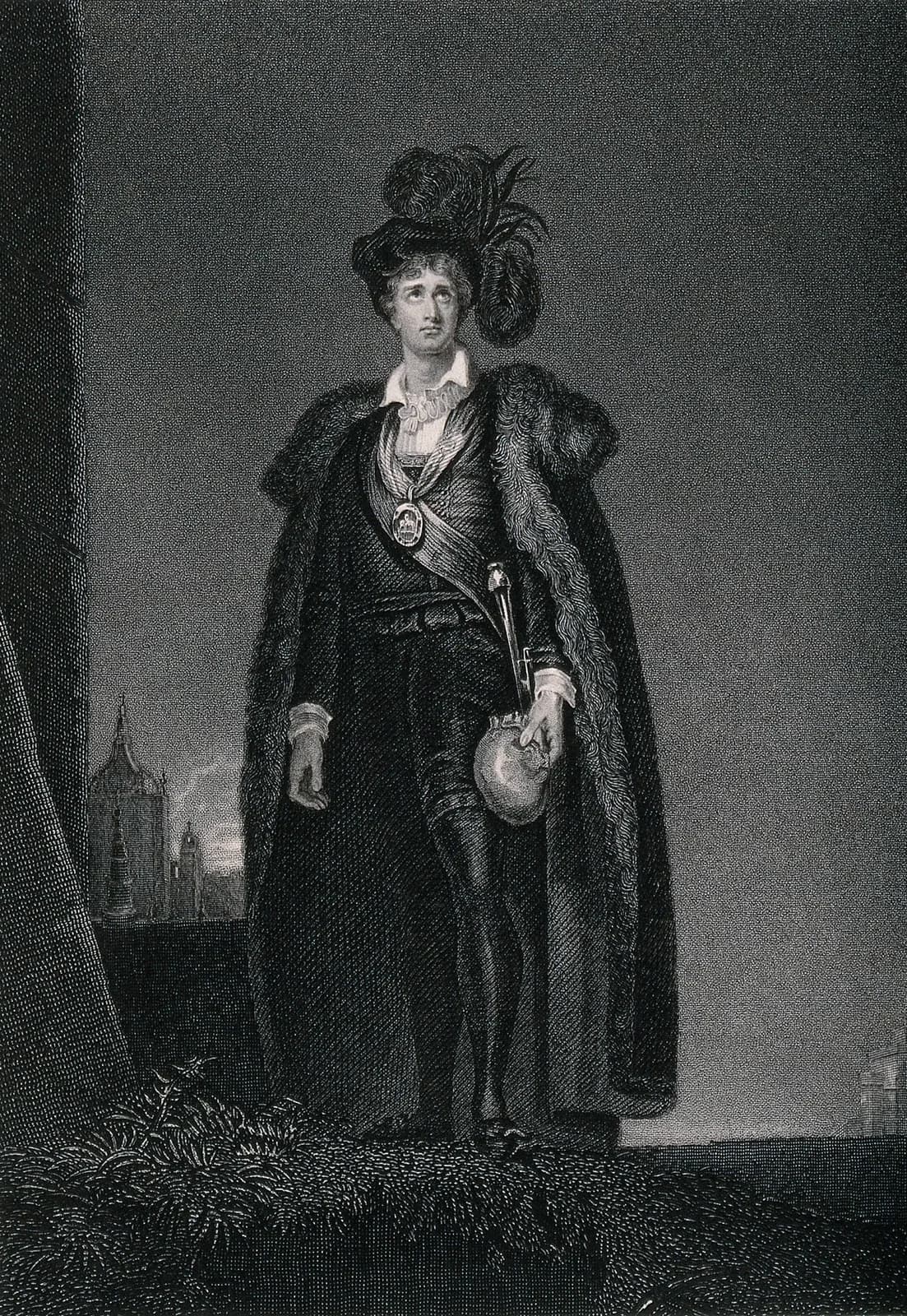
The most famous speech in English drama gets misquoted in two different ways at once, and both mistakes are so common that correcting them feels pedantic until you see how far off they are. One puts the wrong object in Hamlet’s hand. The other puts a different character’s line in his mouth.
Everything below is quoted from the free Project Gutenberg text with the act and scene attached. The speech has its own doorway in the playable Hamlet, where you get to decide what the prince concludes.
💀 Wrong prop: the skull is two acts later
Act 3 Scene 1 opens with the king and Polonius arranging to eavesdrop. Hamlet walks in believing he is alone and says the line. There is no skull in the scene and no graveyard. What there is, and he does not seem to know it yet, is an audience: Ophelia placed in his path, and two men listening from behind a curtain.
The skull turns up in Act 5 Scene 1, in a churchyard, dug up by a gravedigger who has been throwing bones over his shoulder for a hundred lines. It belonged to the old king’s jester, and Hamlet takes it out of the man’s hands to say “Alas, poor Yorick.” The two moments are separated by two full acts, a change of country, and a pirate attack. The graveyard scene, the gravedigger and the full speech to the skull are traced in the post on “Alas, poor Yorick”.
The merge is easy enough to explain. The skull is the most portable image the play ever produced and the speech is its most portable sentence, so the two got welded together on posters, in cartoons, and in the publicity portraits actors have been posing for since the eighteenth century. Painters put the skull in his hand because it is the fastest way to say Hamlet without saying anything else.
The merge also survives because the two scenes are about the same thing from opposite ends. One is a man asking what death is while he still has the option of finding out. The other is a man holding the answer in his hand and finding it disappointingly ordinary. Putting them together makes a tidier story than the play tells, and tidier stories are the ones that get remembered.
| “To be, or not to be” | “Alas, poor Yorick” |
|---|---|
| Act 3, Scene 1 | Act 5, Scene 1 |
| A room in the castle | A churchyard |
| Alone, watched without knowing it | In conversation with a gravedigger and Horatio |
| An argument about whether to go on living | A joke about what happens to everyone anyway |
| Nothing in his hands | The skull of a man he knew as a child |
⚖️ What the speech is actually asking
The question is not “should I kill myself” in any planning sense. It is put as a general problem, in the third person, about what any person should do with unbearable circumstances: endure them, or end them and find out what ending them costs.
“To sleep, perchance to dream—ay, there’s the rub.”
The rub is the catch. Death looks like sleep, and sleep contains dreams, so death might contain something too, and nobody has come back to report. Hamlet calls it “the undiscover’d country, from whose bourn” no traveller returns, and then draws the conclusion the speech is really about: that not knowing is what stops people. It is an argument about paralysis, delivered by the most paralysed character in the canon, which is why it ends without a verdict.
“Thus conscience does make cowards of us all.”
The speech never resolves itself. It lays out the case for enduring, the case for ending, and the reason nobody can choose between them, and then Ophelia walks into the room and the scene turns into something else entirely.
The shape of the argument is a lawyer’s. It states a question, sets out the case for one side at length, raises the single objection that defeats it, and then widens that objection into a rule about everybody. What it never does is apply any of it to the speaker’s own situation, which contains a murdered father and a usurping uncle and is not mentioned once.
That omission is the strongest argument that the speech is genuine rather than staged for the eavesdroppers. A man performing despair for listeners he suspects are behind the curtain would perform his grievance, because the grievance is the thing he wants the king to worry about. What he delivers instead is an abstract argument with no Denmark anywhere in it.
⛪ The conversation that starts the moment he finishes
The speech does not end a scene. Ophelia is standing there, placed by her father as bait, and the argument with her begins immediately, in the same room, with the eavesdroppers still behind the arras. That is why two of Hamlet’s best-known lines sit within forty lines of each other and are almost never quoted together.
He tells her to get to a nunnery, and then keeps telling her. The word occurs five times in the entire play, and every one of them is in this one conversation. Whatever else is happening, the repetition is the performance of a man who has decided to be unbearable on purpose and is overdoing it.
Ophelia gets the last word in the scene and it is the most damning line in it. She has watched a mind she admired come apart, or watched someone pretend to, and she describes it as an instrument ruined: “Like sweet bells jangled out of tune and harsh.” What actually happens to her afterwards is a separate essay on this hub.
The eavesdropping changes how the whole exchange reads. Two men are behind the arras, one of them the king he suspects and one of them her father, and the text leaves open whether Hamlet works that out partway through. If he has, the cruelty is aimed past her at the listeners. If he has not, it lands on her alone, and the scene is a great deal worse for it.
🐟 Wrong speaker: Marcellus, not Hamlet
The other line everybody assigns to Hamlet is not his either. “ Something is rotten in the state of Denmark” belongs to Marcellus, an ordinary guard, at the end of Act 1 Scene 4, as he and Horatio watch the prince follow a ghost off into the dark against their advice.
“Something is rotten in the state of Denmark.”
The misattribution flattens the line badly. Said by the prince it is a judgment from inside the family. Said by a soldier on a wall it is a working man noticing that the country he guards has gone wrong, which is a much colder observation and the one the play actually makes. Marcellus also has no idea about the murder; he is going on atmosphere alone, and he is right.
Marcellus barely exists otherwise. He has a handful of speeches on the battlement, is put under oath alongside Horatio at the end of Act 1 while the Ghost calls “Swear” from under the stage, and then never speaks again for the rest of the play. The most quoted diagnosis of the state of Denmark belongs to a man who leaves before the plot properly begins, which is a joke the play seems entirely aware of making.
🔁 Why both lines get borrowed so often
Both phrases have escaped the play and now work as ordinary English. One supplies a template for any binary choice, which is why headline writers reach for it several times a week. The other supplies a way of saying that an institution is corrupt without naming anybody in it, which is why it turns up in politics.
There is a pattern in which lines escape a play. Both of these travel because neither needs the plot: one is a template with an empty slot in it, the other is a diagnosis with the patient left blank. The lines that stay inside Hamlet are the ones that need Elsinore in order to mean anything, which is most of the good ones.
The cost of that success is the drift these two errors record. A speech about whether to go on living becomes a picture of a man addressing a skull, and a guard’s observation becomes a prince’s verdict. Reading the scenes puts both back where they belong; the full text is at Project Gutenberg, and the Royal Shakespeare Company’s learning pages walk the same scene with staging notes attached.
Sources
- Hamlet (Project Gutenberg text) — Project Gutenberg
- Hamlet — Shakespeare Learning Zone — Royal Shakespeare Company
Frequently asked questions
- Is Hamlet holding a skull during “to be or not to be”?
- No. He is holding nothing, in a room, in Act 3 Scene 1. The skull comes up in a graveyard two acts later, and the gravedigger who hands it over says it has lain in the earth three-and-twenty years. Hamlet's answer is that its owner once carried him on his back a thousand times.
- What does “to be or not to be” actually mean?
- It asks whether it is nobler to endure a bad life or to end it, and it is put as a general problem rather than a plan. The bluntest moment is when Hamlet asks who would carry any of this when a person could settle the account "with a bare bodkin" — an ordinary small dagger.
- Who says “something is rotten in the state of Denmark”?
- Marcellus, a guard, at the end of Act 1 Scene 4 — not Hamlet. Horatio answers him with three words, "Heaven will direct it," and they both go after the prince anyway. Neither of them knows about the murder at this point; Marcellus is going purely on how the night feels.
- What does “get thee to a nunnery” mean?
- It is Hamlet telling Ophelia to withdraw from the world rather than marry and have children, and he says it while being deliberately unbearable. The exchange starts with her giving his presents back — "My lord, I have remembrances of yours" — which is what he is reacting to before anything else.
- Is Hamlet suicidal in this soliloquy?
- Less than in his first one. Act 3 Scene 1 is abstract and reaches no decision. His Act 1 Scene 2 speech is the personal one: "O that this too too solid flesh would melt," spoken about his own body, weeks before the Ghost gives him anything to do. The famous speech is calmer than the earlier one.
Enjoyed this one?